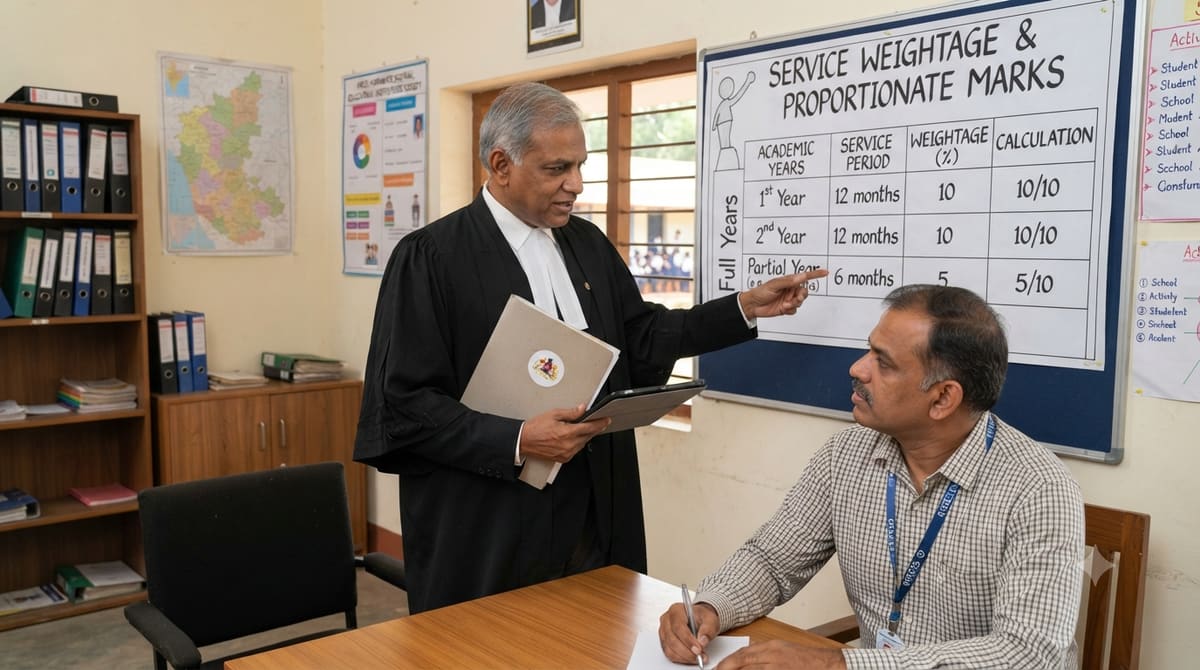
The Karnataka High Court has clarified the interpretation of service weightage under the Karnataka Residential Educational Institutions Society (Cadre & Recruitment) Regulations, 2011. The judgment holds that teachers who served partial academic years are entitled to proportionate weightage, ensuring fair consideration in selection processes. This ruling reinforces the principle of natural justice and equitable treatment for contractual teachers in residential schools.
Background & Facts
The Dispute
The petitioners, 26 teachers employed in various Karnataka Residential Educational Institutions (including Morarji Desai Residential Schools, Ekalavya Model Residential Schools, and Kittur Rani Chennamma Schools), challenged the respondents' refusal to grant them proportionate service weightage for academic years where they served less than a full year. The dispute arose under the Karnataka Residential Educational Institutions Society (Cadre & Recruitment) Regulations, 2011, which provide for 5% weightage per completed year of service but do not explicitly address partial years.
Key Facts
The petitioners were appointed through a competitive recruitment process conducted by Zilla Panchayats or private agencies under the supervision of the Karnataka Residential Educational Institutions Society (KREIS).
Appointments were made during the "No Rule Period" (prior to the formalization of recruitment rules in 2011).
The Regulations, 2011 introduced a one-time measure for granting service weightage (5% per completed year, capped at 40%) to contractual teachers for selection purposes.
The respondents interpreted the term "completed year of service" strictly, denying weightage for partial academic years (e.g., service less than 10 months).
The petitioners filed representations on 15.06.2026, 11.06.2026, 08.04.2026, 06.06.2026, 19.06.2026, and 23.06.2026, seeking proportionate weightage for the academic years 2007-2008 to 2012-2013.
Procedural History
13.07.2012: Writ Petitions (Vishwanath M.S. and Ors v. State of Karnataka, WP Nos. 20204-20364/2011) filed before the Karnataka High Court seeking regularization and service weightage.
13.07.2012: Single Judge allowed the petitions in part, directing regularization for teachers appointed before 2004-05 and service weightage for those appointed on or after 2004-05.
28.02.2013: Division Bench dismissed Writ Appeal No. 5127/2012 filed by KREIS, affirming the Single Judge’s order.
09.09.2013: Supreme Court dismissed SLP No. 30845/2013 filed by KREIS, upholding the High Court’s directions.
02.12.2014: KREIS issued a Tippani (Note) (Annexure-E1) denying proportionate weightage for partial years, leading to fresh litigation.
22.10.2019: Single Judge quashed Annexure-E1 and directed KREIS to grant proportionate weightage for partial academic years (Vishwanath M.S. and Ors v. State of Karnataka, WP Nos. 8113-8131/2015).
19.07.2023: Division Bench dismissed W.A. No. 360/2020, affirming the Single Judge’s order on proportionate weightage.
07.07.2026: Present writ petition (WP No. 202454/2026) filed seeking compliance with earlier judgments.
Relief Sought
The petitioners sought:
A writ of mandamus directing the respondents to grant proportionate service weightage for academic years 2007-2008 to 2012-2013 in accordance with the judgments in W.A. No. 545/2021 and W.A. No. 360/2020.
Consideration of their representations dated 15.06.2026, 11.06.2026, 08.04.2026, 06.06.2026, 19.06.2026, and 23.06.2026 for weightage.
A direction to the respondents not to terminate their services pending disposal of their representations.
Declaration of their eligibility for selection against teaching posts.
The Legal Issue
The central question was whether the Karnataka Residential Educational Institutions Society (Cadre & Recruitment) Regulations, 2011 permit the grant of proportionate service weightage for academic years where a teacher served less than a full year, or whether weightage is strictly limited to completed years of service.
Arguments Presented
For the Petitioners
Judicial Precedent: Relied on the judgments in W.A. No. 545/2021, W.A. No. 360/2020, and WP Nos. 8113-8131/2015, which held that proportionate weightage must be granted for partial academic years.
Equity and Natural Justice: Argued that denying weightage for partial years would defeat the purpose of the one-time measure under the Regulations, 2011, and violate Articles 14, 16, and 21 of the Constitution.
Service Utilization: Contended that the respondents utilized their services irrespective of the academic year’s duration, and it would be unjust to deny weightage based on technicalities.
Finality of Judgments: Emphasized that the earlier judgments had attained finality (including dismissal by the Supreme Court), and the respondents were bound to comply.
For the Respondents
Strict Interpretation: Argued that the Regulations, 2011 explicitly provide weightage only for "completed years of service", and proportionate weightage for partial years was not contemplated.
Judicial Precedent: Cited judgments like Manish v. Rohini Goyal ((2010) 4 SCC 393), State of Punjab v. Singhala (1994 (1) SCC 175), and Karnataka State Road Transport Corporation v. Ashrafulla Khan ((2002) 2 SCC 560) to support the contention that weightage cannot be granted for incomplete years.
Administrative Discretion: Contended that the Tippani dated 02.12.2014 (Annexure-E1) was issued in compliance with the Regulations and judicial directions, and the petitioners’ exclusion was not arbitrary.
Financial Implications: Argued that granting proportionate weightage would impose unjust financial burdens on the State, as salaries for regularized teachers would be borne by the government.
The Court's Analysis
The Court conducted a multi-pronged analysis of the legal and factual matrix:
Judicial Precedent and Finality:
The Court noted that the judgments in W.A. No. 545/2021, W.A. No. 360/2020, and WP Nos. 8113-8131/2015 had attained finality, with the Supreme Court dismissing the SLP filed by KREIS. These judgments held that:
The petitioners’ entry into service was not a backdoor entry; they were qualified and eligible for appointment.
The Regulations, 2011 were a one-time measure to regularize contractual teachers.
Proportionate weightage must be granted for partial academic years to ensure equitable treatment.
The Court emphasized that the respondents were bound by these directions and could not indirectly circumvent them through the Tippani dated 02.12.2014.
Interpretation of "Completed Year of Service":
The Regulations, 2011 did not define "completed year of service", leading to ambiguity.
The Court observed that:
Teachers were paid salaries only for 10 months of the academic year, with no salary for the remaining 2 months.
The date of joining varied among teachers due to administrative delays (e.g., school openings, student admissions).
A strict interpretation would result in injustice, as teachers who served nearly a full year would be denied weightage.
The Court held that the one-time measure under the Regulations was intended to provide relief to contractual teachers, and proportionate weightage aligned with this objective.
Constitutional Principles:
The Court reiterated that the denial of proportionate weightage violated Articles 14 (equality), 16 (equal opportunity), and 21 (right to livelihood) of the Constitution.
It noted that the State Government had accepted the earlier judgments and not filed any appeal, indicating tacit approval of the directions.
Practical Implications:
The Court observed that only a few teachers would benefit from proportionate weightage, minimizing the financial burden on the State.
It also noted that some petitioners were already employed under interim orders, and their services could not be terminated pending final disposal.
"The ambiguity in the language employed in not correctly defining the completed year, particularly in a situation where the employees are paid salary only for 10 months, learned Single Judge is justified in holding that the petitioners should be given a proportionate weightage."
The Verdict
The Court disposed of the writ petition with the following directions:
The respondents must consider the petitioners’ representations dated 15.06.2026, 11.06.2026, 08.04.2026, 06.06.2026, 19.06.2026, and 23.06.2026 and pass appropriate orders within three months from the receipt of this order.
The respondents must grant 5% weightage for each academic year of service, irrespective of the date of appointment, and proportionate weightage for service less than a full academic year, in accordance with the judgments in:
W.A. No. 545/2021 (dated 07.11.2022),
W.A. No. 360/2020 (dated 19.07.2023), and
WP Nos. 8113-8131/2015 (dated 22.10.2019).
The petitioners’ services shall not be terminated pending compliance with these directions.
What This Means For Similar Cases
Proportionate Weightage Is Now a Binding Principle
Contractual employees in similar schemes (e.g., one-time regularization measures) can now demand proportionate weightage for partial years of service, even if the governing regulations do not explicitly provide for it.
Key Takeaway: Courts will lean toward equitable interpretation where strict construction leads to manifest injustice, especially when the State has utilized the employee’s services for a substantial period.
Strict Interpretation Yields to Equity
Regulatory ambiguity (e.g., undefined terms like "completed year of service") will be resolved in favor of employees where:
The entry into service was legal (not backdoor).
The employee was qualified for the post.
The service was utilized by the employer/State.
Key Takeaway: Employers cannot exploit technicalities to deny benefits where the substance of the service has been accepted and utilized.
Compliance with Judicial Directions Is Non-Negotiable
State instrumentalities (e.g., KREIS) cannot indirectly circumvent judicial directions through administrative notes (e.g., Tippani) or selective interpretation.
Key Takeaway:
Final judgments (including those affirmed by the Supreme Court) bind all parties, and non-compliance may attract contempt proceedings.
Representations filed by employees must be decided within a reasonable timeframe (e.g., three months), failing which courts may direct compliance.
Financial Implications Do Not Outweigh Equity
Cost concerns raised by the State or employers will not override equitable considerations, especially when:
The number of beneficiaries is limited.
The employees have served for a considerable period.
The State has already accepted the financial burden by not appealing earlier judgments.
Key Takeaway: Budgetary constraints cannot justify denial of statutory or judicial entitlements where the right to livelihood is at stake.