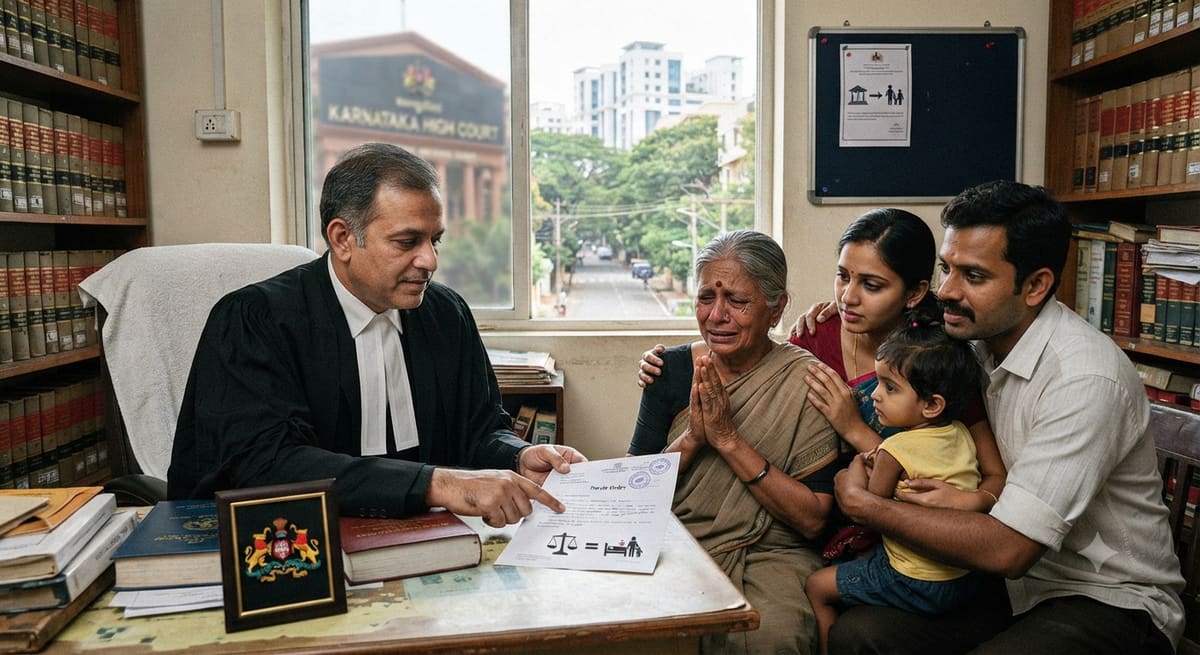
The Karnataka High Court has clarified that pending cases under the Prevention of Money Laundering Act, 2002 (PMLA) do not automatically bar a convict from being granted parole, particularly when humanitarian grounds such as medical emergencies are involved. This judgment underscores the court's discretion in balancing statutory restrictions with compassionate considerations, setting a precedent for future parole applications.
Background & Facts
The Dispute
The petitioner, Segabandi Bhaskara Chary, a convicted prisoner (CTP No. 1178) undergoing imprisonment since 17.03.2024 following a judgment dated 05.03.2024 in Special Case No. 01/2022, sought general parole for 90 days. The parole was requested to attend to his ailing wife and mother, both of whom suffer from medical issues, and to address the financial and emotional distress faced by his family, including his minor daughter.
Key Facts
The petitioner was convicted in Special Case No. 01/2022 and has been in judicial custody since 17.03.2024.
An appeal against the conviction (Criminal Appeal No. 200148/2024) is pending before the Karnataka High Court.
The petitioner filed a representation dated 01.04.2026 seeking parole on medical and humanitarian grounds.
The respondents rejected the parole request vide endorsement dated 04.04.2026 (Annexure-D), citing:
A pending case (Special Case No. 60/2025) under Sections 44 and 45 of the PMLA, which prescribes a maximum punishment of 7 years.
Rule 191(2)(j)(i) of the Karnataka Parole Guidelines and Rule 191(2)(iii)(a)(b) of the Karnataka Prisons and Correctional Services Manual, 2022, which allegedly bar parole for convicts facing sentences exceeding 7 years.
Procedural History
01.04.2026: Petitioner filed a representation seeking parole (Annexure-C).
04.04.2026: Respondent No. 2 rejected the parole request (Annexure-D).
2026: The present writ petition (WP No. 201731/2026) was filed under Articles 226 and 227 of the Constitution of India, seeking:
Quashing of the endorsement dated 04.04.2026.
A writ of mandamus directing the respondents to release the petitioner on general parole for 90 days.
Relief Sought
The petitioner prayed for:
Quashing of the impugned endorsement dated 04.04.2026.
Release on general parole for 90 days to attend to his ailing wife and mother and care for his minor daughter.
The Legal Issue
The central question was whether Rule 191(2)(j)(i) of the Karnataka Parole Guidelines and Rule 191(2)(iii)(a)(b) of the Karnataka Prisons Manual operate as an absolute bar to granting parole when a convict faces pending cases under the PMLA, even on humanitarian grounds.
Arguments Presented
For the Petitioner
The petitioner contended that the respondents misapplied Rule 191(2)(j)(i) and Rule 191(2)(iii)(a)(b), as these provisions do not automatically disqualify convicts from parole when the pending case prescribes a maximum punishment of 7 years (as under Sections 44 and 45 of the PMLA).
The petitioner relied on the judgment in Smt. Kantamma v. The Director General of Police and Ors. (WP No. 202485/2026), where the court granted parole on medical grounds despite pending cases.
The petitioner emphasized the humanitarian grounds - his wife and mother's medical conditions and the welfare of his minor daughter - justifying the grant of parole.
For the Respondent
The learned Additional Government Advocate argued that the petition lacked merit and was liable to be dismissed.
The respondents relied on Rule 191(2)(j)(i) and Rule 191(2)(iii)(a)(b), contending that the pending PMLA case disqualified the petitioner from parole.
The Court's Analysis
The Court critically examined the impugned endorsement and the provisions relied upon by the respondents. It observed:
"A perusal of the aforesaid provisions will clearly indicate that the petitioner may not be entitled to seek general parole, in the event, sentence of imprisonment is in excess of 7 years, which are pending against the petitioner. In the instant case, in Special Case No. 60/2025 initiated against the petitioner, is for the alleged offence under Sections 44 and 45 of the Prevention of Money Laundering Act, 2002, for which maximum punishment prescribed is up to 7 years, thereby leading to the unmistakable conclusion that the aforesaid provisions/rules relied upon by the respondents were clearly not applicable to the facts of the instant case, nor would the same come in the way or operate as a bar for considering grant of parole in favour of the petitioner."
The Court further relied on its earlier judgment in Smt. Kantamma v. The Director General of Police and Ors. (WP No. 202485/2026), where it had granted parole on medical grounds, emphasizing that humanitarian considerations outweigh rigid application of parole guidelines. The Court noted that the petitioner's request was for attending to his ailing wife and mother, which warranted compassionate consideration.
The Verdict
The Court allowed the writ petition and granted the petitioner general parole for 60 days, effective from 09.07.2026 to 07.09.2026, subject to the following conditions:
The convict (CTP No. 1178) shall mark his attendance at the jurisdictional police station weekly during the parole period.
The jurisdictional police shall ensure the convict's return to prison after the parole period expires.
Respondent No. 2 shall impose strict conditions to ensure the convict's compliance and prevent commission of any offences during parole.
The petitioner retains the liberty to seek extension of parole, which shall be considered based on his conduct during the parole period.
What This Means For Similar Cases
Pending Cases Under PMLA Do Not Automatically Bar Parole
Courts must distinguish between the nature of pending cases and the maximum punishment prescribed under the statute. A pending case under Sections 44 and 45 of the PMLA, which prescribes a maximum punishment of 7 years, does not automatically disqualify a convict from parole.
Practitioners should argue that parole guidelines must be interpreted flexibly, especially when the pending case does not involve a sentence exceeding 7 years.
Humanitarian Grounds Outweigh Rigid Application of Parole Rules
Medical emergencies and family welfare are valid grounds for parole, even if the convict faces pending cases.
Courts are likely to grant parole when the convict's presence is essential for the care of ailing family members, particularly in cases involving minor children or elderly parents.
Practitioners should emphasize compassionate grounds and provide medical documentation to strengthen parole applications.
Compliance and Conduct During Parole Are Critical
Convicts granted parole must strictly adhere to conditions, such as weekly attendance at the police station, to avoid revocation.
The conduct of the convict during parole will determine future extensions, making compliance non-negotiable.