High Courts judgments

10232 High Courts judgments explained in plain English: what was decided, the law applied and why it matters. Page 58 of 427.

AP Private Medical Establishments Act | Statutory Inaction in Registration & Inspection Violates Articles 14 & 21 : AP HC Issues Mandamus
Case Law Analysis
|Andhra Pradesh High Court

AP Private Medical Establishments Act | Statutory Inaction in Registration & Inspection Violates Articles 14 & 21 : AP HC Issues Mandamus

Andhra Pradesh High Court holds that failure to conduct periodic inspections of unregistered medical establishments under the APAPMC Act, 2002, amounts to arbitrary inaction violating constitutional rights. The court directs authorities to enforce registration and regulatory compliance, reinforcing state accountability in healthcare oversight.

Proportionality Principle in Bank Freezes | Cyber Crime Investigations Must Not Exceed Specified Amounts : Karnataka HC
Case Law Analysis
|Karnataka High Court

Proportionality Principle in Bank Freezes | Cyber Crime Investigations Must Not Exceed Specified Amounts : Karnataka HC

Karnataka High Court rules that banks cannot freeze accounts beyond the amounts directed by investigating agencies, reinforcing customer rights under the proportionality principle. The judgment mandates PNB to limit the freeze to Rs. 25,000 and allow access to remaining funds, setting a precedent for balanced cyber crime investigations.

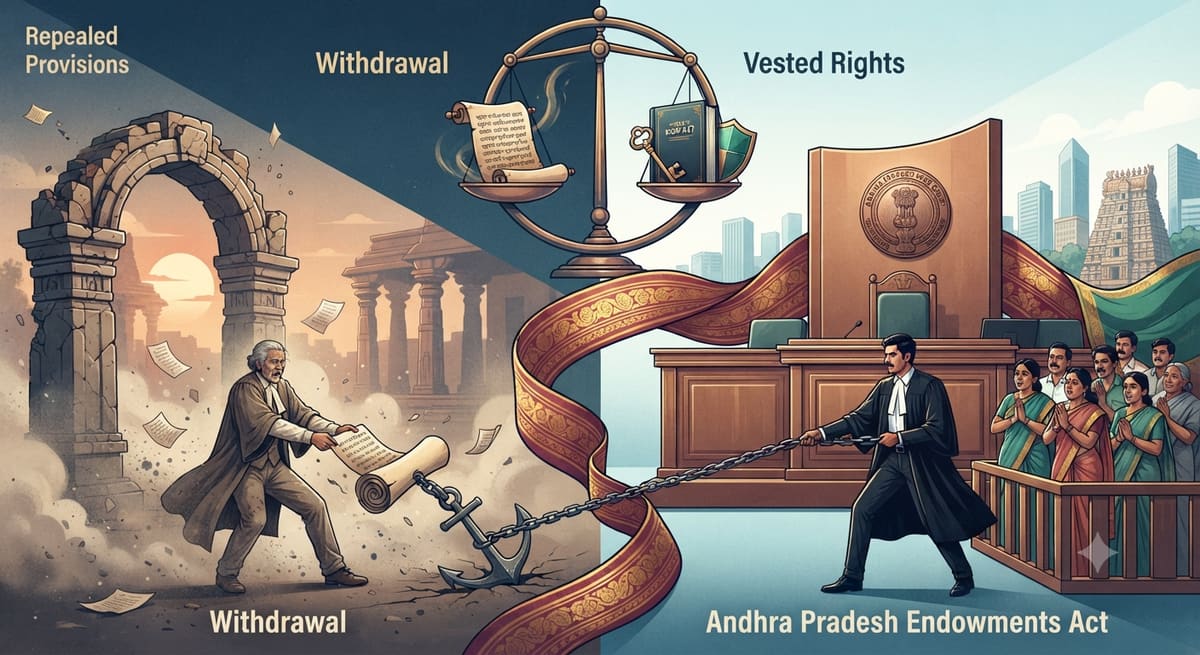
Section 83(2) Andhra Pradesh Endowments Act | Withdrawal of Proceedings Under Repealed Provisions Impermissible Without Vested Rights Impact : AP HC
Case Law Analysis
|Andhra Pradesh High Court

Section 83(2) Andhra Pradesh Endowments Act | Withdrawal of Proceedings Under Repealed Provisions Impermissible Without Vested Rights Impact : AP HC

The Andhra Pradesh High Court ruled that proceedings cannot be withdrawn under repealed provisions of the Andhra Pradesh Endowments Act merely to invoke amended provisions, unless no vested rights are affected. The Court also affirmed the authority of a Founder Family Member to issue eviction notices for exempted institutions, reinforcing statutory compliance in religious endowment disputes.

Section 34 Trade Marks Act | Prior Adoption & Registration in India Prevail Over Trans-Border Reputation : Bombay HC Denies Interim Relief in Co-Existence Dispute
Case Law Analysis
|Bombay High Court

Section 34 Trade Marks Act | Prior Adoption & Registration in India Prevail Over Trans-Border Reputation : Bombay HC Denies Interim Relief in Co-Existence Dispute

Bombay High Court rules that prior adoption and registration of a trademark in India override claims of trans-border reputation, even for globally recognized brands. The Court denied interim relief to both parties, permitting co-existence of identical marks due to acquiescence and failure to establish goodwill in India, setting a precedent for domestic trademark disputes involving foreign entities.

Section 65-B Evidence Act | Hyper-Technical Rejection of Digital Evidence Overturned in Property Demolition Case : Bombay HC
Case Law Analysis
|Bombay High Court

Section 65-B Evidence Act | Hyper-Technical Rejection of Digital Evidence Overturned in Property Demolition Case : Bombay HC

Bombay High Court rules that substantive justice prevails over procedural technicalities, admitting photographic and digital evidence under Section 65-B of the Evidence Act despite minor procedural lapses. The judgment reinforces that trial courts must avoid hyper-technical approaches that undermine the merits of a case, particularly in property disputes involving demolition.

Fraud on Court | Suppression of Material Facts Disentitles Writ Relief Under Article 226 : Bombay HC Rejects Petition for Hotel Misrepresentation
Case Law Analysis
|Bombay High Court

Fraud on Court | Suppression of Material Facts Disentitles Writ Relief Under Article 226 : Bombay HC Rejects Petition for Hotel Misrepresentation

Bombay High Court dismisses a writ petition under Article 226 after finding the petitioner misrepresented a hotel as a residential property and suppressed statutory permissions. The court invoked the principles of 'fraud on court' and judicial estoppel, reinforcing that litigants cannot seek equitable relief through misrepresentation or concealment of material facts.

Clause 35(4) Fertilizer Control Order | Show-Cause Notice Must Specify Charge Before Penalty : Andhra Pradesh HC
Case Law Analysis
|Andhra Pradesh High Court

Clause 35(4) Fertilizer Control Order | Show-Cause Notice Must Specify Charge Before Penalty : Andhra Pradesh HC

The Andhra Pradesh High Court quashed a ₹5 lakh penalty under the Fertilizer (Control) Order, 1985, ruling that regulatory authorities cannot impose penalties without explicitly stating the charge in the show-cause notice. This judgment reinforces procedural fairness in enforcement actions under the Essential Commodities Act, impacting companies and government agencies alike.

Section 2(s) ID Act | Predominant Technical Duties Override Designation to Classify Employee as 'Workman' : Bombay HC Awards Rs. 20 Lakh for Wrongful Termination
Case Law Analysis
|Bombay High Court

Section 2(s) ID Act | Predominant Technical Duties Override Designation to Classify Employee as 'Workman' : Bombay HC Awards Rs. 20 Lakh for Wrongful Termination

Bombay High Court rules that Quality Assurance Supervisors performing predominantly technical work qualify as 'workmen' under the Industrial Disputes Act, regardless of supervisory titles. The court upheld Rs. 20 lakh compensation for wrongful termination, reinforcing that actual job functions-not designations-determine employment status under service law.

Section 2(s) ID Act | Quality Assurance Supervisor Qualifies as 'Workman' Entitling Reinstatement & Rs. 20 Lakh Compensation : Bombay HC
Case Law Analysis
|Bombay High Court

Section 2(s) ID Act | Quality Assurance Supervisor Qualifies as 'Workman' Entitling Reinstatement & Rs. 20 Lakh Compensation : Bombay HC

Bombay High Court clarifies that a Quality Assurance Supervisor, despite supervisory duties, falls under the definition of 'workman' under the Industrial Disputes Act, 1947, entitling wrongful termination compensation. The court rejected presumptive findings of post-termination employment and awarded Rs. 20 lakh for denial of backwages, reinforcing protections for non-managerial supervisory roles.

Section 9 Arbitration Act | Bombay HC Appoints Receiver to Preserve Disputed Property; Registered Deeds Prevail Over Unregistered Agreements
|Bombay High Court

Section 9 Arbitration Act | Bombay HC Appoints Receiver to Preserve Disputed Property; Registered Deeds Prevail Over Unregistered Agreements

Bombay High Court reinforces interim protection under Section 9 of the Arbitration Act by restraining further transfers of 152 disputed plots and appointing a symbolic Receiver. The ruling clarifies that registered conveyance deeds override unregistered agreements, ensuring preservation of arbitration subject-matter for developers and investors in real estate disputes.

Section 9 Arbitration Act | Post-Award Interim Protection Survives Section 34 Challenge If Asset Dissipation Risk Proven : Bombay HC
|Bombay High Court

Section 9 Arbitration Act | Post-Award Interim Protection Survives Section 34 Challenge If Asset Dissipation Risk Proven : Bombay HC

Bombay High Court rules that interim relief under Section 9 of the Arbitration Act remains available even after a Section 34 challenge, but only if the applicant demonstrates concrete evidence of potential asset dissipation. The court permitted asset disclosure and deposit of the awarded amount to prevent award frustration, setting a precedent for post-award asset protection in arbitration disputes.

COVID-19 Ex-Gratia Compensation | Rs. 50 Lakh Mandatory for Public-Risk Employees Under Government Resolution : Bombay HC
Case Law Analysis
|Bombay High Court

COVID-19 Ex-Gratia Compensation | Rs. 50 Lakh Mandatory for Public-Risk Employees Under Government Resolution : Bombay HC

Bombay High Court rules that families of government employees who died due to COVID-19 while performing public-facing duties are entitled to Rs. 50 lakh ex-gratia compensation, regardless of uncommunicated orders. The Court also directed reconsideration of compassionate appointments, reinforcing that procedural lapses cannot deny statutory benefits.

Section 24 Right to Fair Compensation Act | Land Acquisition Proceedings Lapse If Possession Not Taken Nor Compensation Paid Before 01.01.2014 : Bombay HC
Case Law Analysis
|Bombay High Court

Section 24 Right to Fair Compensation Act | Land Acquisition Proceedings Lapse If Possession Not Taken Nor Compensation Paid Before 01.01.2014 : Bombay HC

Bombay High Court rules that land acquisition proceedings under the Right to Fair Compensation Act 2013 lapse if neither possession is taken nor compensation paid by the cut-off date of 01.01.2014, entitling landowners to compensation under the new Act. This judgment reinforces landowners' rights and sets a critical precedent for pending compensation claims under Section 24.

Minimum Guarantee Charges Unrecoverable After Permanent Disconnection | Bombay HC Invalidates Unilateral OTS Without Consumer Consent
Case Law Analysis
|Bombay High Court

Minimum Guarantee Charges Unrecoverable After Permanent Disconnection | Bombay HC Invalidates Unilateral OTS Without Consumer Consent

Bombay High Court rules that electricity suppliers cannot recover minimum guarantee charges post-permanent disconnection, even if paid during temporary disconnection. The judgment also invalidates one-time settlement (OTS) approvals without consumer consent and mandates security deposit refunds, reinforcing consumer protection in electricity supply agreements.

Section 21 Arbitration Act | Fresh Proceedings Post Award Set-Aside Commence on Section 21 Notice; Bombay HC Clarifies Non-Signatory Liability Under Group of Companies Doctrine
Case Law Analysis
|Bombay High Court

Section 21 Arbitration Act | Fresh Proceedings Post Award Set-Aside Commence on Section 21 Notice; Bombay HC Clarifies Non-Signatory Liability Under Group of Companies Doctrine

Bombay High Court rules that fresh arbitral proceedings after an award is set aside under Section 34 begin only upon issuance of a Section 21 notice, not retrospectively. Non-signatories can be impleaded only if prima facie evidence links them to the underlying contract, reinforcing the 'Group of Companies' doctrine in commercial arbitration.