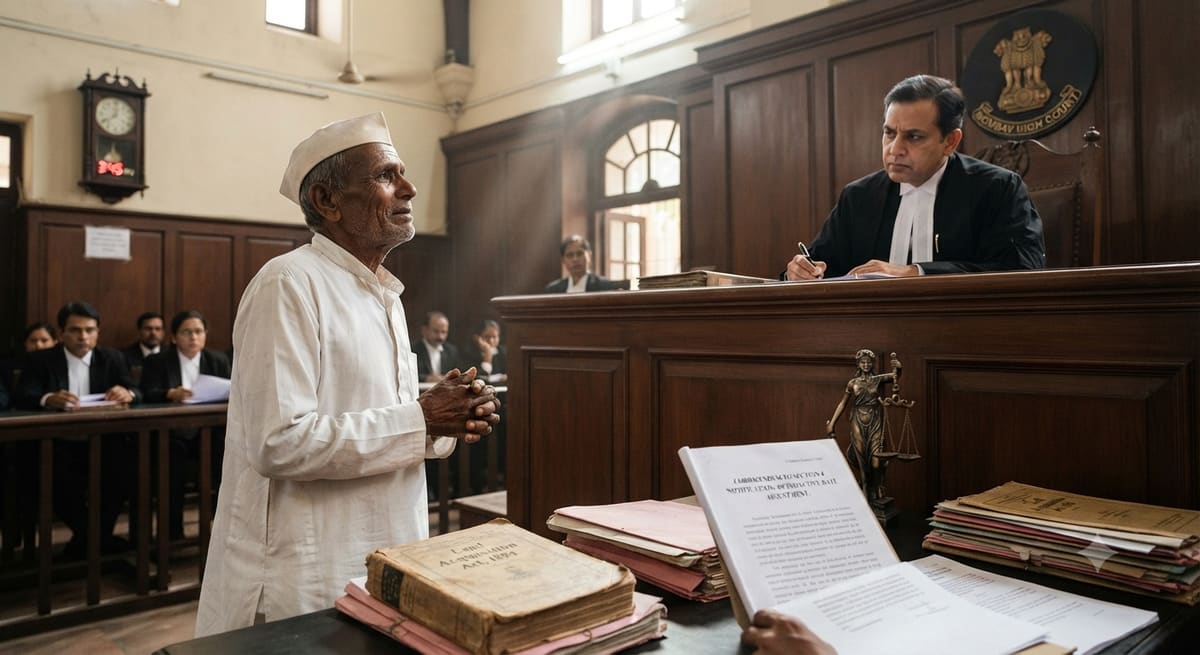
The Bombay High Court has underscored the importance of allowing litigants a fair opportunity to correct inadvertent errors in evidence, particularly in land acquisition compensation disputes. In this case, the Court set aside a lower court order that denied permission to amend a claim petition to rectify an arithmetical error in an expert valuation report, holding that such refusal unjustly prejudiced the petitioner's right to just compensation.
Background & Facts
The Dispute
The petitioner, Sahebrao Misal, a 75-year-old farmer from Railgaon, Jalna district, challenged the acquisition of his land bearing Gat No. 25 for the construction of a storage tank. An award under Section 11 of the Land Acquisition Act, 1894 was passed on 22.11.2013, following which the petitioner sought a reference under Section 18 of the Act, alleging inadequate compensation.
Key Facts
- The land was acquired for the construction of a storage tank by the respondents, the State of Maharashtra and the Executive Engineer, Jalna Minor Irrigation Division
- The petitioner filed evidence in lieu of examination-in-chief at Exhibit-29 and was cross-examined
- A Government Approved Expert Valuer (PW-2) submitted a valuation report, which was also cross-examined
- The petitioner later discovered an inadvertent error in the valuation report: the rate of mangoes was recorded as Rs. 35 per kg instead of the actual rate of Rs. 55 per kg prescribed by the Agricultural Produce Market Committee (APMC) for the year 2009-10
- The petitioner sought to amend his claim petition and submit a corrected valuation report through applications below Exhibit 58 and 60
Procedural History
- 22.11.2013: Award passed under Section 11 of the Land Acquisition Act, 1894
- Date not specified: Petitioner filed reference under Section 18 of the Act
- Date not specified: Petitioner filed evidence (Exhibit-29) and was cross-examined
- Date not specified: PW-2 (Expert Valuer) was examined and cross-examined
- Date not specified: Petitioner realized the error in the valuation report and sought correction
- Applications filed: Below Exhibit 58 and 60 seeking amendment of claim and submission of corrected valuation report
- 10.10.2024: Civil Judge Senior Division, Jalna rejected the applications (impugned order)
- Date not specified: Petitioner filed Writ Petition No. 435 of 2025 before the Bombay High Court, Aurangabad Bench
- 01.07.2026: Judgment reserved
- 06.07.2026: Judgment pronounced
Relief Sought
The petitioner sought:
- Permission to amend the claim petition to correct the valuation error
- Leave to submit the corrected valuation report as evidence
- Setting aside of the impugned order dated 10.10.2024
The Legal Issue
The central question was whether a litigant in a land acquisition compensation dispute should be permitted to amend a claim petition and submit corrected evidence to rectify an inadvertent error in an expert valuation report, even after the expert had been cross-examined.
Arguments Presented
For the Petitioner
Mr. A.P. Bhandari, learned advocate for the petitioner, contended:
- The petitioner was litigating to obtain just compensation for fruit-bearing trees lost due to acquisition
- The error in the valuation report was inadvertent and inconsistent with APMC-prescribed rates
- The corrected valuation report had already been furnished by the expert valuer
- Denying the amendment would prejudice the petitioner's right to fair compensation
For the Respondent
Mr. K.S. Patil, learned AGP for the State, supported the impugned order, arguing:
- The petitioner had already relied on the original valuation report, and PW-2 had been cross-examined
- Allowing the amendment at this stage would prejudice the respondents
The Court's Analysis
The Court observed that the petitioner was seeking just compensation for acquired land and fruit-bearing trees. While the petitioner had relied on the expert's report, an inadvertent arithmetical error had been discovered, which was inconsistent with APMC-prescribed rates. The Court held:
"True that petitioner has relied upon report of PW-2 to prove market rate of fruits in year 2009-10, however according to petitioner, inadvertent arithmetical error was caused in report, which is inconsistent with rates prescribed by APMC during the year 2009-10. In this backdrop, there was no impediment in permitting petitioner to amend his claim and lead further evidence as per corrected valuation report."
The Court further noted that the Reference Court had erred in refusing the amendment solely on the ground that PW-2 had already been examined. The Court emphasized that the veracity of the evidence could be assessed during the final adjudication, but denying the opportunity to present the best possible evidence was unjust:
"The petitioner can be given a fair opportunity to bring on record evidence in support of his claim. The veracity in evidence and pleadings can be taken care of while appreciating pleadings and evidence of petitioner before passing final order. However, it would be inappropriate to refuse opportunity to bring best possible evidence on record."
The Verdict
The Bombay High Court allowed the writ petition in terms of prayer clauses (C) and (D). The impugned order dated 10.10.2024 was set aside, and the petitioner was permitted to amend the claim petition and submit the corrected valuation report as evidence.
What This Means For Similar Cases
Fair Opportunity to Correct Evidence
- Courts must allow litigants a fair opportunity to correct inadvertent errors in evidence, even if the expert has already been cross-examined
- The veracity of the corrected evidence can be assessed during final adjudication, but denying the opportunity to present the best possible evidence is prejudicial
Prejudice to the Opposing Party
- While the opposing party's potential prejudice is a relevant consideration, it cannot outweigh the litigant's right to present accurate evidence, especially in compensation disputes where the stakes are high
- The Court distinguished this case from scenarios where amendments are sought to introduce entirely new claims or evidence, holding that corrections to existing evidence should be liberally permitted
Procedural Flexibility in Land Acquisition Cases
- Land acquisition compensation disputes often involve complex valuations and expert reports. Courts should adopt a flexible approach to procedural rules to ensure that litigants are not unjustly deprived of just compensation due to technicalities or inadvertent errors
- Practitioners should ensure that expert reports are meticulously reviewed before submission, but courts should also be willing to permit corrections where errors are genuine and do not prejudice the opposing party