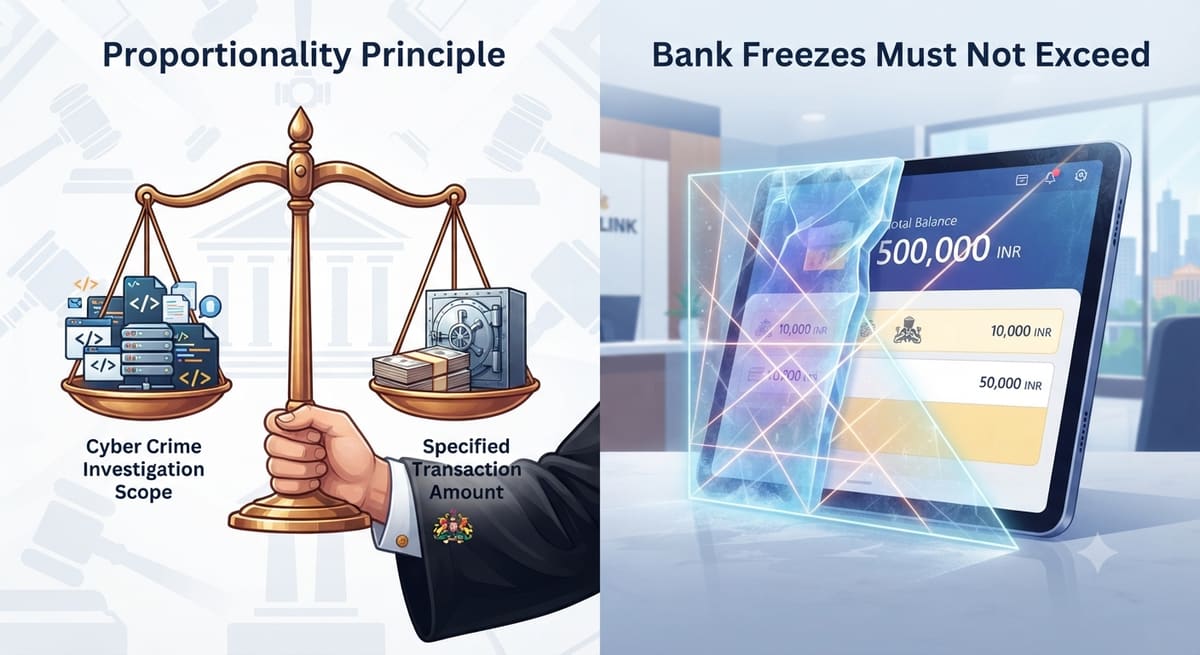
In a significant ruling on banking regulations and customer rights, the Karnataka High Court has clarified that banks cannot unilaterally freeze accounts beyond the specific amounts directed by investigating agencies. The judgment underscores the principle of proportionality, holding that banks must confine freezing actions strictly to the scope of lawful directions, thereby protecting account holders from arbitrary restrictions on their funds.
Background & Facts
The Dispute
The petitioner, Mohammed Aslam, held a bank account with Punjab National Bank (PNB). His account was frozen pursuant to communications received from multiple investigating agencies, including cyber crime police stations in Andhra Pradesh, Telangana, and Delhi. The petitioner contended that the bank froze his entire account, despite the freezing directions specifying only limited amounts. This freeze prevented him from accessing funds beyond the directed amounts, causing financial hardship.
Key Facts
The petitioner’s account was frozen based on communications from investigating agencies
The first communication, from the Cyber Crime Police Station, Prakasam District, sought freezing of Rs. 15,000
The second communication, from the Barrackpore Police Station, West Bengal, sought freezing of Rs. 10,000
The aggregate amount covered by the freezing directions was Rs. 25,000
PNB froze the entire account, citing apprehensions of future freezing requests
The petitioner was unable to access funds beyond Rs. 25,000, leading to financial distress
Procedural History
06.07.2026: Writ Petition (WP No. 202457 of 2026) filed before the Karnataka High Court, Kalaburagi Bench
The petitioner sought reliefs including:
Restriction of the freeze to Rs. 25,000 as per the investigating agencies’ directions
Release of excess funds and permission to operate the account for future credits
Furnishing of details of all communications and freezing instructions
Quashing of the bank’s action insofar as it exceeded the specified amounts
The matter was heard preliminarily, with notice dispensed to respondents 2, 3, and 4
Relief Sought
The petitioner prayed for:
A writ of mandamus directing PNB to restrict the freeze to Rs. 25,000 and permit operation of the remaining balance
Release of all amounts in excess of Rs. 25,000 and permission to operate future credits
Furnishing of complete particulars of all complaints, FIRs, notices, and freezing instructions
Quashing of PNB’s action to the extent it froze funds beyond the specified amounts
The Legal Issue
The central question before the Court was whether a bank is justified in freezing an entire account when the investigating agencies’ directions specify only a limited amount. Specifically, the Court had to determine:
Whether banks can unilaterally expand the scope of freezing directions based on apprehensions of future requests
Whether the principle of proportionality applies to the implementation of freezing orders by banks
The legal limits of a bank’s authority while acting on directions from investigating agencies
Arguments Presented
For the Petitioner
The petitioner relied on the judgment in Sri Madhu v. The Indus Bank Ltd. and Others (WP No. 38362/2025, dated 09.06.2026), where the Karnataka High Court held that banks cannot freeze accounts beyond the amounts specified in investigating agencies’ directions. The petitioner argued:
The bank’s action was arbitrary and disproportionate, as it froze the entire account despite the directions specifying only Rs. 25,000
The freeze caused irreparable injury and hardship, preventing the petitioner from accessing legitimately earned funds
The bank acted beyond its authority by assuming powers not conferred by law
For the Respondent (PNB)
PNB contended that:
It received two separate communications directing the freezing of the petitioner’s account, aggregating to Rs. 25,000
The bank froze the entire account as a precautionary measure, apprehending further freezing requests from other investigating agencies
The bank required the petitioner to comply with banking norms and submit forms before defreezing the account
The freeze was necessary to prevent misuse of funds originating from cyber financial fraud
The Court's Analysis
The Court undertook a detailed examination of the legal principles governing the implementation of freezing directions by banks. Key observations included:
"The power exercised by the Bank in the present case is not an independent power. The Bank acts merely as a custodian of the account and is required to implement the directions lawfully issued by the competent investigating authorities. Its authority is therefore circumscribed by the terms of the directions received by it."
The Court held that banks perform a limited and ministerial function while acting on freezing directions. They are neither investigating authorities nor adjudicatory bodies, and their obligation is confined to faithfully implementing lawful directions. The Court emphasized:
"The communications relied upon by respondent No.1 disclose that respondent No.2 sought freezing of the account to the extent of Rs.15,000/- and the communication received from the Barrackpore Police Station sought freezing to the extent of Rs.10,000/-. Thus, the aggregate amount covered by the freezing directions is only Rs.25,000/-. In the absence of any further communication or direction from a competent authority, respondent No.1 could not have enlarged the scope of the freezing orders on its own accord."
The Court rejected PNB’s argument that administrative convenience or apprehensions of future requests could justify freezing funds beyond the specified amounts. It held:
"Administrative convenience or anticipatory action cannot substitute a valid legal mandate. If and when additional directions are received from competent authorities, respondent No.1 would undoubtedly be required to act in accordance therewith. However, until such directions are received, respondent No.1 is bound to confine its action strictly to the extent authorised by the communications already in its possession."
The Court underscored the principle of proportionality, noting that freezing a bank account directly impacts the account holder’s ability to utilize legitimately available funds. Any restriction must correspond to the objective sought to be achieved and must not exceed the limits prescribed by the competent authority. The Court observed:
"The freezing of a bank account directly impacts the account holder's ability to utilise legitimately available funds and has civil and financial consequences. Any restriction imposed on the operation of a bank account must therefore be proportionate to the purpose sought to be achieved and must not exceed the limits prescribed by the competent authority issuing the direction."
The Court also made general observations regarding the implementation of freezing directions by banks:
Banks must act with due care and circumspection, ensuring that the interests of investigation are protected while safeguarding the rights of account holders
The relationship between a bank and its customer is founded on contract and confidence, and amounts in an account remain the property of the account holder, subject only to lawful restrictions
Freezing an account affects the account holder’s ability to meet day-to-day expenses, honour contractual obligations, and conduct business transactions
Banks must ensure that freezing actions are strictly in accordance with the directions received and do not travel beyond their scope
The Court concluded that PNB’s action in freezing the entire account was unsustainable and liable to be modified. It directed that the freeze be restricted to Rs. 25,000, corresponding to the aggregate amount specified in the investigating agencies’ communications.
The Verdict
The Court allowed the writ petition and passed the following directions:
The debit freeze imposed by PNB on the petitioner’s account was restricted to an aggregate sum of Rs. 25,000, corresponding to the amounts covered by the freezing communications
PNB was directed to permit the petitioner to operate the account in respect of the balance amount lying to the credit thereof
PNB was prohibited from extending the scope of any freezing direction beyond the amount or extent specifically mandated by the investigating agencies
PNB was directed to comply with the order within four (4) days from the date of receipt of a certified copy of the judgment
The petitioner was required to comply with banking norms and submit the required forms as stated in PNB’s memo dated 06.07.2026
What This Means For Similar Cases
Banks Must Adhere Strictly to Freezing Directions
Banks cannot unilaterally expand the scope of freezing directions based on apprehensions of future requests
Freezing actions must be proportionate to the amounts specified in the investigating agencies’ communications
Banks must confine their actions strictly to the terms of the directions received and cannot impose additional restrictions
Proportionality Is Key to Customer Rights
The judgment reinforces that freezing orders must balance the requirements of investigation with the rights of account holders
Banks must ensure that account holders are not subjected to restrictions beyond those authorised by law
The Court’s observations serve as a guiding principle for banks to act with due care and circumspection while implementing freezing directions
Legal Recourse for Aggrieved Account Holders
Account holders whose accounts are frozen beyond the specified amounts can seek judicial intervention under Articles 226 and 227 of the Constitution of India
The judgment in Sri Madhu v. The Indus Bank Ltd. provides a precedent for challenging disproportionate freezing actions
Banks are put on notice that future freezing actions must be legally sustainable and confined to the scope of the directions received