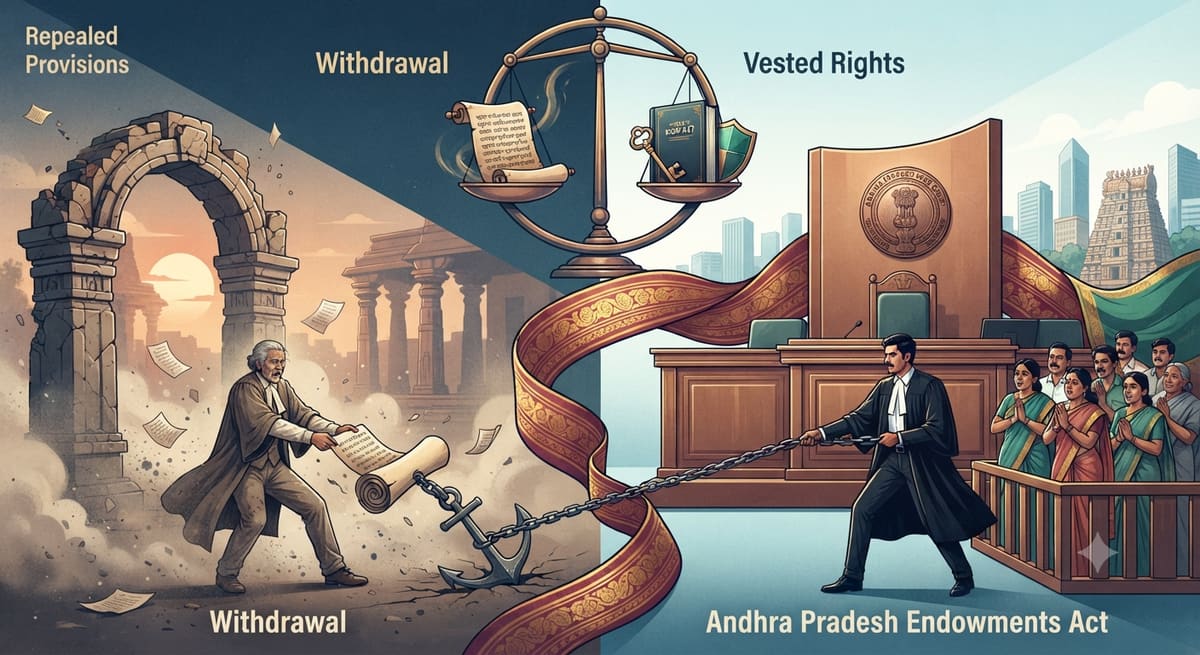
The Andhra Pradesh High Court recently delivered a significant ruling on the interpretation of Section 83 of the Andhra Pradesh Charitable and Hindu Religious Institutions and Endowments Act, 1987 (Act 30 of 1987), as amended by Act 36 of 2023. The Court held that withdrawal of proceedings under repealed provisions and invocation of amended provisions is permissible, provided no vested rights are affected. The judgment clarifies the scope of authority of trustees and executive officers under the amended Act and underscores the procedural flexibility in eviction matters.
Background & Facts
The Dispute
The petitioner, M. Murali, is alleged to have encroached upon a portion of the property belonging to the Yadalla Pitchaiah Chetty Charities Association (4th respondent), a charitable institution in Kadapa. The property in question is a building bearing Door No. 19/646, measuring 115 feet east-west and 10 feet north-south, located in Sy. No. 30/2B/1A1, Kadapa Town. The 4th respondent, represented by its Founder Family Member and Secretary, Dr. Jwala Chaitanya, initiated proceedings for the petitioner’s eviction.
Key Facts
The 4th respondent filed O.A. No. 54 of 2018 before the Andhra Pradesh Endowments Tribunal seeking eviction of the petitioner from the schedule property.
While the original application (O.A.) was pending, the 4th respondent filed I.A. No. 911 of 2025 seeking withdrawal of the O.A. to avail remedies under the amended provisions of Act 30 of 1987 (as amended by Act 36 of 2023).
The Tribunal, vide order dated 21.01.2026, allowed the withdrawal and dismissed the O.A., granting liberty to the 4th respondent to proceed under the amended Act.
Following the dismissal, the 4th respondent issued a notice dated 31.01.2026 under Section 83(2) of the amended Act, calling upon the petitioner to vacate the premises or submit an explanation.
The petitioner challenged the notice in the present writ petition, contending that the withdrawal of the O.A. and the subsequent notice were illegal, arbitrary, and without jurisdiction.
Procedural History
15.03.2016: Alleged encroachment by the petitioner on the 4th respondent’s property.
2018: O.A. No. 54 of 2018 filed before the Endowments Tribunal for eviction.
2023: Act 30 of 1987 amended by Act 36 of 2023, substituting Section 83 and omitting Sections 84 to 86.
2025: I.A. No. 911 of 2025 filed for withdrawal of O.A. No. 54 of 2018.
21.01.2026: Tribunal allows withdrawal and dismisses O.A. No. 54 of 2018.
31.01.2026: Notice issued under Section 83(2) of the amended Act by the 4th respondent.
2026: Present writ petition (W.P. No. 5378 of 2026) filed before the Andhra Pradesh High Court.
The Parties' Positions
Petitioner’s Contentions
Retrospective Operation: The amended Act 36 of 2023 does not specify retrospective operation, and the Tribunal’s permission to withdraw the O.A. and proceed under the amended Act is impermissible.
Lack of Jurisdiction: The notice under Section 83(2) was not issued by a competent authority (Executive Officer or Assistant Commissioner) but by the Founder Family Member, who lacks jurisdiction.
Vested Rights: The withdrawal of the O.A. and invocation of the amended Act nullifies the petitioner’s vested rights under the repealed provisions.
Respondent’s Contentions
Exempted Institution: The 4th respondent is an exempted institution under Section 154 of the Act, notified vide G.O.Ms.No.1098 (11.09.2008) and G.O.Ms.No.306 (05.11.2021). As such, the Trustee/Secretary is competent to discharge the functions of an Executive Officer.
Procedural Nature of Amendment: The amendment is procedural and does not affect vested rights. The withdrawal of the O.A. was necessary as the repealed provisions (Sections 84 to 86) could not be executed.
Authority of Founder Family Member: The Founder Family Member was appointed as Executive Officer vide proceedings dated 12.01.2021 and is competent to issue notices under Section 83(2).
Judicial Precedents: The High Court has previously upheld the authority of Executive Officers (including Trustees) to invoke Section 83 in similar cases (W.A. Nos. 1188/2025 & 1191/2025 dated 13.11.2025 and W.P. Nos. 28866/2024 & 28869/2024 dated 20.12.2024).
Relief Sought
The petitioner sought a writ of mandamus to:
Declare the notice dated 31.01.2026 as illegal, arbitrary, and without jurisdiction.
Set aside the Tribunal’s order dated 21.01.2026 permitting withdrawal of O.A. No. 54 of 2018.
Restrain the respondents from taking coercive action under the impugned notice.
The Legal Issue
The Court was called upon to resolve two primary questions:
Whether the withdrawal of proceedings under repealed provisions of the Act and invocation of amended Section 83 is permissible, particularly when no vested rights are affected.
Whether a Founder Family Member/Secretary of an exempted institution is competent to issue a notice under Section 83(2) of the Act, or whether such authority is restricted to the Executive Officer or Assistant Commissioner.
Arguments Presented
For the Petitioner
Retrospective Operation: Relied on the Supreme Court’s judgment in Ambalal Sarabhai Enterprises Ltd. v. Amrit Lal & Co. ((2001) 8 SCC 397) and the erstwhile Andhra Pradesh High Court’s judgment in Sri Satya Pramod’s Teertha Swamuluvaru v. Commissioner of Hindu Religious and Charitable Endowments (AIR 1971 AP 371) to argue that vested rights under repealed provisions cannot be nullified by new legislation.
Lack of Jurisdiction: Contended that the Founder Family Member is not authorized to issue notices under Section 83(2), as the provision restricts such authority to the Executive Officer or Assistant Commissioner.
For the Respondent
Exempted Institution: Argued that the 4th respondent is an exempted institution, and the Trustee/Secretary is competent to discharge the functions of an Executive Officer under the proviso to Section 29 of the Act.
Procedural Amendment: Submitted that the amendment is procedural and does not affect vested rights. The withdrawal of the O.A. was necessary as the repealed provisions (Sections 84 to 86) could not be executed.
Judicial Precedents: Cited High Court orders upholding the authority of Trustees/Executive Officers to invoke Section 83 in similar cases.
The Court's Analysis
Withdrawal of Proceedings and Invocation of Amended Provisions
The Court examined the petitioner’s reliance on Ambalal Sarabhai Enterprises Ltd. and Sri Satya Pramod’s Teertha Swamuluvaru and held that these judgments are inapplicable to the present case. The Court observed:
"In this case, the new legislation has not diminished the petitioner's rights; rather, it has enhanced them. Under Sections 84 and 85 of the Act of 1987 (Act 30 of 1987), the Deputy Commissioner was the competent authority to remove encroachments with police assistance. The petitioner has failed to specify which rights have accrued to them or how the repealed and amended provisions negatively affect their position. Conversely, the amended provisions provide the petitioner with the protection of natural justice and establish a formal procedure for the eviction of encroachers."
The Court further analyzed Order XXIII Rule 1(3) of the Code of Civil Procedure, 1908 (CPC), which permits withdrawal of a suit with liberty to file a fresh suit on grounds of "formal defect" or "sufficient grounds." The Court relied on K.S. Bhoopathy v. Kokila ((2000) 5 SCC 458) to hold that the withdrawal of O.A. No. 54 of 2018 was permissible as no evidence had been recorded, and no vested rights had accrued to the petitioner.
Authority of Founder Family Member to Issue Notice
The Court addressed the petitioner’s contention that the Founder Family Member lacked authority to issue the notice under Section 83(2). The Court examined the proviso to Section 29 of the Act, which empowers the Commissioner to authorize a trustee or any employee of an institution to discharge the functions of an Executive Officer where the institution’s annual income exceeds ₹2 lakhs but is less than ₹25 lakhs.
The Court noted that the 4th respondent’s annual income is approximately ₹22 lakhs, bringing it within the purview of the proviso. The Commissioner had appointed the Founder Family Member as Executive Officer vide proceedings dated 12.01.2021, thereby conferring the requisite authority to issue notices under Section 83(2).
The Court concluded:
"Accordingly, a member of the founder family was appointed to manage the affairs of the 4th respondent institution, the Founder Family Member is an Executive Officer for all practical purposes under the Act 30 of 1987."
The Verdict
The Court dismissed the writ petition (W.P. No. 5378 of 2026), holding:
The withdrawal of O.A. No. 54 of 2018 and invocation of the amended Section 83 is permissible, as no vested rights of the petitioner were affected.
The Founder Family Member is competent to issue notices under Section 83(2) of the Act, being duly authorized by the Commissioner.
The respondents are directed to proceed in accordance with the law, following the procedure prescribed under the amended Act.
No order as to costs was passed, and pending interlocutory applications, if any, were closed.
What This Means For Similar Cases
Procedural Flexibility in Amended Legislation
Withdrawal Permissible: Courts may permit withdrawal of proceedings under repealed provisions if the amended provisions introduce procedural improvements (e.g., natural justice safeguards) and no vested rights are affected. Practitioners must argue the absence of prejudice to the opposing party.
No Vested Rights in Procedural Matters: Where amendments are procedural (e.g., eviction mechanisms), courts are unlikely to uphold claims of vested rights unless substantive benefits under the repealed Act are nullified.
Authority of Trustees in Exempted Institutions
Dual Capacity: Trustees of exempted institutions (notified under Section 154) may discharge the functions of an Executive Officer, including issuing notices under Section 83(2), provided the institution’s income falls within the prescribed range (₹2 lakhs to ₹25 lakhs) and the Commissioner has authorized such appointment.
Government Orders and Provisos: Reliance on G.O.Ms.No.1098 and G.O.Ms.No.306, along with the proviso to Section 29, can bolster arguments for the competence of Trustees/Secretaries to act as Executive Officers.
Strategic Considerations for Practitioners
Challenge Amended Provisions Early: Parties aggrieved by amendments should challenge the validity of the provisions at the earliest opportunity, rather than waiting to contest notices or orders issued thereunder.
Focus on Evidence and Trial Stage: Withdrawal of proceedings is more likely to be permitted where no evidence has been recorded or rights have vested. Practitioners should emphasize the stage of proceedings to resist withdrawal applications.
Alternative Remedies: Courts may dismiss writ petitions where alternative remedies (e.g., appeals before the Endowments Tribunal) are available. Petitioners must exhaust statutory remedies before approaching constitutional courts.