Calcutta High Court judgments

302 Calcutta High Court judgments explained in plain English: what was decided, the law applied and why it matters. Page 4 of 13.

Natural Justice in Disciplinary Proceedings | Uncorroborated Admission Insufficient for Dismissal : Calcutta HC
Case Law Analysis
|Calcutta High Court

Natural Justice in Disciplinary Proceedings | Uncorroborated Admission Insufficient for Dismissal : Calcutta HC

Calcutta High Court rules that disciplinary dismissal based solely on an uncorroborated admission violates natural justice, mandating reinstatement where no independent evidence supports the charge. The judgment reinforces that proportionality and fair hearing are non-negotiable in service law, impacting employers and employees in industrial disputes.

Pension Option Form | Unacknowledged Peon Book Entries Cannot Substitute for Original Documentary Proof : Calcutta HC
Case Law Analysis
|Calcutta High Court

Pension Option Form | Unacknowledged Peon Book Entries Cannot Substitute for Original Documentary Proof : Calcutta HC

The Calcutta High Court ruled that self-made, unverified entries in a peon book-without official acknowledgment or corroboration-cannot satisfy the burden of proof for pension eligibility. This reinforces that statutory pension claims require authentic, contemporaneous documentation, not internal administrative notes, affecting all government and public sector employees relying on informal records to assert vested rights.

Section 245 Income Tax Act | Refund Adjustment Exceeding 20% of Disputed Demand Without Hearing Violates Natural Justice : Calcutta HC
Case Law Analysis
|Calcutta High Court

Section 245 Income Tax Act | Refund Adjustment Exceeding 20% of Disputed Demand Without Hearing Violates Natural Justice : Calcutta HC

The Calcutta High Court has ruled that adjusting a tax refund beyond 20% of a disputed demand without giving the assessee a prior opportunity to be heard violates the principles of natural justice. This sets a critical precedent for all taxpayers facing refund adjustments under Section 245, mandating procedural fairness even in recovery actions by the Income Tax Department.

Section 500 IPC | Administrative Disciplinary Actions Do Not Constitute Defamation Without Proof of Public Reputation Damage : Calcutta HC
Case Law Analysis
|Calcutta High Court

Section 500 IPC | Administrative Disciplinary Actions Do Not Constitute Defamation Without Proof of Public Reputation Damage : Calcutta HC

The Calcutta High Court has ruled that official disciplinary measures against public servants, even if financially damaging or procedurally flawed, do not amount to criminal defamation under Section 500 IPC unless they demonstrably lower the individual’s reputation in the eyes of the public. This clarifies the boundary between service jurisprudence and criminal liability, protecting institutional authority while upholding the high threshold for defamation.

Absence of Mens Rea | Quashing FIR in Visitation Dispute Under BNS : Calcutta HC
Case Law Analysis
|Calcutta High Court

Absence of Mens Rea | Quashing FIR in Visitation Dispute Under BNS : Calcutta HC

Calcutta HC quashed criminal proceedings against a father accused of assault during court-ordered visitation, ruling that the FIR lacked credible evidence of criminal intent (mens rea) and suffered from unexplained delay. The judgment reinforces that visitation disputes cannot be criminalized without clear proof of wrongful intent, protecting parents from abuse of process under Bharatiya Nyaya Sanhita (BNS).

Section 406/420 IPC | Commercial Disputes Without Dishonest Intent at Transaction Inception Cannot Be Criminalized: Calcutta HC
Case Law Analysis
|Calcutta High Court

Section 406/420 IPC | Commercial Disputes Without Dishonest Intent at Transaction Inception Cannot Be Criminalized: Calcutta HC

Calcutta High Court quashes criminal proceedings under IPC Sections 406/420, ruling that mere failure to repay for returned goods does not constitute criminal breach of trust or cheating unless dishonest intent is proven at the transaction's outset. The judgment reinforces that commercial defaults should be resolved through civil remedies, not criminal prosecution.

UAPA & IPC Section 121 | Suspension of Life Sentence Denied for Terrorist Attack Killing 24 Security Personnel : Calcutta HC
|Calcutta High Court

UAPA & IPC Section 121 | Suspension of Life Sentence Denied for Terrorist Attack Killing 24 Security Personnel : Calcutta HC

Calcutta High Court refuses to suspend the life sentence of a convict in the 2010 Silda camp terrorist attack, emphasizing that grave offences under UAPA, IPC (waging war against the State), and the Arms Act override personal circumstances, including prolonged pre-conviction bail. The ruling underscores the stringent bail standards for terrorism-related convictions.

Section 9 Arbitration Applications | Commercial Disputes Must Be Adjudicated Only by Designated Commercial Courts: Calcutta HC
Case Law Analysis
|Calcutta High Court

Section 9 Arbitration Applications | Commercial Disputes Must Be Adjudicated Only by Designated Commercial Courts: Calcutta HC

Calcutta High Court holds that interim relief applications under Section 9 of the Arbitration and Conciliation Act, 1996, in commercial disputes must exclusively be heard by courts notified under the Commercial Courts Act, 2015. Orders passed by non-designated courts are set aside, reinforcing jurisdictional clarity for businesses and arbitral parties.

Natural Justice in Motor Insurance | Delayed FIR or Fake License Allegations Cannot Bar Claims Without Inquiry : Calcutta HC
|Calcutta High Court

Natural Justice in Motor Insurance | Delayed FIR or Fake License Allegations Cannot Bar Claims Without Inquiry : Calcutta HC

Calcutta High Court rules that insurers cannot reject motor accident claims solely based on delayed FIR filing or unverified allegations of fake licenses. The court mandates a prior inquiry and hearing for the vehicle owner before denying compensation, enhancing the award to Rs. 14 lakh with 6% interest. This reinforces procedural fairness in third-party liability claims under the Motor Vehicles Act.

Contract Law | Silence Amounts to Acceptance in Public Works Contracts; Municipal Body Liable for Rs. 1.88 Crore in Unpaid RA Bills & Deposits : Calcutta HC
|Calcutta High Court

Contract Law | Silence Amounts to Acceptance in Public Works Contracts; Municipal Body Liable for Rs. 1.88 Crore in Unpaid RA Bills & Deposits : Calcutta HC

Calcutta High Court rules that a municipal body's failure to dispute running account bills or supplementary work claims under a public works contract constitutes acceptance, imposing liability for Rs. 1.88 crore in unpaid dues. The court awarded 10% p.a. interest from the date of filing, reinforcing contractors' rights against delayed payments by government entities.

Tacit Consent for Deputation | Silence & Continued Service Infer Implied Agreement Under Service Law : Calcutta HC
Case Law Analysis
|Calcutta High Court

Tacit Consent for Deputation | Silence & Continued Service Infer Implied Agreement Under Service Law : Calcutta HC

Calcutta High Court rules that employees transferred on deputation without express consent cannot later challenge the posting if they accepted the role, drew salaries, and remained silent for over a year. The court holds that conduct implying acceptance-such as continued service-constitutes tacit consent, binding employees under public sector standing orders.

Section 36(3) Arbitration Act | Arbitrator Bias Does Not Constitute Fraud for Unconditional Stay; Conditional Stay Granted on Security Deposit : Calcutta HC
Case Law Analysis
|Calcutta High Court

Section 36(3) Arbitration Act | Arbitrator Bias Does Not Constitute Fraud for Unconditional Stay; Conditional Stay Granted on Security Deposit : Calcutta HC

The Calcutta High Court ruled that arbitrator bias, even with public evidence like attendance at events, does not meet the threshold of 'fraud' under Section 36(3) of the Arbitration Act to warrant an unconditional stay of a ₹765.78 crore award. The court granted a conditional stay pending deposit of security, setting a precedent on the narrow interpretation of fraud in arbitration enforcement.

RBI Master Directions on Fraud Classification | Bank Must Disclose Audit Reports & JLM Outcomes Before Fraud Tag: Calcutta HC
Case Law Analysis
|Calcutta High Court

RBI Master Directions on Fraud Classification | Bank Must Disclose Audit Reports & JLM Outcomes Before Fraud Tag: Calcutta HC

Calcutta HC quashes Punjab National Bank's fraud classification of borrower accounts, ruling that reliance on undisclosed Joint Lenders Meeting decisions and judicially quashed audit reports violates natural justice. The judgment reinforces that banks must provide borrowers an opportunity to respond to all adverse material before fraud tagging under RBI Master Directions.

Section 14 Limitation Act | Time Spent in Abortive IBC Section 9 Proceedings Excluded for Subsequent Debt Recovery Suit : Calcutta HC
Case Law Analysis
|Calcutta High Court

Section 14 Limitation Act | Time Spent in Abortive IBC Section 9 Proceedings Excluded for Subsequent Debt Recovery Suit : Calcutta HC

Calcutta High Court rules that the period spent pursuing an IBC Section 9 application dismissed due to a pre-existing dispute can be excluded under Section 14 of the Limitation Act when filing a subsequent civil suit. This holding clarifies the interplay between IBC jurisdictional bars and limitation periods, offering relief to creditors navigating procedural hurdles in debt recovery.

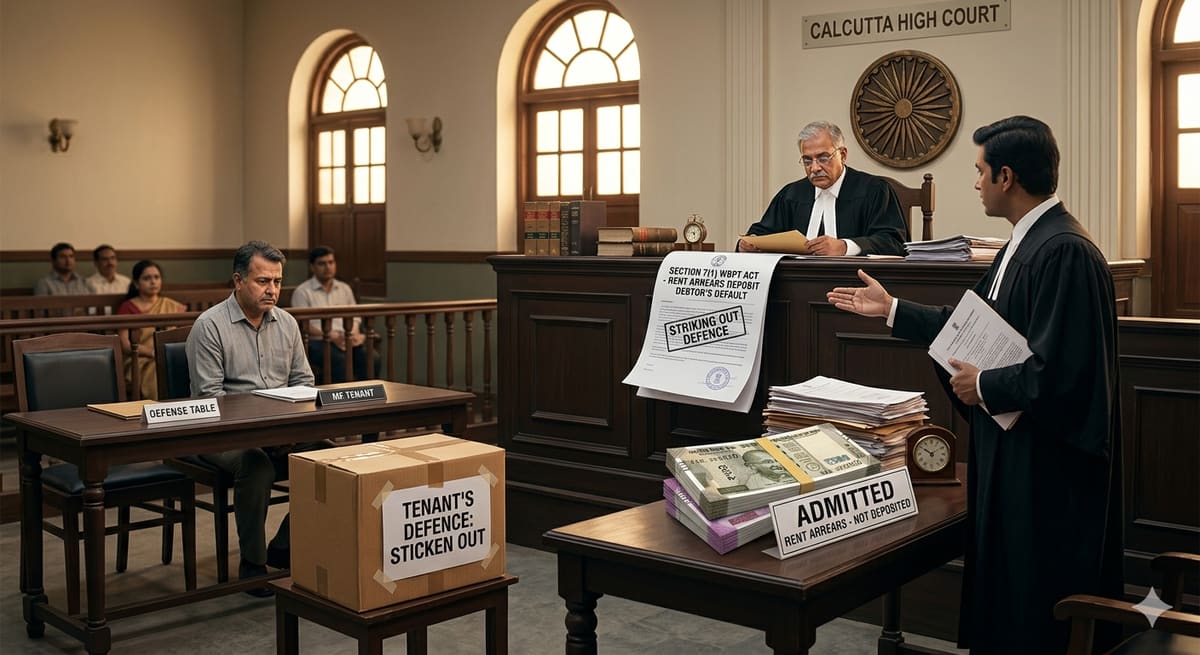
Section 7(1) WBPT Act | Failure to Deposit Admitted Rent Arrears Within 30 Days Strikes Out Tenant’s Defence, Even Amidst Section 7(2) Dispute : Calcutta HC
Case Law Analysis
|Calcutta High Court

Section 7(1) WBPT Act | Failure to Deposit Admitted Rent Arrears Within 30 Days Strikes Out Tenant’s Defence, Even Amidst Section 7(2) Dispute : Calcutta HC

The Calcutta High Court has ruled that under the West Bengal Premises Tenancy Act, 1997, a tenant’s defence is automatically struck out if admitted rent arrears are not deposited within 30 days of filing under Section 7(1), regardless of whether a rent dispute is pending under Section 7(2). This sets a strict compliance standard for tenants seeking to contest eviction, making timely deposit a non-negotiable precondition to legal defence.

Section 33A BCKV Act | Functional Parity Without State Sanction Does Not Confer Teacher Status or Enhanced Retirement Age : Calcutta HC
Case Law Analysis
|Calcutta High Court

Section 33A BCKV Act | Functional Parity Without State Sanction Does Not Confer Teacher Status or Enhanced Retirement Age : Calcutta HC

Calcutta HC rules that AICRP scientists, despite identical service conditions, cannot claim regular teacher status or retirement age benefits under the BCKV Act without explicit State approval under Section 33A. The judgment underscores that statutory compliance prevails over functional equivalence, impacting employment rights of project-based academic staff.

Order XLI Rule 33 CPC | Appellate Court Can Adjudicate Unchallenged Eviction Grounds If Evidence Supports : Calcutta HC
Case Law Analysis
|Calcutta High Court

Order XLI Rule 33 CPC | Appellate Court Can Adjudicate Unchallenged Eviction Grounds If Evidence Supports : Calcutta HC

The Calcutta High Court reinforced that appellate courts may independently adjudicate unchallenged eviction grounds under the West Bengal Premises Tenancy Act if evidence supports them, even when the trial court declined to rule on those grounds. This ruling clarifies the scope of appellate powers in tenancy disputes, ensuring substantive justice over procedural technicalities.

Test Identification Parade | Delayed TIP & Lack of Corroboration Vitiates Dacoity Conviction Under Section 392 IPC : Calcutta HC
Case Law Analysis
|Calcutta High Court

Test Identification Parade | Delayed TIP & Lack of Corroboration Vitiates Dacoity Conviction Under Section 392 IPC : Calcutta HC

Calcutta High Court acquitted appellants in a dacoity case, ruling that a delayed test identification parade and inconsistent witness statements without corroborative evidence cannot sustain conviction. The judgment underscores that recovery from one accused does not implicate co-accused without direct evidence, reinforcing strict standards for identification evidence under the Indian Evidence Act.