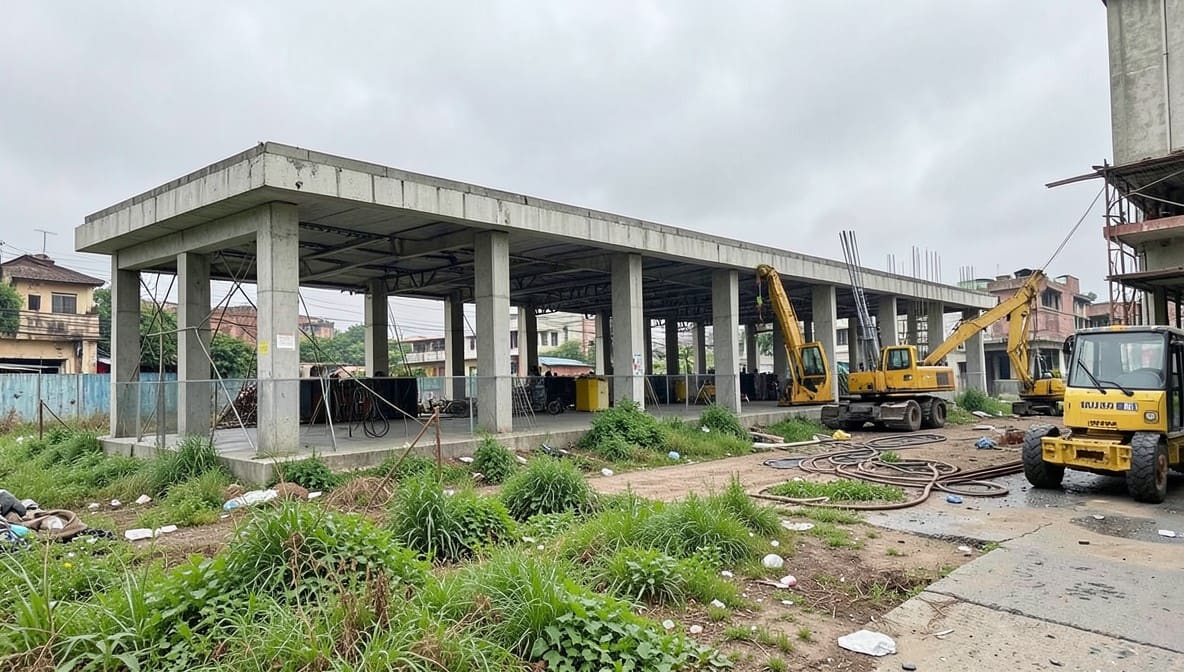
The Calcutta High Court has affirmed that municipal bodies cannot evade contractual obligations by citing financial constraints or procedural delays. In a significant ruling, the Court held the Bongaon Municipality liable for multiple breaches of a public works contract, including failure to issue timely drawings, non-payment of running account bills, refusal to pay for supplementary work, and unjustified retention of earnest and security deposits. The judgment reinforces the principle that public entities are bound by the same contractual duties as private parties.
Background & Facts
The Dispute
The plaintiff, Narayan Kumar Infrastructure Private Limited, was awarded a contract by the Bongaon Municipality for the construction of a Bus Terminus along with a Commercial Market Complex and Residential Complex at Gandhipally, Ward No. 14. The contract arose from a tender floated by the Municipality on 21.11.2017 (Exhibit A). The plaintiff submitted a bid 0.20% below the tendered rate and was declared the lowest bidder. A work order was issued on 09.02.2018 (Exhibit B), fixing the commencement date as 16.02.2018 and the completion date as 15.02.2019, within a 365-day period.
Key Facts
- The contract comprised Conditions of Contract, Additional Conditions, Bill of Quantities, and Special Terms and Conditions (Exhibit C).
- The plaintiff deposited an Earnest Money Deposit (EMD) of Rs. 41,13,041/- on 21.11.2017 (Exhibit A).
- From Running Account Bills (RABs) Nos. 1 to 8, the Municipality deducted a Security Deposit of Rs. 45,59,116/- (Exhibit K).
- The plaintiff submitted the 9th RAB on 17.12.2019 (Exhibit N), claiming Rs. 39,09,330.24 for work executed up to 30.09.2019.
- The plaintiff executed supplementary work valued at Rs. 62,18,386.84 (Exhibit O), including Pile Cap Casting not listed in the Bill of Quantities.
- The plaintiff repeatedly requested drawings, reference points, and approvals via letters and emails dated 02.04.2018, 05.09.2018, 23.11.2018, 11.12.2018, 05.02.2019, 08.02.2019, 13.02.2019, 14.02.2019, 11.03.2019, and 27.04.2019 (Exhibits E, F, J).
- The Municipality failed to provide critical drawings, reference points, and approvals, causing repeated delays.
- On 11.07.2019, the plaintiff requested payment of the 7th RAB and cessation of work due to non-payment (Exhibit H).
- On 07.05.2020, the plaintiff discovered the Municipality had sanctioned a fish market on the same site, leading to pilferage of materials and occupation by roadside vendors.
- On 29.08.2020, the Municipality admitted non-payment due to Covid-19 funds shortage but demanded resumption of work.
- The plaintiff filed a pre-institution mediation request on 11.09.2023, which ended in a non-starter report.
- The writ of summons was served on the Municipality on 02.02.2024 and received on 10.02.2024.
- The Municipality did not enter appearance; the suit was declared undefended on 25.06.2024.
Procedural History
- 21.11.2017: Tender floated by Bongaon Municipality.
- 09.02.2018: Work order issued; commencement date fixed as 16.02.2018.
- 02.04.2018 to 27.04.2019: Repeated correspondence by plaintiff for drawings and approvals.
- 17.12.2019: 9th Running Account Bill submitted.
- 24.02.2020 to 26.07.2021: Repeated reminders for payment of 9th RAB and supplementary work.
- 07.05.2020: Discovery of fish market sanction on project site.
- 29.08.2020: Municipality’s letter admitting non-payment due to funds and demanding resumption.
- 11.09.2023: Pre-institution mediation failed; non-starter report issued.
- 02.02.2024: Service of summons.
- 25.06.2024: Suit declared undefended.
- 30.04.2026: Judgment delivered.
The Parties' Positions
Plaintiff: Argued that the Municipality materially breached the contract by failing to provide drawings, delaying payments, refusing to pay for supplementary work, and withholding deposits. Claimed Rs. 1,87,99,874.08 in dues and Rs. 2,77,73,825.24 in consequential losses.
Defendant: Did not appear, file written statement, or contest any claim. No evidence or submissions were made.
Relief Sought
The plaintiff sought:
- Payment of Rs. 39,09,330.24 for the 9th Running Account Bill.
- Payment of Rs. 62,18,386.84 for supplementary work.
- Refund of Rs. 45,59,116/- security deposit.
- Refund of Rs. 41,13,041/- earnest money deposit.
- Compensation of Rs. 73,86,535/- for losses due to site stagnation.
- Interest at 18% per annum on all amounts from the date of filing.
The Legal Issue
The central question was whether a municipal body, having accepted a contract and received performance, can avoid liability for non-payment of running account bills, refusal to pay for supplementary work, and retention of security and earnest deposits merely by remaining silent and failing to appear in court.
Arguments Presented
For the Plaintiff
The plaintiff relied on the express terms of the contract, particularly Clauses 7 and 8 of the Conditions of Contract, which mandated monthly submission of bills and timely payment by the Municipality. It cited Clause 28, which permits payment for supplementary work when directed by the Engineer-in-Charge. The plaintiff demonstrated that all bills were submitted, no disputes were raised, and no objections were filed. It relied on State of U.P. v. Krishna Industries to argue that silence in the face of contractual obligations constitutes acquiescence. The plaintiff also cited M/s. R.K. Builders v. Municipal Corporation of Delhi to establish that retention of deposits without forfeiture clause is unlawful.
For the Respondent
The defendant did not appear, file any written statement, or present any argument. No counter-evidence or legal submissions were made.
The Court's Analysis
The Court examined the contractual framework, the plaintiff’s evidence, and the defendant’s complete absence. It noted that the plaintiff had submitted the 9th Running Account Bill on 17.12.2019, and despite repeated reminders until 26.07.2021, the Municipality neither disputed the bill nor made payment. Under Clause 8, the Engineer-in-Charge was required to verify the bill within ten days; no such verification was contested, and no objection was raised. The Court held that silence in the face of a contractual obligation, particularly when the bill is submitted and no dispute is raised, constitutes acceptance.
"The defendant, by its inaction, has not merely failed to discharge its obligations but has effectively acquiesced to the plaintiff’s claims. The absence of any dispute, objection, or counter-claim after repeated notices is fatal to the defendant’s position."
Regarding supplementary work, the Court found that the Pile Cap Casting was not in the Bill of Quantities but was executed under the direction of the Municipality’s officials. Clause 28 permits such work and mandates payment based on P.W.D. schedules or market rates. The plaintiff submitted a detailed abstract (Exhibit O) and followed up with correspondence. The Municipality’s silence amounted to acceptance.
The Court further held that the retention of the security deposit (Rs. 45,59,116/-) and earnest money (Rs. 41,13,041/-) was unlawful. The contract contained no clause permitting forfeiture upon termination, and the Municipality did not allege any default by the plaintiff. The Court cited Union of India v. M/s. R.K. Dass to affirm that deposits must be refunded unless expressly forfeited.
The plaintiff’s claim for Rs. 73,86,535/- in consequential losses was rejected for lack of precise quantification and documentary corroboration. The Court emphasized that while losses due to delay are compensable, speculative claims without supporting evidence cannot be sustained.
The Verdict
The plaintiff succeeded on claims 1, 2, and 3. The Court directed the Bongaon Municipality to pay Rs. 1,87,99,874.08 to the plaintiff, comprising Rs. 39,09,330.24 for the 9th Running Account Bill, Rs. 62,18,386.84 for supplementary work, Rs. 45,59,116/- for the security deposit, and Rs. 41,13,041/- for the earnest money deposit. The plaintiff is entitled to interest at 10% per annum from the date of filing of the suit (08.01.2023) until realization. Claim 4 for Rs. 73,86,535/- in consequential losses was dismissed. The suit is disposed of with costs.
What This Means For Similar Cases
Municipal Bodies Cannot Remain Silent on Contractual Obligations
- Practitioners must assert that silence in response to contractual bills or requests constitutes acceptance under Section 10 of the Indian Contract Act, 1872.
- Public authorities cannot evade liability by ignoring notices or failing to appear in court.
- In undefended suits, courts will rely on documentary evidence and contractual terms to determine liability.
Supplementary Work Must Be Paid Even Without Formal Orders
- If supplementary work is executed under the direction of the Engineer-in-Charge and documented, payment is enforceable under Clause 28 of standard public works contracts.
- The absence of a written order does not negate liability if the work was performed at the authority’s behest and accepted by conduct.
- Maintain detailed records of all verbal instructions, emails, and site communications.
Security and Earnest Deposits Are Not Forfeited Absent Express Clause
- Public bodies cannot retain security or earnest deposits unless the contract explicitly provides for forfeiture upon default.
- The burden lies on the authority to prove default; mere termination of contract does not justify retention.
- Always demand refund of deposits in writing upon contract termination, citing absence of forfeiture clause.