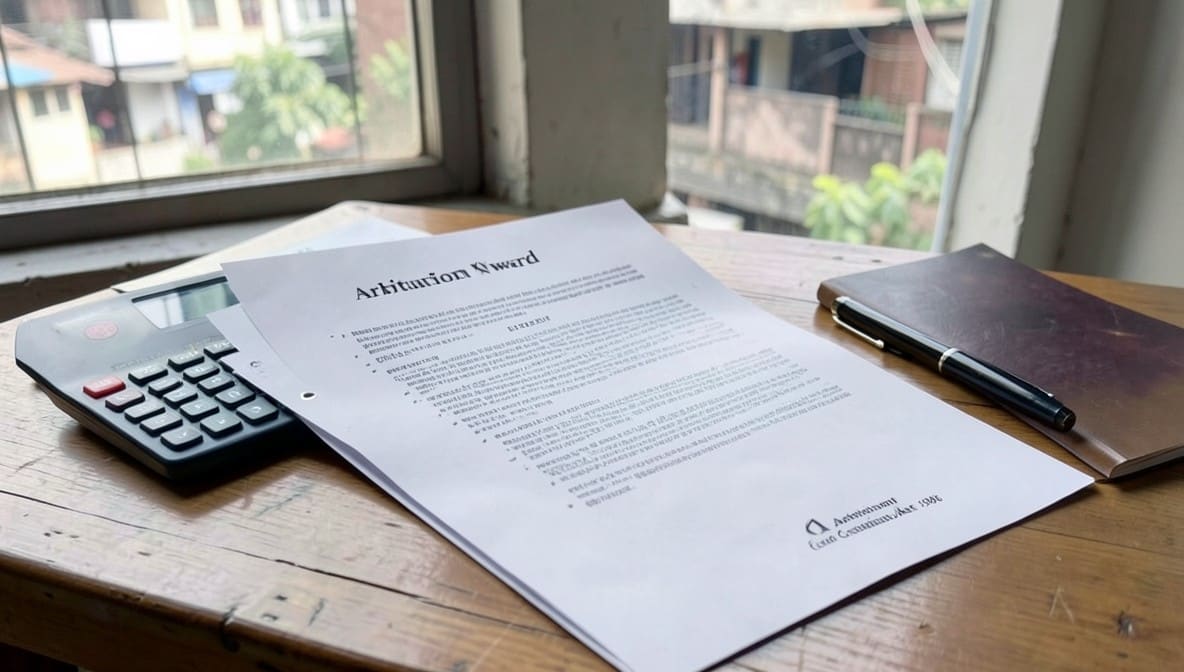
The Calcutta High Court has clarified that allegations of arbitrator bias, even when supported by public records of social engagements, do not constitute fraud under Section 36(3) of the Arbitration and Conciliation Act, 1996, unless the conduct meets the stringent threshold of evident deception affecting the award’s making. This ruling reinforces the narrow scope of Section 36(2) applications and underscores the statutory exclusivity of fraud and corruption as grounds for unconditional stay.
Background & Facts
The Dispute
The dispute arose between the West Bengal Industrial Development Corporation Limited (WBIDC), the award debtor, and Tata Motors Limited, the award holder, concerning the allotment of land for a car manufacturing unit. WBIDC provided land to Tata Motors under a lease deed dated 15.03.2007. Disagreements over indemnification claims triggered arbitration proceedings before a three-member arbitral tribunal.
Key Facts
- The arbitration commenced on 07.05.2019 and concluded with the arbitral award dated 30.10.2023.
- The award, Annexure-A, directed WBIDC to pay Tata Motors Rs. 765.78 crores, plus 11% per annum interest from the date of default.
- The award was unanimous, with one arbitrator nominated by WBIDC.
- WBIDC alleged that the presiding arbitrator, while serving on the tribunal, attended at least seven public events between 24.06.2020 and 15.03.2023 where Tata Motors’ new car models were launched.
- These events were organized by Tata Motors’ dealers, not Tata Motors itself.
- Photographs and news articles documenting the arbitrator’s attendance were published on public websites and became accessible to WBIDC as early as January 2020.
- WBIDC did not raise any objection to the arbitrator’s conduct during the arbitration proceedings under Section 13(1) of the Arbitration Act.
- The presiding arbitrator had made a declaration at the commencement meeting on 07.05.2019 that he had no interest or relationship with either party.
- WBIDC filed an application under Section 34 of the Arbitration Act to set aside the award on 15.11.2023.
- Simultaneously, on 12.06.2024, WBIDC filed the present application under Section 36(2) seeking unconditional stay of the award.
- On 09.04.2024, WBIDC filed a supplementary affidavit alleging that Tata Motors removed a press release from its website on 08.04.2024, thereby destroying evidence.
Procedural History
- 07.05.2019: Arbitration proceedings commenced.
- 24.06.2020 to 15.03.2023: Seven alleged events attended by the presiding arbitrator.
- 30.10.2023: Final arbitral award issued in favor of Tata Motors.
- 12.06.2024: Section 36(2) application filed by WBIDC seeking unconditional stay.
- 15.11.2023: Section 34 application filed to set aside the award.
- 19.06.2025: Calcutta High Court dismissed WBIDC’s application (GA 01 of 2025) to implead the arbitrator.
- 08.08.2025: Supreme Court dismissed WBIDC’s SLP against the dismissal order.
- 28.08.2025: Oral arguments concluded.
- 29.01.2026: Judgment reserved.
- 07.05.2026: Judgment delivered.
The Parties' Positions
WBIDC (Applicant/Award Debtor): Alleged that the presiding arbitrator’s repeated attendance at Tata Motors’ car launch events, without disclosure, constituted fraud under Section 36(3) of the Arbitration Act. Argued that bias is an element of fraud and that the award was tainted by partiality. Also claimed patent illegality in the award’s reasoning, including rejection of its Rs. 260 crore counter-claim in a single sentence without reasons.
Tata Motors (Respondent/Award Holder): Contended that the alleged events were public, dealer-organized functions unrelated to the arbitration. Asserted that WBIDC had access to the materials since 2020 and failed to challenge the arbitrator under Section 13(1). Argued that bias is not fraud under Section 36(3), and that the Fifth and Seventh Schedules are exhaustive. Stated that the application was a dilatory tactic to delay payment of a valid award.
Relief Sought
WBIDC sought:
- Unconditional stay of the arbitral award dated 30.10.2023.
- Injunction restraining Tata Motors from enforcing the award.
- Costs of the application.
The Legal Issue
The central question was whether the alleged conduct of the presiding arbitrator - attending public car launch events without disclosure - constitutes fraud within the meaning of the second proviso to Section 36(3) of the Arbitration and Conciliation Act, 1996, thereby mandating an unconditional stay of the award.
Arguments Presented
For the Appellant/Petitioner
WBIDC, through Mr. Kishore Datta, Senior Advocate, argued that:
- Bias, though not explicitly mentioned in Section 36(3), is an inherent element of fraud.
- The arbitrator’s failure to disclose seven public appearances during the arbitration violated Section 12(2) and created a justifiable doubt about impartiality.
- The non-disclosure, coupled with the arbitrator’s prior declaration of neutrality, amounted to fraudulent concealment.
- The award was patently illegal due to the tribunal’s failure to address the counter-claim and reliance on unverified SAP entries.
- Relied on Lifestyle Equities C.V. v. Amazon Technologies Inc. (2025 SCC OnLine SC 2153) to argue that courts may grant unconditional stay in exceptional cases beyond fraud or corruption.
- Invoked Bhadra International v. Airports Authority of India (2026 SCC OnLine SC 7) to assert that ineligibility can be raised at any stage.
For the Respondent/State
Tata Motors, through Mr. Sudipto Sarkar, Senior Advocate, countered that:
- The second proviso to Section 36(3) permits unconditional stay only if fraud or corruption is plainly evident on the face of the record.
- Bias is not fraud under the Arbitration Act; the Fifth and Seventh Schedules are exhaustive and do not include attendance at public events.
- WBIDC had access to the news articles since 2020 and failed to challenge the arbitrator under Section 13(1), thereby waiving its right.
- The alleged events were organized by dealers, not Tata Motors, and did not create a conflict of interest.
- The Lifestyle Equities judgment was distinguishable as it concerned a trademark decree under CPC, not Section 36 of the Arbitration Act.
- The rejection of the counter-claim in one sentence is a merits issue, only reviewable under Section 34, not Section 36.
- Relied on Voestalpine Schienen v. Delhi Metro Rail Corp. (2017) and Chennai Metro Rail v. Transtonnels Troy Afcons (2023) to argue that statutory grounds for disqualification are exclusive.
The Court's Analysis
The Court undertook a rigorous statutory interpretation of Section 36(3) and its second proviso, introduced by the 2021 amendment with retrospective effect from 23.10.2015. It emphasized that the proviso creates a narrow, exceptional exception to the general rule that an arbitral award is enforceable pending Section 34 challenge.
"The expression 'fraud' has not been defined under the Arbitration Act. Fraud, in its plain meaning, is an act with the potential to vitiate and undo all subsequent incidents which had occurred as a result of practicing of fraud. Fraud unravels the layers of cover concealing of truth. Fraud must be and clearly should be apparent on the face of the record, so that the Court is not required to go for a deeper enquiry into the depth of the facts presented."
The Court held that the alleged conduct - attendance at public car launches organized by dealers - did not meet this threshold. The materials were publicly accessible, and WBIDC had knowledge of them during the arbitration. The failure to raise an objection under Section 13(1) within 15 days of acquiring knowledge constituted a waiver under Section 4 of the Act.
The Court further examined the Fifth and Seventh Schedules to the Arbitration Act and concluded that none of the enumerated grounds for disqualification or justifiable doubt included attendance at public events. The Court rejected the argument that bias equates to fraud, noting that the legislature deliberately confined the scope of unconditional stay to fraud and corruption, excluding bias.
"The scope of enquiry under Section 36(2) is extremely narrow. The Court cannot go for a deeper and detailed enquiry. Accordingly, the ratio of the judgments rendered under Section 34 of the Arbitration Act would not apply in the facts and circumstances of the instant case."
The Court also dismissed the claim of patent illegality in the award’s reasoning as a merits issue beyond the purview of Section 36(2). It held that Lifestyle Equities was inapplicable because it concerned a CPC stay application, not an arbitral award under Section 36, and did not consider the 2021 amendment.
The Court acknowledged the public interest in preserving the integrity of arbitration but stressed that statutory boundaries must be respected. It found no exceptional case warranting an unconditional stay, as the conduct alleged did not rise to the level of fraud or corruption.
The Verdict
The application under Section 36(2) was dismissed. The Court held that no prima facie case of fraud or corruption was made out under the second proviso to Section 36(3). However, in exercise of its discretion under the first proviso to Section 36(3), the Court granted a conditional stay of the award dated 30.10.2023. WBIDC must, within eight weeks:
- File an undertaking by affidavit through its managing director or chairman, detailing immovable properties free of encumbrances sufficient to cover the entire awarded sum of Rs. 765.78 crores plus interest.
- If the immovable property is insufficient, deposit the balance amount in cash with the Registrar, Original Side.
- The security shall be held in an interest-bearing fixed deposit with the State Bank of India.
Failure to comply within eight weeks will result in automatic vacation of the stay. Costs of Rs. 50,000 are imposed on WBIDC to be paid to the West Bengal State Legal Services Authority within four weeks.
What This Means For Similar Cases
Bias Alone Cannot Trigger Unconditional Stay
- Practitioners must now distinguish between procedural challenges under Section 13 (for arbitrator bias) and statutory grounds for unconditional stay under Section 36(3).
- Allegations of arbitrator bias, even if substantiated by public records, cannot be converted into fraud to bypass the deposit requirement.
- A party must raise objections under Section 13(1) within 15 days of acquiring knowledge; failure constitutes waiver.
Statutory Framework Is Exhaustive
- The Fifth and Seventh Schedules to the Arbitration Act are exhaustive lists of grounds for disqualification and justifiable doubt.
- Courts cannot expand these grounds by judicial inference, even if conduct appears ethically questionable.
- Non-disclosure of non-schedule events does not, by itself, constitute fraud under Section 36(3).
Section 36 Applications Are Narrowly Construed
- Section 36(2) applications are not mini Section 34 proceedings; courts must not delve into merits, reasoning, or evidentiary disputes.
- The burden to prove fraud under the second proviso is high: it must be plain, indefensible, and apparent on the face of the record.
- Courts may grant conditional stay under the first proviso, but only if the security mechanism (cash or immovable property) fully covers the award amount.
Exceptional Cases Require Clear Legal Basis
- The Lifestyle Equities precedent does not permit courts to grant unconditional stay based on general notions of fairness.
- Exceptional circumstances must arise from statutory fraud or corruption, not from perceived procedural unfairness.
- Government entities are not entitled to special treatment; the same deposit and security rules apply.