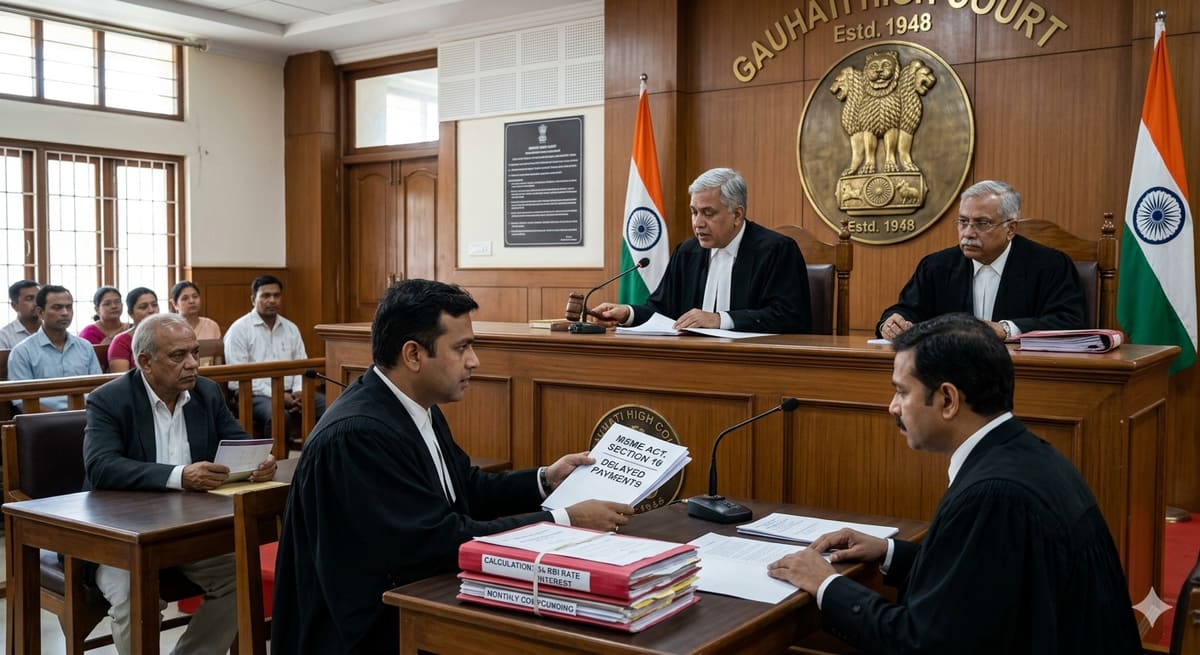
The Calcutta High Court has reaffirmed that banks cannot classify borrower accounts as fraud based on forensic audit reports already judicially quashed or on decisions taken in undisclosed Joint Lenders Meetings, thereby violating the fundamental principles of natural justice. This judgment sets a critical precedent for procedural fairness in banking enforcement actions under RBI guidelines.
Background & Facts
The Dispute
The petitioners, Vishambhar Saran and Vikas Agarwal, are promoter directors of M/s Visa Power Limited (In Liquidation), a company that availed a consortium loan from Punjab National Bank (PNB) and other lenders in March 2010 for a thermal power project in Raigarh, Chhattisgarh. The project collapsed after the Central Government cancelled the company’s coal block allocation pursuant to the Supreme Court’s order in September 2014. This led to suspension of fund disbursements by the consortium, resulting in the company’s account being classified as a Non-Performing Asset on 31.03.2016.
Key Facts
The loan was sanctioned in March 2010 for a thermal power project.
Coal block cancellation occurred in September 2014, halting project progress.
Account declared NPA on 31.03.2016.
Bank of Maharashtra initiated CIRP under IBC in 2017; NCLT admitted the petition on 15.07.2017.
NCLT ordered liquidation on 11.10.2018 and appointed a Liquidator.
Liquidator commissioned M/s Deloitte Touche Tohmatsu India LLP (DTTILLP) to conduct a Forensic Audit covering two years prior to CIRP admission.
DTTILLP’s Transaction Audit Report (dated 24.08.2018) alleged fraudulent, preferential, and undervalued transactions.
NCLT, by order dated 25.07.2019, held that the audit report did not prove any fraudulent, preferential, or undervalued transaction.
NCLAT affirmed the NCLT order on 30.09.2019.
PNB withdrew Wilful Defaulter proceedings against the petitioners on 09.11.2022, explicitly acknowledging the finality of the NCLT and NCLAT orders.
CBI registered FIR on 18.08.2023 based on the same audit report; Calcutta HC quashed the FIR on 17.11.2023.
Central Bank of India initiated Wilful Defaulter proceedings based on the same report; Calcutta HC quashed them on 14.05.2024.
RBI issued new Master Directions on Fraud Risk Management dated 15.07.2024, superseding the 2016 version.
PNB issued a show cause notice on 25.10.2023, relying on the quashed DTTILLP report.
PNB reported the account as fraud to RBI on 16.07.2024 (FMR No. PNB2403-0361), informing petitioners only on 09.08.2024.
The fraud classification was based on a Joint Lenders Meeting (JLM) attended by 60% of consortium lenders, whose proceedings were never shared with the petitioners.
Procedural History
15.07.2017: NCLT admitted CIRP application filed by Bank of Maharashtra.
11.10.2018: NCLT ordered liquidation of M/s Visa Power Limited.
24.08.2018: DTTILLP submitted Transaction Audit Report.
25.07.2019: NCLT rejected Liquidator’s plea that transactions were fraudulent, preferential, or undervalued.
30.09.2019: NCLAT upheld NCLT’s order.
02.07.2020: PNB issued first show cause notice for Wilful Defaulter status.
09.11.2022: PNB withdrew Wilful Defaulter proceedings, accepting finality of NCLT/NCLAT orders.
18.06.2021: PNB filed CBI complaint based on DTTILLP report.
17.11.2023: Calcutta HC quashed CBI complaint.
14.05.2024: Calcutta HC quashed Central Bank of India’s Wilful Defaulter proceedings.
25.10.2023: PNB issued second show cause notice (impugned) relying on same DTTILLP report.
16.07.2024: PNB reported account as fraud to RBI.
09.08.2024: PNB communicated fraud classification to petitioners.
07.05.2026: Calcutta HC delivered judgment.
The Parties' Positions
Petitioners (Vishambhar Saran & Vikas Agarwal): Argued that the DTTILLP report was judicially quashed, the Wilful Defaulter proceedings were withdrawn on record, and the JLM decisions were never disclosed to them. They contended that the show cause notice and fraud classification violated audi alteram partem and were contrary to State Bank of India v. Rajesh Agarwal and State Bank of India v. Amit Iron Private Limited.
Respondent (Punjab National Bank): Contended that the fraud classification was based on the DTTILLP report, non-compliance with loan terms, and majority consent from JLM. Argued that the petitioners had opportunity to respond and that the CBI FIR corroborated fraud.
Relief Sought
The petitioners sought quashing of the show cause notice dated 25.10.2023 and the fraud classification order dated 09.08.2024, along with directions to delete the fraud classification from RBI records and prevent future action based on the quashed audit report.
The Legal Issue
The central question was whether a bank can classify a borrower’s account as fraud under RBI Master Directions based on a forensic audit report already rejected by NCLT and NCLAT, and on decisions taken in a Joint Lenders Meeting whose proceedings were never disclosed to the borrower, thereby denying the principles of natural justice.
Arguments Presented
For the Petitioner
Mr. Sabyasachi Chowdhury, Senior Advocate, submitted that the DTTILLP report was explicitly rejected by NCLT on 25.07.2019 and affirmed by NCLAT on 30.09.2019. PNB itself withdrew Wilful Defaulter proceedings on 09.11.2022, acknowledging the finality of these orders. The JLM meeting, which formed the basis of the fraud classification, was never communicated to the petitioners. No point-wise reply was sought or considered. The bank’s reliance on the CBI FIR was impermissible as it was not referenced in the show cause notice or the impugned order. The Supreme Court in State Bank of India v. Rajesh Agarwal (2023) 6 SCC 1 and State Bank of India v. Amit Iron Private Limited (2026 SCC OnLine SC 538) mandates that borrowers must be given notice, access to evidence, and a meaningful opportunity to respond before classification as fraud.
For the Respondent
Ms. Parna Roy Choudhury argued that the bank had issued a show cause notice, received a reply, and acted after considering the JLM’s majority view. She contended that the DTTILLP report, though previously rejected in CIRP, still contained indicia of fraud warranting further scrutiny. She relied on the CBI FIR as corroborative evidence and asserted that the 2024 Master Directions permitted classification based on consortium consensus.
The Court's Analysis
The Court meticulously examined the procedural sequence and found that the bank’s actions were fundamentally flawed. The NCLT’s order dated 25.07.2019 was not merely a rejection of the audit report’s conclusions in the context of CIRP - it was a judicial determination that the report, on its own, failed to establish fraud, preferential, or undervalued transactions. The NCLAT’s affirmation rendered this finding final. The bank’s own withdrawal of Wilful Defaulter proceedings on 09.11.2022 was a clear admission that the report could not sustain a fraud finding.
"Audi alteram partem, therefore, entails that an entity against whom evidence is collected must: (i) be provided an opportunity to explain the evidence against it; (ii) be informed of the proposed action, and (iii) be allowed to represent why the proposed action should not be taken."
The Court emphasized that the JLM’s decision, which formed the sole basis for the fraud classification in the impugned order, was never disclosed to the petitioners. No minutes, no voting records, no rationale were shared. The petitioners were not given an opportunity to challenge the views of other lenders. This violated the explicit mandate in Rajesh Agarwal and Clause 4.1.4 of the 2024 Master Directions.
The Court further noted that the bank’s reliance on the CBI FIR was impermissible because it was not part of the show cause notice or the decision-making record. The principle of nemo judex in causa sua was breached: the bank used a criminal complaint, which was itself quashed, to justify a civil classification.
The Court held that the bank’s conduct amounted to procedural arbitrariness. The show cause notice and the fraud classification order were not based on independent, fresh evidence but on a discredited report and undisclosed consortium decisions. The absence of any reasoned findings in the impugned order further compounded the violation.
The Verdict
The Calcutta High Court set aside the show cause notice dated 25.10.2023 and the fraud classification order dated 09.08.2024. The bank’s report of the account as fraud to the Reserve Bank of India on 16.07.2024 (FMR No. PNB2403-0361) is quashed. The bank is directed to delete the fraud classification from all internal and external records, including RBI systems, within four weeks. The petitioners’ names are restored to their prior status. The bank may initiate fresh proceedings only if it obtains independent, verifiable documentary evidence and complies fully with audi alteram partem as mandated by Rajesh Agarwal and the 2024 Master Directions.
What This Means For Similar Cases
Natural Justice Is Non-Negotiable in Fraud Classification
Banks must serve borrowers with full copies of all forensic audit reports, JLM minutes, and voting records before classification.
A borrower’s reply must be addressed point-by-point; generic rejections are invalid.
Reliance on quashed or judicially rejected reports as primary evidence renders classification void.
Consortium Consensus Cannot Override Individual Due Process
A 60% majority vote in a JLM cannot substitute individualized notice and hearing.
Banks cannot use JLM outcomes as a backdoor to bypass Rajesh Agarwal’s procedural safeguards.
Each lender must independently apply its mind; collective decisions without transparency are unlawful.
Quashed Evidence Cannot Be Revived Through Administrative Channels
A forensic audit report rejected by NCLT/NCLAT cannot be resurrected for fraud classification.
Withdrawal of Wilful Defaulter proceedings based on judicial findings binds the bank from re-litigating the same allegations.
CBI FIRs cannot be retroactively inserted into administrative proceedings to validate prior procedural defects.