The Allahabad High Court has reaffirmed that a candidate’s candidature for public employment cannot be rejected solely on the basis of a pending criminal case, absent a reasoned application of mind by the District Magistrate as mandated by statutory guidelines. This judgment clarifies the limits of character verification in government appointments and reinforces procedural fairness.
Background & Facts
The Dispute
The applicant, Vipin Kumar Kureel, applied for the post of Lecturer (Civil Engineering) pursuant to Advertisement No. 1/2014-15 issued by the Public Service Commission on 16.05.2014. He successfully cleared the selection process and was included in the merit list. As part of the appointment procedure, he submitted a self-attestation form on 25.04.2015, declaring in the criminal history column: "NO". The final selection list was published on 24.06.2020. Subsequently, the Department initiated character verification of selected candidates, including the applicant, by writing to the District Magistrate, Agra on 17.09.2021. The District Magistrate, relying solely on a police report dated 23.10.2021, issued a verification report stating that a case under Sections 498A, 322B/504/506 IPC and Sections 3/4 of the Dowry Prohibition Act (Crime No. 900 of 2019) was registered against the applicant. Based on this report, the State Government passed an order on 24.12.2020 rejecting his candidature.
Key Facts
- The applicant submitted his self-attestation form on 25.04.2015, declaring no criminal history.
- The criminal case (Crime No. 900 of 2019) was registered on an unknown date prior to 17.09.2021, but after the applicant’s application.
- The case arose from a domestic dispute between husband and wife, with no allegation of public misconduct or moral turpitude.
- The District Magistrate’s report did not independently evaluate the nature of the case, its outcome, or the applicant’s conduct; it merely reproduced the police report.
- The applicant was never given an opportunity to explain or respond to the allegations before the rejection.
- The State Government’s rejection order dated 24.12.2020 was based entirely on the flawed verification report.
Procedural History
- 16.05.2014: Public Service Commission issued advertisement for Lecturer (Civil Engineering).
- 25.04.2015: Applicant submitted self-attestation form with "NO" in criminal history column.
- 24.06.2020: Merit list published; applicant selected.
- 17.09.2021: Department requested character verification from District Magistrate, Agra.
- 23.10.2021: Superintendent of Police, Agra submitted report to District Magistrate.
- Unknown date (prior to 24.12.2020): District Magistrate issued verification report based solely on police input.
- 24.12.2020: State Government rejected applicant’s candidature.
- 07.02.2022: Writ Petition No. 757 of 2022 filed before Allahabad High Court.
- 06.02.2024: High Court allowed the writ petition, quashed the rejection order, and directed fresh verification under Government Order 1958.
- 21.03.2024: Applicant filed representation seeking reconsideration.
- 09.10.2024: District Magistrate, Agra passed order on applicant’s representation (Annexure No. 2 to compliance affidavit).
- 14.05.2026: Contempt application dismissed as compliance was complete.
The Parties' Positions
Applicant’s Position: The applicant argued that the District Magistrate failed to follow the mandatory procedure under Government Order dated 28.04.1958, which requires an independent assessment of character, not mere transmission of police reports. He contended that the criminal case was not known to him at the time of application, and even if known, it arose from a private family dispute without moral turpitude. He relied on Shivendra Kumar Paswan v. State of U.P. and Avtar Singh v. Union of India to argue that suppression or false declaration requires knowledge and intent, neither of which existed here.
Respondent’s Position: The State, through the Standing Counsel, defended the rejection on the ground that a criminal case was registered against the applicant and that the District Magistrate had discharged his duty by obtaining the police report. The respondent did not dispute the legal principles laid down in Mooni v. State of U.P. but argued that the report was sufficient to justify the decision.
Relief Sought
The applicant sought quashing of the State Government’s order dated 24.12.2020 and a direction for fresh character verification in accordance with Government Order 28.04.1958 and the principles in Avtar Singh. He also sought reinstatement in the selection process.
The Legal Issue
The central question was whether the District Magistrate’s reliance on a police report, without independent application of mind under Government Order dated 28.04.1958, constitutes a lawful basis for rejecting a candidate’s candidature for public employment, particularly when the criminal case arose after application and involves no allegation of moral turpitude.
Arguments Presented
For the Petitioner
The applicant relied on Mooni v. State of U.P. to argue that the District Magistrate must independently evaluate the nature of the criminal case, its relevance to public employment, and whether it reflects moral turpitude. He cited Avtar Singh v. Union of India to establish that a candidate cannot be penalized for non-disclosure of a fact unknown at the time of application. He emphasized that the criminal case was a domestic dispute under Section 498A IPC, which courts have repeatedly held does not per se indicate moral turpitude. He further argued that the absence of any opportunity to be heard violated principles of natural justice.
For the Respondent
The State contended that the District Magistrate had discharged his statutory duty by obtaining the police report and that the rejection was based on objective information. The respondent did not dispute the binding precedent of Mooni but argued that the report was sufficient to raise a legitimate concern about character. No independent legal argument was advanced to justify deviation from the 1958 Order.
The Court's Analysis
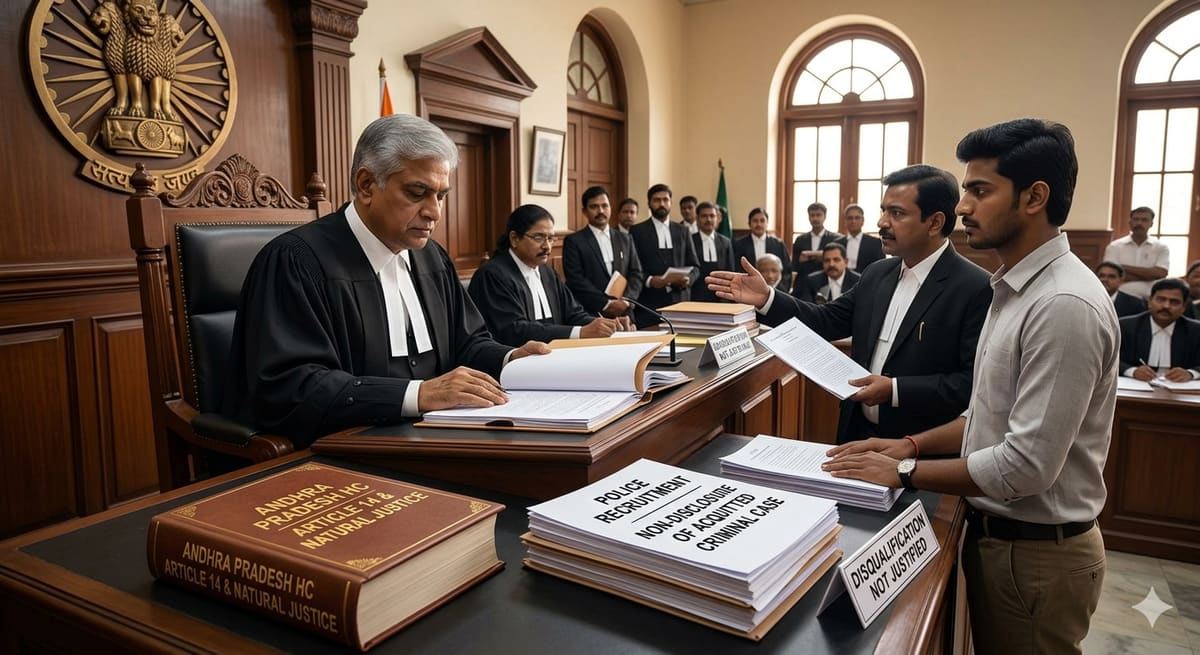
The Court began by affirming the binding precedent in Mooni v. State of U.P., which held that the District Magistrate cannot act as a mere conduit for police reports. The Government Order dated 28.04.1958 mandates an independent, reasoned assessment of character, including consideration of the nature of the offence, its outcome, and the candidate’s conduct.
"It is not open for the District Magistrate to just obtain report from the police and submit the same before the authority concerned."
The Court noted that the applicant had no knowledge of the criminal case at the time of submitting his self-attestation form on 25.04.2015. Citing Avtar Singh, the Court held that suppression or false declaration requires both knowledge and intent. Since the case was registered after application, there could be no suppression.
The Court further observed that the offence under Section 498A IPC, arising from a marital dispute, does not automatically amount to moral turpitude. The District Magistrate’s report failed to analyze the facts of the case, its status, or its relevance to the duties of a Lecturer. The Court emphasized that public employment cannot be denied on the basis of mere accusation, especially where no conviction or even charge sheet was produced.
The Court also referenced Beer Bahadur Singh v. State of U.P., reinforcing that mere involvement in a criminal case is insufficient to deny appointment. The State’s reliance on the police report alone was held to be legally unsustainable.
The Verdict
The writ petition was allowed and the State’s order dated 24.12.2020 was quashed. The Court directed fresh character verification by the District Magistrate in accordance with Government Order dated 28.04.1958 and the principles in Avtar Singh. The contempt application was dismissed as the District Magistrate had issued a fresh order on 09.10.2024 in compliance with the Court’s directions. The contempt notice was discharged.
What This Means For Similar Cases
Character Verification Must Be Independent, Not Mechanical
- Practitioners must challenge any rejection based solely on police reports or unanalyzed criminal case mentions.
- District Magistrates must record reasons for their conclusions, not merely forward police inputs.
- A pending criminal case, without conviction or evidence of moral turpitude, cannot be grounds for denial.
Knowledge Is Essential for Allegations of Suppression
- Candidates cannot be penalized for failing to disclose criminal cases unknown at the time of application.
- Self-attestation forms must be specific; if a question is not asked, non-disclosure cannot be treated as suppression.
- Employers must assess relevance objectively, not automatically assume unfitness due to criminal allegations.
Domestic Disputes Do Not Equate to Moral Turpitude
- Cases under Section 498A IPC, dowry harassment, or similar family disputes must be evaluated contextually.
- No automatic presumption of unfitness arises from such cases.
- Authorities must distinguish between private conduct and professional unfitness.