The Allahabad High Court has clarified that the mere pendency of a criminal case, where the candidate is a co-accused in a trivial domestic dispute and has fully disclosed the matter, cannot justify rejection for government service. This ruling reinforces the principle that employment decisions must be grounded in proportionality, disclosure compliance, and the nature of the alleged offence, not blanket stigma.
Background & Facts
The Dispute
The petitioner applied for the post of Junior Assistant under Advertisement No. 04/2016 issued by the U.P. Subordinate Services Selection Commission, which advertised 3,258 vacancies. He was declared successful, allotted to the Department of Cane and Sugar Commissioner, Uttar Pradesh, through the online Department Allotment System, and received a revised allotment letter dated 12.02.2019 (Annexure No. 4). However, his appointment was denied by an order dated 06.07.2020 (Annexure No. 1) solely on the ground that a criminal case was pending against him.
Key Facts
- A matrimonial dispute arose between the petitioner’s elder brother, Chandra Pal, and his wife, Kamini, leading to FIR No. 5467 of 2007 under Sections 498-A, 323, 504, 506 IPC and Section 3/4 of the Dowry Prohibition Act at Police Station Kotwali, Lakhimpur Kheri.
- The petitioner was named as a co-accused in the FIR, alongside other family members, but was not the main accused.
- The FIR contained general, sweeping allegations of dowry demand against the entire family, with no specific acts or roles attributed to the petitioner.
- The petitioner disclosed the pendency of this case in compliance with Clauses 15(9) and 15(14) of Advertisement No. 04/2016.
- The petitioner underwent medical examination on 12.02.2019 and was declared medically fit by the Chief Medical Officer, Lakhimpur Kheri, on 18.02.2019.
- No other adverse material or misconduct was found against the petitioner.
- The District Collector, Lakhimpur Kheri, sent a report dated 15.03.2019 confirming the pendency of the case, which formed the sole basis for denial.
- The petitioner’s representation dated 20.05.2020 (Annexure No. 1) was rejected without any individualized assessment of his role or the nature of the allegations.
Procedural History
- 12.02.2019: Medical examination ordered by respondent No. 2.
- 18.02.2019: Medical fitness report submitted and accepted.
- 06.07.2020: Appointment denied by order citing pending criminal case.
- 23.03.2026: Writ Petition No. 18090 of 2020 decided by the Allahabad High Court.
Relief Sought
The petitioner sought quashing of the order dated 06.07.2020 and a direction to issue the appointment letter forthwith, arguing that his candidature was rejected without application of mind and in violation of settled legal principles on disclosure and proportionality.
The Legal Issue
The central question was whether the mere pendency of a criminal case, where the candidate has truthfully disclosed the matter and is only a co-accused in a domestic dispute involving general allegations, constitutes a valid ground to deny appointment to a government post under Clause 15(9) and 15(14) of the advertisement.
Arguments Presented
For the Petitioner
The petitioner’s counsel argued that the criminal case was disclosed in full compliance with the advertisement’s verification clauses. The allegations were vague, non-specific, and arose from a family dispute with no direct link to the duties of a Junior Assistant. Reliance was placed on Avtar Singh v. Union of India to contend that trivial offences or co-accused status in domestic cases cannot justify automatic disqualification, especially where no conviction exists and medical fitness is established.
For the Respondent
The State, through the Standing Counsel, contended that the pendency of a criminal case under Sections 498-A and 506 IPC, even if the petitioner is a co-accused, reflects adversely on moral character and renders the candidate unsuitable for government service. It was argued that the employer has the discretion to reject candidature on grounds of criminal antecedents, regardless of disclosure.
The Court's Analysis
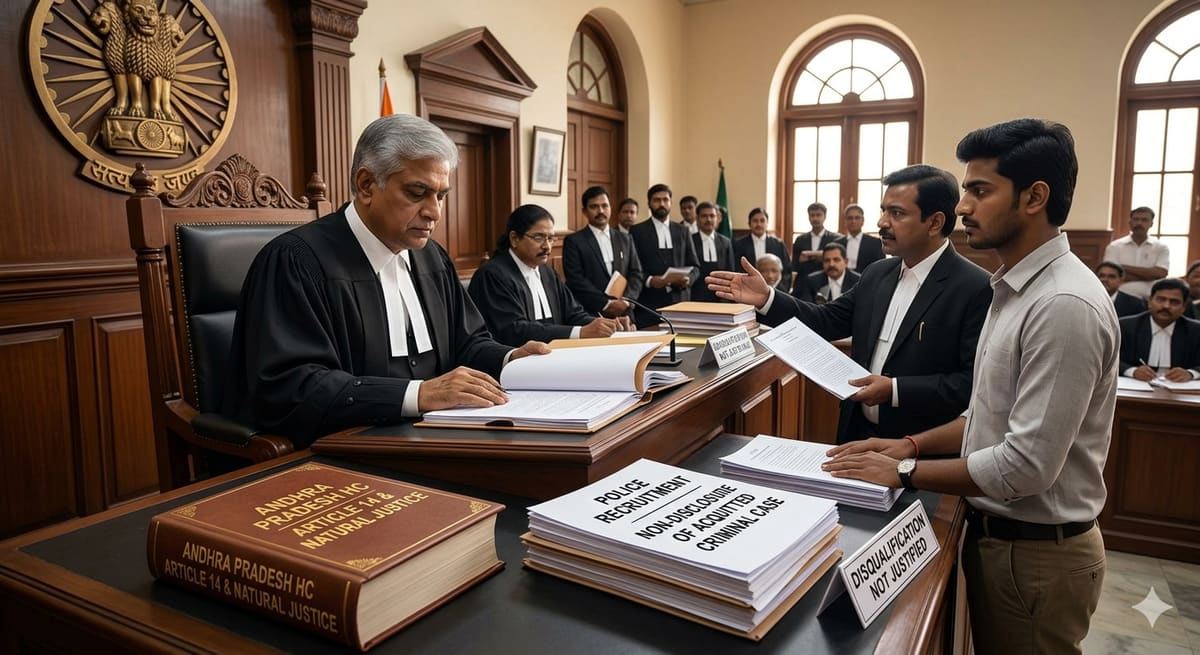
The Court examined the impugned order and found it to be based solely on the pendency of the criminal case, with no independent evaluation of the petitioner’s role, the nature of allegations, or the proportionality of the denial. The Court emphasized that truthful disclosure under the advertisement’s verification clauses negates any claim of suppression or false information.
"In case when fact has been truthfully declared in character verification form regarding pendency of a criminal case of trivial nature, employer, in facts and circumstances of the case, in its discretion, may appoint the candidate subject to decision of such case."
The Court noted that the FIR, while invoking serious sections, contained no specific allegations against the petitioner. The offences were part of a broader family dispute, typical of matrimonial conflicts, and did not involve moral turpitude or acts of corruption, violence, or abuse of official position. The Court drew upon Avtar Singh v. Union of India and referenced Commissioner of Police v. Sandeep Kumar to underscore that youthful indiscretions or minor offences arising from personal circumstances must not lead to lifelong disqualification.
The Court further observed that the principle of reformative justice, illustrated by the character Jean Valjean, demands that society and employers avoid branding individuals based on unproven allegations in non-serious cases. The denial of appointment, without any assessment of the petitioner’s conduct, character, or the likelihood of conviction, amounted to a violation of Article 14 and Article 16 of the Constitution.
The Court held that the employer’s discretion under Avtar Singh is not unfettered - it must be exercised reasonably, with due regard to the nature of the offence, the candidate’s role, and the relevance of the allegations to the job. Here, the denial was arbitrary and disproportionate.
The Verdict
The writ petition was allowed. The impugned order dated 06.07.2020 was quashed. Respondent No. 2 is directed to issue the appointment letter to the petitioner forthwith. However, such appointment shall be subject to the outcome of the criminal trial or appeal, if any.
What This Means For Similar Cases
Truthful Disclosure Shields Against Arbitrary Rejection
- Practitioners must argue that full disclosure under advertisement clauses negates grounds of suppression, even if a criminal case is pending.
- Employers cannot rely on blanket policies to reject candidates based on co-accused status in domestic cases without individualized assessment.
Triviality of Offence Overrides Formal Charges
- Cases involving Sections 498-A, 504, 506 IPC arising from family disputes, with no specific allegations against the candidate, should be treated as trivial under Avtar Singh.
- The nature of the offence - not the section invoked - determines suitability. Generalized dowry allegations without individual culpability do not equate to moral turpitude.
Proportionality Must Guide Recruitment Decisions
- Medical fitness, absence of prior misconduct, and relevance of the offence to the post must be weighed.
- Denial of appointment without a departmental inquiry or opportunity to explain is procedurally flawed and violates natural justice.
Appointment Is Conditional, Not Absolute
- While appointment must be issued, it remains subject to the outcome of the criminal case. This balances the candidate’s right to employment with the state’s interest in integrity.
No Automatic Stigma for Co-Accused
- Merely being named as a co-accused in a family dispute does not equate to criminal antecedents. The burden lies on the employer to prove the candidate’s personal involvement in serious misconduct.