The Allahabad High Court has delivered a significant ruling affirming that the pendency of criminal cases against a juvenile delinquent cannot serve as a ground to withhold a government appointment, especially where the investigation has concluded with a closure report and the individual was a minor at the time of the alleged offences. This judgment reinforces the legislative intent behind the Juvenile Justice Act to ensure social reintegration without stigma.
Background & Facts
The Dispute
The petitioner, a candidate who applied for the post of Multi-Tasking Staff (MTS) with the Employees’ State Insurance Corporation (ESIC), was shortlisted after successfully clearing both Phase-I and Phase-II examinations. He received an offer of appointment via email dated 09-07-2024 and submitted a duly filled attestation form on 18-07-2024, disclosing two pending criminal cases against him. Despite completing all formalities, the ESIC withheld issuance of the joining letter pending police verification, citing the criminal history as a bar to final appointment.
Key Facts
- ESIC issued recruitment advertisement on 28-12-2021 for MTS posts in Uttar Pradesh, with 119 vacancies
- Petitioner applied under the unreserved category and appeared in Phase-I and Phase-II examinations
- Phase-II examination was held on 05-06-2022 at Lucknow
- Petitioner was shortlisted on 10-06-2024 and called for document verification on 20-06-2024
- Offer of appointment issued on 09-07-2024; attestation form submitted on 18-07-2024
- Two criminal cases disclosed by petitioner:
- N.C.R. No. 93 of 2015 under Sections 323 & 504 IPC, Police Station Bhiti, Ambedkar Nagar
- F.I.R. No. 50 of 2020 under Sections 419, 420, 467, 468 & 471 IPC, Police Station Bhiti, Ambedkar Nagar
- On 20-12-2024, the petitioner was declared a juvenile delinquent in relation to N.C.R. No. 93 of 2015
- Final Report (Closure Report) No. 57 of 2022 was submitted in F.I.R. No. 50 of 2020; no order yet passed by trial court
- Other shortlisted candidates received joining letters; petitioner was not
- Petitioner submitted representations on 13-02-2025 and 18-08-2025; no final decision issued
Procedural History
- 28-12-2021: ESIC issued recruitment advertisement
- 15-02-2022: Last date for application submission
- 05-06-2022: Phase-II examination conducted
- 10-06-2024: Petitioner placed on additional shortlist
- 20-06-2024: Document verification completed
- 09-07-2024: Offer of appointment issued via email
- 18-07-2024: Petitioner submitted attestation form disclosing criminal cases
- 20-12-2024: Juvenile Justice Board declared petitioner a juvenile delinquent in N.C.R. No. 93 of 2015
- 13-02-2025: Petitioner received reply citing DoPT guidelines on police verification
- 18-08-2025: Petitioner filed representation; referred for legal opinion
- 12-12-2025: Writ Petition filed before Allahabad High Court
- 21-05-2026: Judgment delivered
The Parties' Positions
Petitioner: Argued that disclosure of criminal cases was transparent, no concealment, and that under the Juvenile Justice Act, 2000, a juvenile cannot suffer disqualification even if convicted. Further, the closure report in F.I.R. No. 50 of 2020 indicates no prima facie case, and delay in trial court’s decision cannot be used to deny livelihood.
Respondent (ESIC/Union of India): Contended that police verification is mandatory under DoPT guidelines, and disclosure of pending criminal cases justifies withholding appointment until clearance. Argued that the matter was under legal review and relief sought was premature.
Relief Sought
The petitioner sought a direction to the Regional Director, ESIC, Kanpur, to issue the joining letter for the post of MTS within a stipulated time, ignoring the pendency of the two criminal cases, and to treat him as appointed with all consequential benefits.
The Legal Issue
Can the pendency of criminal cases against a person declared a juvenile delinquent, along with the non-adjudication of a closure report by a trial court, constitute a valid ground to withhold a government appointment?
Arguments Presented
For the Petitioner
The petitioner relied on Section 19 of the Juvenile Justice (Care and Protection of Children) Act, 2000, which explicitly bars any disqualification arising from juvenile offences. He cited Union of India v. Ramesh Bishnoi (2019) 19 SCC 710, where the Supreme Court held that even a conviction of a juvenile cannot disqualify him from employment, as the law aims at reintegration without stigma. He further argued that the filing of a closure report in F.I.R. No. 50 of 2020 indicates the investigating agency found no prosecutable evidence, and the trial court’s delay cannot be used to penalize the petitioner. He emphasized that the right to livelihood under Article 21 cannot be suspended indefinitely due to unadjudicated allegations.
For the Respondent
The respondent relied on DoPT guidelines requiring police verification as a condition precedent to final appointment. They contended that disclosure of pending criminal cases, regardless of the petitioner’s age at the time of offence, triggers mandatory scrutiny. They argued that the matter was under legal review and no final order had been passed, making the petition premature. They did not dispute the juvenile status but maintained that procedural compliance must precede appointment.
The Court's Analysis
The Court undertook a detailed examination of the Juvenile Justice (Care and Protection of Children) Act, 2000, particularly Section 19, which states:
"Notwithstanding anything contained in any other law, a juvenile who has committed an offence and has been dealt with under the provisions of this Act shall not suffer disqualification, if any, attaching to a conviction of an offence under such law."
The Court emphasized that the legislative intent is not merely to shield juveniles from punishment, but to ensure their full social reintegration. It cited Union of India v. Ramesh Bishnoi, where the Supreme Court held that the principle of "fresh start" under Section 3(xiv) of the 2015 Act mandates erasure of past records, and that even if a juvenile is convicted, it cannot be used to deny employment.
The Court further noted that the petitioner was declared a juvenile delinquent on 20-12-2024 in relation to N.C.R. No. 93 of 2015, and that the offence under Sections 323 and 504 IPC is not of a grave nature. The Court held that the very requirement to disclose juvenile offences violates the right to privacy and reputation, as affirmed in Navodaya Vidyalaya Samiti v. Pundarikaksh Dev Pathak.
Regarding F.I.R. No. 50 of 2020, the Court observed that the Final Report (Closure Report No. 57 of 2022) had been submitted, indicating the investigating officer found no prosecutable evidence. The Court relied on State of Gujarat v. Surya Kant Chunilal Shah (1999) 1 SCC 529, holding that mere pendency of a case after closure report cannot be equated with guilt. The Court stated:
"The fate of a person, whose career is on stake, cannot be thrown to suffer for there being any material reason. Assuming, if the trial court accepts the final report at a belated stage, such accused person, must suffer irreparable loss and injury, which cannot be compensated by any means."
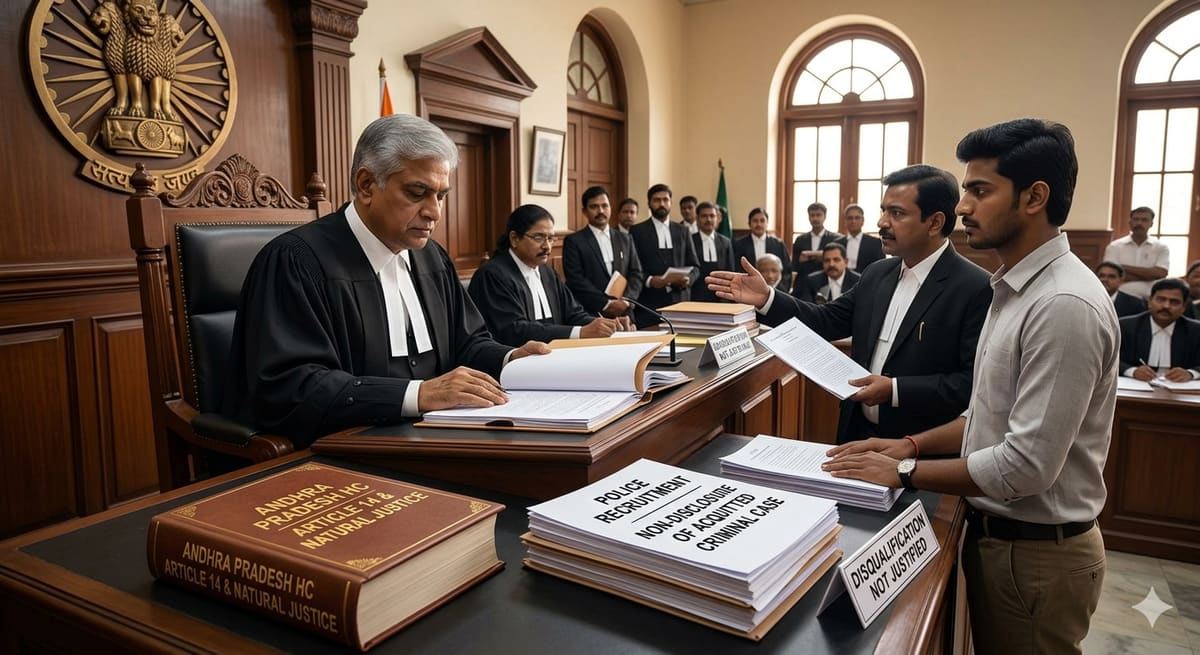
The Court rejected the argument that police verification is an absolute bar, noting that such procedures cannot override statutory protections granted to juveniles under the JJ Act. It held that the respondent’s inaction for over a year after the offer of appointment was arbitrary and violative of Article 14 and Article 21.
The Verdict
The writ petition was allowed. The Regional Director, ESIC, Kanpur, is directed to issue the joining letter to the petitioner for the post of Multi-Tasking Staff within thirty days from the date a certified copy of this order is produced before him. The petitioner shall be deemed appointed with all consequential benefits, including seniority and service benefits, from the date of joining of the first batch of selected candidates. Costs of Rs. 25,000 are awarded to the petitioner.
What This Means For Similar Cases
Juvenile Status Overrides Police Verification
- Government departments cannot withhold appointments based on police verification if the candidate was a juvenile at the time of the alleged offence
- Disclosure of juvenile offences is not mandatory and may violate constitutional rights to privacy and reputation
- Closure reports must be treated as indicators of no prosecutable evidence unless overturned by a court
Final Reports Cannot Be Used as Indefinite Barriers
- Pendency of trial court orders on closure reports cannot justify indefinite delay in appointments
- Employers must assume the closure report reflects the investigating agency’s conclusion of no guilt
- If conviction occurs later, termination remains a legal recourse; pre-appointment denial is not
Procedural Delays Cannot Punish Applicants
- Administrative delays in processing applications or verification must not result in loss of livelihood
- Courts will intervene where procedural compliance is used to perpetuate uncertainty
- The principle of "fresh start" under the Juvenile Justice Act is non-negotiable in public employment contexts