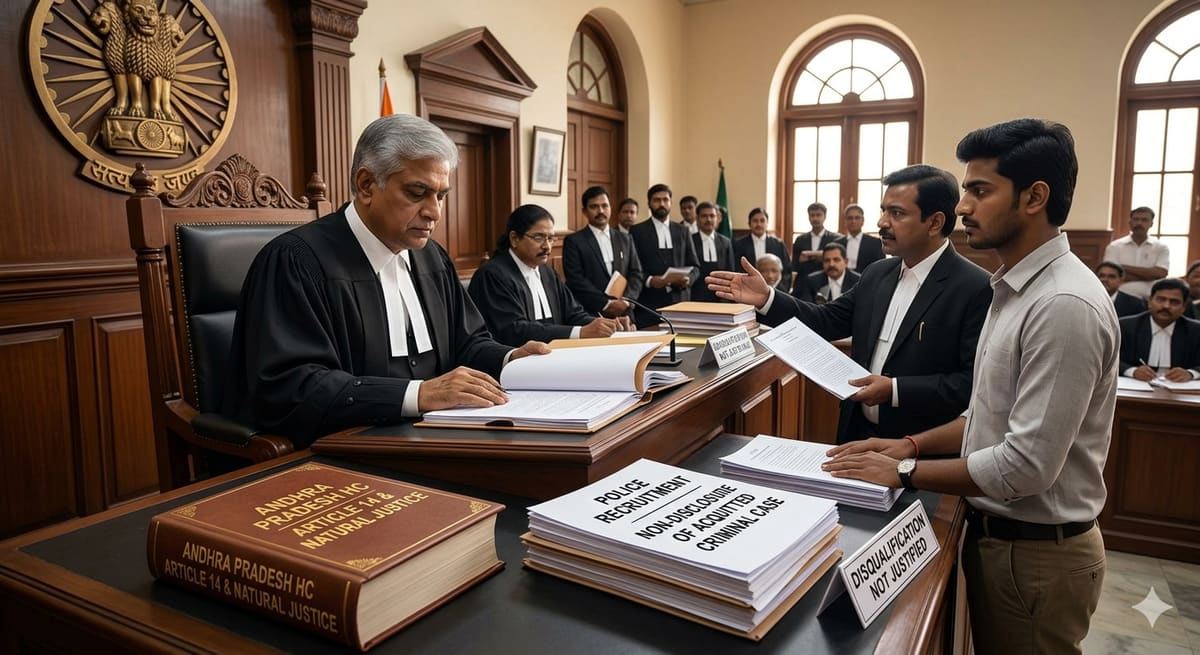
The Allahabad High Court has clarified that the mere pendency of a criminal case cannot justify the denial of a character certificate, provided the facts are disclosed transparently. This ruling reinforces the principle that presumption of innocence must guide administrative decisions affecting employment eligibility.
Background & Facts
The Dispute
The petitioner, Ram Prakash Tiwari, applied for a Character Certificate required for employment purposes. His application was withheld by the authorities on the ground that a criminal case - Crime No. 487 of 2025 under Sections 115(2), 351(3), and 352 of the Bharatiya Nyaya Sanhita (BNS) - was pending against him at Police Station Kotwali Dehat, Sultanpur. The petitioner contended that he had never been arrested or imprisoned in connection with this case and that the pendency alone was being used to deny him the certificate.
Key Facts
- The petitioner submitted an application for a Character Certificate in connection with a prospective employment opportunity.
- The Superintendent of Police, Hardoi, declined to issue the certificate citing the pending criminal case.
- The petitioner has not been convicted in the case nor has he undergone any period of custody or trial.
- The petitioner emphasized that the filing of an FIR does not equate to guilt and that the case remains under trial.
- The petitioner relied on the judgment in Anil Kumar v. State of U.P. & Ors., Writ-C No. 718 of 2025, delivered on 28.05.2025, which laid down the standard for issuing character certificates in cases involving pending criminal proceedings.
Procedural History
- Date of Application: Not specified in judgment, but implied to be prior to filing of writ petition.
- Date of Refusal: Not explicitly stated, but occurred prior to filing of the writ petition.
- 28.05.2025: Judgment delivered in Anil Kumar v. State of U.P. & Ors., Writ-C No. 718 of 2025, establishing the disclosure-based approach to character certificates.
- 05.04.2026: Writ Petition No. 4754 of 2026 filed before the Allahabad High Court, Lucknow Bench.
- 15.05.2026: Hearing conducted before a Division Bench.
Relief Sought
The petitioner sought a writ of mandamus directing the respondents to issue the Character Certificate without withholding it on account of the pending criminal case, subject to full disclosure of the FIR details.
The Legal Issue
The central question was whether the mere pendency of a criminal case against an applicant can serve as a ground to withhold a Character Certificate, or whether the certificate must merely disclose the pendency and leave the final assessment of suitability to the employing authority.
Arguments Presented
For the Petitioner
The petitioner’s counsel argued that the filing of an FIR does not establish guilt and that withholding a character certificate on this basis violates the presumption of innocence under Article 21 of the Constitution. He relied on the precedent set in Anil Kumar v. State of U.P. & Ors., which held that the role of the police is to verify and disclose, not to adjudicate. He further submitted that the petitioner had never been arrested or imprisoned, and that the case was still at the investigation or trial stage, making denial of the certificate arbitrary and disproportionate.
For the Respondent
The State did not contest the legal principle laid down in Anil Kumar but maintained that the pending case warranted non-issuance until final disposal. However, no specific statutory provision or policy was cited to justify outright denial. The Standing Counsel conceded that the police’s role was limited to reporting facts, not making suitability determinations.
The Court's Analysis
The Court examined the judgment in Anil Kumar v. State of U.P. & Ors., which had been delivered by the same Division Bench on 28.05.2025. In that case, the Court had held that the Superintendent of Police, when preparing a character certificate, must not act as a judge of the applicant’s moral character or guilt. Instead, the police’s duty is limited to verifying and disclosing the existence of pending criminal cases.
"The character certificate is not a verdict on guilt or innocence. It is a factual report. The employer, not the police, must decide whether a pending case affects suitability."
The Court emphasized that the presumption of innocence is a fundamental constitutional value and that administrative action based on unproven allegations violates the right to equality and fair procedure under Articles 14 and 21. The Court noted that the petitioner had not been convicted, nor had he been subjected to any custodial detention. The existence of an FIR, without more, cannot be the sole basis for denial of a certificate essential for employment.
The Court further observed that the Anil Kumar judgment had been rendered in a batch of similar petitions and had established a uniform standard across the State. To deviate from it in the present case would create inconsistency and undermine the rule of law.
The Verdict
The petition was allowed. The Court directed the Superintendent of Police, Hardoi, to send a verification report to the competent authority containing full details of the pending FIR (Crime No. 487 of 2025). The Character Certificate must disclose the pendency of the case but must not be withheld on that ground. The certificate shall be issued within four weeks from the date a certified copy of this order is produced before the concerned authorities.
What This Means For Similar Cases
Disclosure, Not Disqualification, Is the Standard
- Practitioners must advise clients that pending FIRs cannot be used to automatically deny character certificates.
- Employers must be informed that they alone bear the responsibility to assess suitability based on disclosed facts, not police recommendations.
- Administrative bodies cannot substitute their judgment for judicial determination.
Police Role Is Limited to Verification
- Police authorities must restrict their reports to factual disclosures: case number, section, court, and status (pending/under trial).
- Any editorial commentary, moral judgment, or suggestion of unsuitability in the report is legally impermissible.
- Failure to disclose pending cases may expose authorities to liability for non-compliance with Anil Kumar.
Procedural Fairness in Employment Screening
- Candidates with pending cases must be given an opportunity to explain the context before adverse decisions are made.
- Employers should adopt transparent policies that distinguish between allegations and convictions.
- Legal challenges to blanket denials of character certificates are now strongly supported by binding precedent.