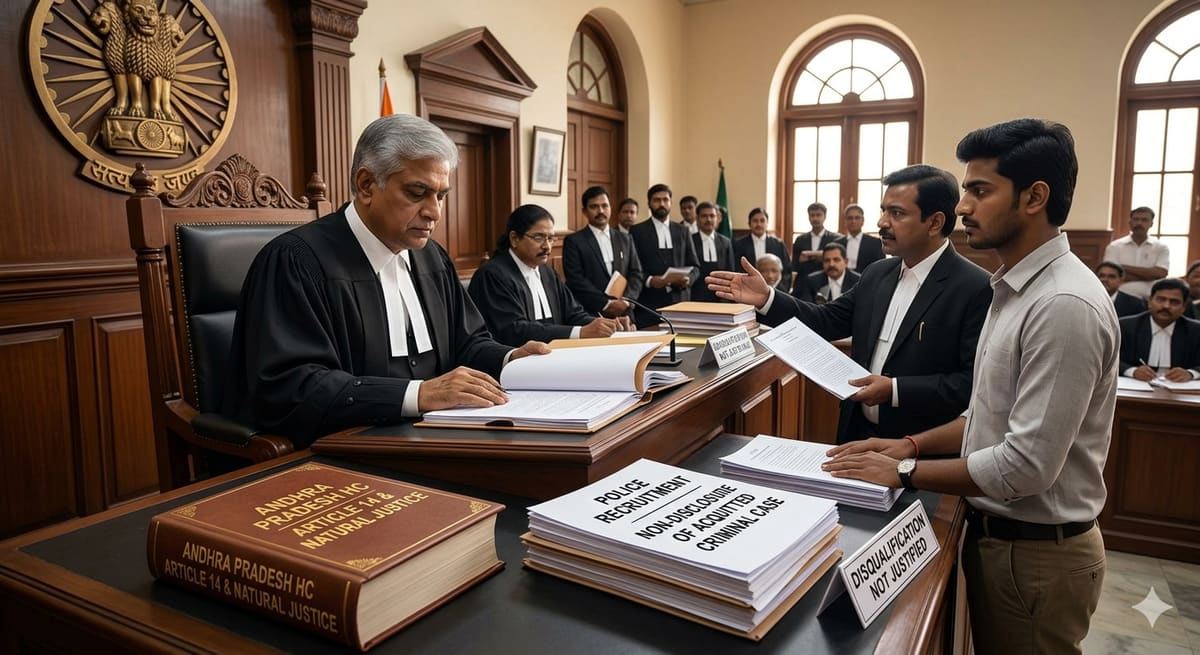
The Central Administrative Tribunal, Jammu Bench, has delivered a significant ruling affirming that the mere registration of FIRs, without conviction or credible evidence of wrongdoing, cannot serve as a valid basis to withhold appointment in public service. This judgment reinforces the principle that character verification must be objective, not mechanical, and must account for subsequent exoneration by investigating agencies.
Background & Facts
The Dispute
The applicant, Sumit Sharma, applied for the post of Constable in the 02 Border Battalion of J&K Police under Advertisement Notification No. Pers-Rectt.-A-105-2018/16207-50 dated 09.03.2019. The recruitment process was open to candidates from ten notified border districts within 0-10 km of the International Border/LoC/AGPL. The applicant, a graduate, applied under the ALC/IB category for District Jammu.
Key Facts
- The selection process included Physical Endurance Test (PET), Physical Standard Test (PST), and a written examination.
- The applicant successfully cleared PET and PST and appeared for the written examination conducted in 2022.
- He secured 90 marks and was ranked 52nd in the merit list for District Jammu.
- Due to his high merit, he was placed in the Open Merit category despite applying under ALC/IB.
- He was called for document verification and medical examination.
- Despite clearing all stages, his appointment was withheld on the basis of an adverse CID verification report.
- The adverse report relied on two FIRs:
- FIR No. RC0042022A0008 dated 03.08.2022 (CBI case) concerning alleged irregularities in a separate recruitment process.
- FIR No. 226/2023 dated 07.08.2023 registered at Police Station Akhnoor under Section 447 IPC relating to a private property dispute.
- A supplementary charge-sheet dated 02.07.2024 under Section 173(8) Cr.P.C. was filed in the CBI case, explicitly dropping the applicant’s name from the list of accused.
- Proceedings in FIR No. 226/2023 have been stayed by the Hon’ble High Court.
- The applicant had not concealed any information in his application.
Procedural History
- 09.03.2019: Advertisement Notification issued for recruitment of 1350 Constables.
- 2022: Written examination conducted; applicant secured 90 marks and ranked 52nd.
- 2023: CID verification initiated; adverse report received.
- 2024: Applicant filed Original Application No. 120/2024 before CAT Jammu on 01.01.2024.
- 22.02.2024: Tribunal issued interim order reserving one post in the Open Merit category for the applicant.
- 02.07.2024: Supplementary charge-sheet filed by CBI dropping applicant’s name.
- 06.11.2025: Hearing concluded.
- 29.04.2026: Judgment pronounced.
The Parties' Positions
For the Applicant
- Argued that inclusion in the select list, after clearing all stages, creates a legitimate expectation of appointment.
- Contended that the adverse CID report is based on stale, unsubstantiated, and legally extinguished allegations.
- Highlighted that the CBI itself exonerated him through a supplementary charge-sheet.
- Relied on Sapna Sharma v. State of J&K to assert that mere pendency of FIRs cannot justify denial of appointment.
- Asserted violation of Articles 14 and 16 of the Constitution due to arbitrary and non-reasoned action.
For the Respondents
- Admitted the applicant’s merit and successful completion of selection stages.
- Maintained that appointment is subject to satisfactory character and antecedent verification as per advertisement terms.
- Argued that inclusion in the select list does not confer an indefeasible right to appointment.
- Claimed the decision was based on objective assessment of CID report.
- Did not dispute the content of the supplementary charge-sheet but contended that the mere existence of FIRs warranted caution.
Relief Sought
The applicant sought:
- Directing the Police Recruitment Board to recommend his name for appointment.
- Directing the Union Territory and DGP to appoint him as Constable in the 02 Border Battalion.
- Granting all consequential benefits w.e.f. the date of appointment of other selectees.
- Restraint on cancellation of his candidature or filling the post with another candidate.
- Any other relief deemed fit.
The Legal Issue
Can the denial of appointment to a candidate who has cleared all selection stages and been formally exonerated by the investigating agency be justified solely on the basis of two FIRs, one of which has been stayed and the other resulting in a supplementary charge-sheet dropping the applicant’s name?
Arguments Presented
For the Appellant/Petitioner
The applicant relied on Sapna Sharma v. State of J&K to argue that mere registration of FIRs, without conviction or serious involvement affecting suitability, cannot be a ground to deny appointment. He emphasized that the CBI’s supplementary charge-sheet under Section 173(8) Cr.P.C. constituted a formal exoneration, rendering the earlier FIR legally irrelevant. He further contended that the respondents’ reliance on the CID report was mechanical and violated the principles of natural justice and Article 14. The applicant submitted that the High Court’s stay on the second FIR further negated any subsisting criminal liability.
For the Respondent/State
The respondents conceded the applicant’s merit and successful completion of selection stages but maintained that the appointment process is conditional upon satisfactory character verification. They argued that the CID report, even if based on FIRs, was a legitimate part of the screening mechanism under the advertisement terms. They contended that the appointing authority has discretion to assess suitability and that the applicant’s inclusion in the select list did not create a vested right to appointment.
The Court's Analysis
The Tribunal examined the nature of the two FIRs and the subsequent legal developments. It noted that the CBI, after a full investigation, filed a supplementary charge-sheet under Section 173(8) Cr.P.C. on 02.07.2024, explicitly dropping the applicant’s name from the list of accused. The Court held that once the investigating agency itself concludes that there is no material to proceed against a candidate, the stigma of mere FIR registration cannot be used to deny a public appointment.
"Once the investigating agency exonerates a person and does not find sufficient evidence to proceed against him, the stigma attached to mere registration of FIR loses its significance. Denial of appointment on such basis becomes wholly arbitrary."
The Tribunal further observed that the second FIR, relating to a private property dispute, was under stay by the High Court, meaning no adverse finding or conviction existed. The respondents’ reliance on these FIRs without independent evaluation amounted to a mechanical application of rules, contrary to the requirement of reasonableness under Articles 14 and 16.
The Court distinguished the present case from situations where pending serious criminal charges may legitimately affect suitability. Here, the applicant was not merely under investigation - he was formally cleared. The Tribunal emphasized that public employment decisions must be based on current, credible, and substantiated information, not on stale or extinguished allegations.
The Verdict
The applicant succeeded. The Tribunal allowed the Original Application and directed the respondents to consider the applicant’s case for appointment against the post reserved for him under the Open Merit category. The appointment order shall be issued if no other legal impediment exists, with notional seniority from the date of appointment of his immediate junior in the same selection process. Actual monetary benefits shall commence only from the date of joining, in accordance with the principle of "no work no pay." The respondents shall complete the process within 12 weeks from service of a certified copy of this order. The interim order dated 22.02.2024 stands merged with this order. No costs awarded.
What This Means For Similar Cases
Exoneration Trumps FIR Registration
- Practitioners must now argue that a supplementary charge-sheet dropping a candidate’s name constitutes formal exoneration under Cr.P.C., rendering prior FIRs legally irrelevant for employment purposes.
- Any denial of appointment based solely on an FIR that has been formally closed by the investigating agency is unsustainable in law.
Mechanical Verification Violates Natural Justice
- Public authorities cannot rely blindly on CID reports; they must conduct an objective assessment of the nature, outcome, and current status of allegations.
- Where courts have stayed proceedings or investigating agencies have dropped names, the verification process must reflect these developments.
Merit-Based Selection Must Be Honored
- Candidates who clear all selection stages and are placed on the select list have a legitimate expectation of appointment, subject only to valid, current, and substantiated disqualifications.
- Denial of appointment after merit-based selection requires compelling, legally valid reasons - not procedural formalities based on extinguished allegations.