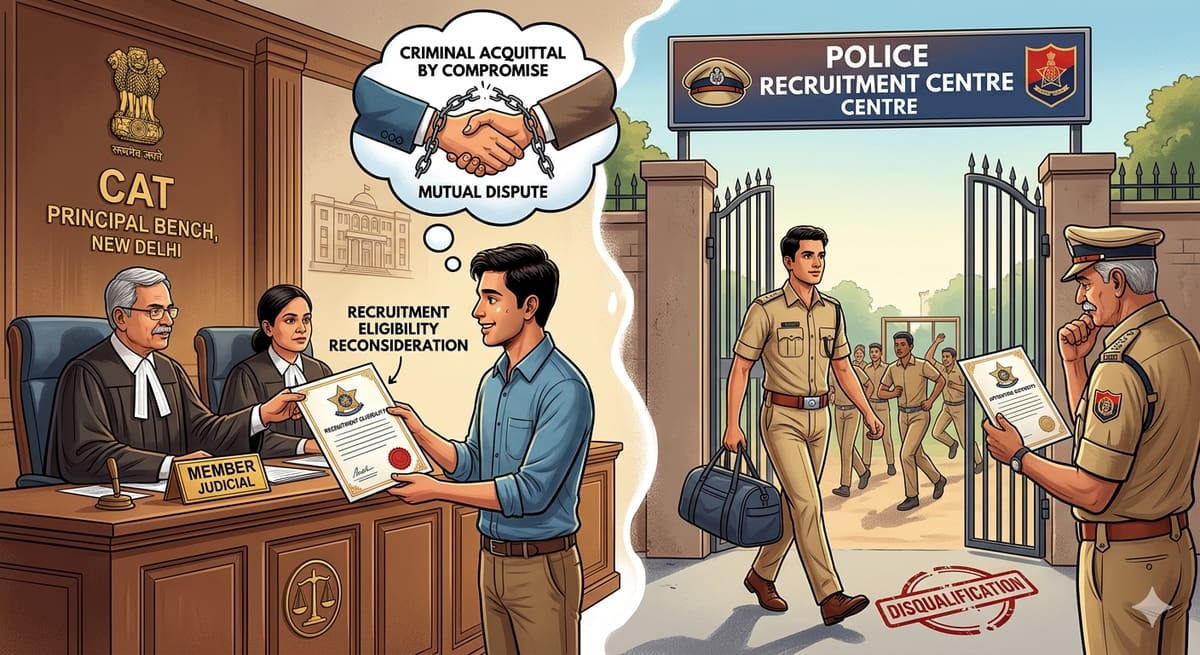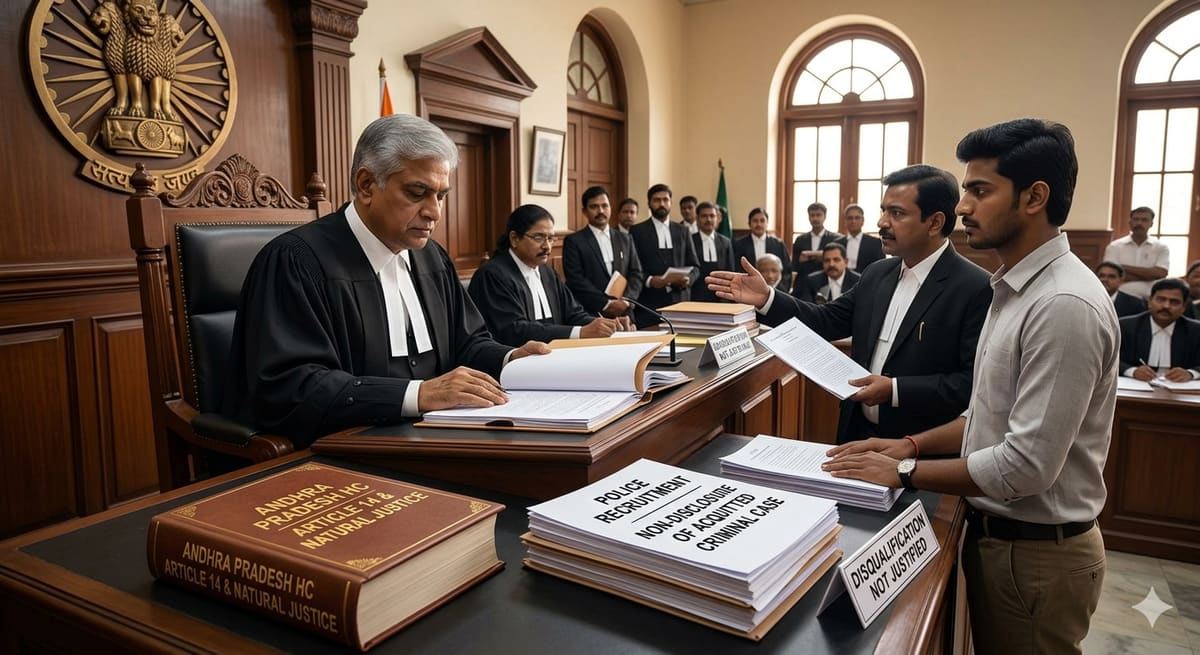
The Andhra Pradesh High Court has reaffirmed that the suppression of a criminal case ending in acquittal does not automatically disqualify a candidate from government service, particularly when the offence is trivial and the candidate has no other antecedents. This judgment marks a significant shift from rigid procedural compliance to a nuanced, rights-based evaluation of suitability in public employment.
Background & Facts
The Dispute
The petitioner, DODLA PENCHALAIAH, a member of a Scheduled Tribe from Kamakshi Colony, Bucchireddypalem, SPSR Nellore District, applied for the post of Police Constable (Civil) under Notification No. 2008(2) issued by the State Level Police Recruitment Board, Andhra Pradesh, on 30.12.2008. He successfully cleared all stages of the selection process - the preliminary test (March 2009), Physical Measurement Test (16.07.2009), written examination (13.09.2009), and Physical Efficiency Test - and was provisionally selected. However, his selection was cancelled on 29.04.2011 on the grounds that he had failed to disclose a pending criminal case during attestation.
Key Facts
The petitioner submitted his attestation form on 23.12.2010.
On 03.01.2010, Crime No. 6 of 2010 was registered at Bucchireddypalem Police Station under Sections 147, 148, 452, 323, 324, 427 r/w 149 IPC against Seenaiah and others, with the petitioner named as Accused No. 13.
The case was charge-sheeted on 16.02.2010.
The petitioner was acquitted by the Additional Judicial Magistrate (First Class), Kovur, on 19.03.2014, with the court holding that the prosecution failed to prove guilt beyond reasonable doubt due to hostile witnesses and lack of incriminating evidence.
The petitioner had no prior criminal record before or after this case.
The petitioner’s family and community were embroiled in local political feuds, and the case against him was widely perceived as retaliatory, filed to sabotage his recruitment prospects.
The attestation form did not ask specifically about pending cases; it only required disclosure of convictions or acquittals.
Procedural History
29.04.2011: Provisional selection cancelled by the State Level Police Recruitment Board.
12.06.2013: Petitioner filed Original Application (O.A. No. 1381 of 2013) before the Andhra Pradesh Administrative Tribunal seeking reinstatement.
15.09.2014: Tribunal directed authorities to reconsider the petitioner’s request in light of his acquittal (M.A. No. 2235 of 2014).
22.12.2014: Respondents rejected the request via Memo Rc. No. 114/R&T/Admn.2/2013.
24.06.2016: O.A. No. 1381 of 2013 dismissed for default.
24.10.2017: Review petition (M.A. No. 1675 of 2016) dismissed.
03.01.2020: Division Bench of this Court set aside the dismissal for default and restored O.A. No. 1381 of 2013.
2021: Andhra Pradesh Administrative Tribunal abolished; O.A. No. 1381 of 2013 transferred and renumbered as W.P.(AT) No. 22 of 2021.
13.04.2025: Learned Single Judge dismissed W.P.(AT) No. 22 of 2021.
30.04.2025: Writ Appeal No. 1364/2025 filed before the Division Bench.
06.05.2026: Judgment pronounced.
The Parties' Positions
Petitioner: Argued that the criminal case was trivial, politically motivated, and ended in acquittal. He did not disclose it out of fear of automatic disqualification, not malice. He had no other criminal history and was otherwise fit for the post.
Respondents: Contended that suppression of any criminal case, even if acquitted, violated Rule 12(1)(a)(ii) of the A.P. State & Subordinate Service Rules, 1996, and G.O.Ms. No. 97 of 2006, rendering him ineligible. They relied on the technical breach of attestation norms.
Relief Sought
The petitioner sought quashing of the cancellation orders dated 29.04.2011 and 22.12.2014, reinstatement to the post of Police Constable (Civil), and entitlement to all notional benefits including pay, seniority, and consequential benefits, without back wages.
The Legal Issue
The central question was whether the non-disclosure of a pending criminal case that ended in acquittal, without evidence of moral turpitude or deliberate fraud, justifies automatic cancellation of provisional selection for a police constable post under service rules.
Arguments Presented
For the Appellant/Petitioner
The learned counsel relied on Ravindra Kumar v. State of U.P. (2024), Avtar Singh v. Union of India (2016), and Sandeep Kumar v. Commissioner of Police (2011) to argue that suppression of a trivial, non-moral turpitude offence ending in acquittal cannot be treated as a fatal flaw. He emphasized that the petitioner was a young man from a marginalized tribal background, implicated in a village feud with no prior or subsequent criminal record. The attestation form did not explicitly ask for pending cases, and the suppression was not malicious but born of fear. The court must adopt a holistic, objective approach, not a mechanical one.
For the Respondent/State
The Government Pleader contended that Rule 12(1)(a)(ii) of the A.P. State & Subordinate Service Rules, 1996, and G.O.Ms. No. 97 of 2006 mandate full disclosure of antecedents. Non-disclosure, even if the case ended in acquittal, constitutes a breach of trust and disqualifies the candidate. The State has the right to maintain high standards of character for police personnel. The acquittal was based on hostile witnesses, not innocence, and thus cannot be treated as a "clean acquittal." The cancellation was lawful and justified.
The Court's Analysis
The Court undertook a comprehensive review of the Supreme Court’s evolving jurisprudence on character verification and suppression of information. It noted that the Apex Court has consistently moved away from rigid, automatic disqualifications toward a contextual, proportionate assessment.
"Broad-brushing every non-disclosure as a disqualification will be unjust and the same will tantamount to being completely oblivious to the ground realities obtaining in this great, vast and diverse country. Each case will depend on the facts and circumstances that prevail thereon, and the court will have to take a holistic view, based on objective criteria..."
The Court emphasized that Avtar Singh established that suppression must be evaluated in light of the nature of the offence, the candidate’s age, socio-economic background, and the purpose of the post. The petitioner was 20 years old at the time of the incident, belonged to a Scheduled Tribe, and was implicated as Accused No. 13 in a general village brawl involving multiple parties. The acquittal was not on technical grounds alone but because the prosecution failed to prove guilt - a finding that the Court treated as substantive.
The Court rejected the respondents’ argument that the acquittal was not "clean" because it was based on hostile witnesses. It held that acquittal, regardless of the reason, extinguishes the presumption of guilt and must be given full weight. The absence of any prior or subsequent criminal record further supported the petitioner’s suitability.
The Court also noted that the attestation form did not explicitly require disclosure of pending cases, only convictions or acquittals. The petitioner’s failure to mention a pending case, therefore, did not amount to a deliberate falsehood under suggestio falsi. The appointing authority had not undertaken any objective assessment of suitability but mechanically applied the rule.
The Court concluded that the cancellation was arbitrary, violative of Article 14, and failed the test of reasonableness under Maneka Gandhi v. Union of India. The State’s duty to maintain integrity in police ranks cannot override the individual’s right to livelihood, especially when the underlying conduct is trivial and the person is otherwise fit.
The Verdict
The writ appeal was allowed. The order dated 30.04.2025 of the Single Judge was set aside. The cancellation orders dated 29.04.2011 and 22.12.2014 were quashed. The respondents were directed to appoint the petitioner to the post of Police Constable (Civil) within four weeks from the date of judgment. The petitioner is entitled to all notional benefits, including pay, seniority, and consequential benefits, but not arrears of salary for the period of non-service. There shall be no order as to costs.
What This Means For Similar Cases
Non-Disclosure of Acquitted Cases Is Not Automatic Disqualification
Practitioners must now argue that acquittal, even if based on hostile witnesses, negates the presumption of guilt and must be treated as a clean slate.
Mechanical application of service rules without assessing the nature of the offence or the candidate’s background is legally unsustainable.
Where the offence is trivial (e.g., group scuffles, minor altercations), and the candidate has no prior record, courts will intervene to prevent livelihood deprivation.
Holistic Assessment Is Mandatory in Service Selection
Employers must evaluate: (i) the nature of the offence, (ii) the timing of the case relative to application, (iii) the reason for non-disclosure, (iv) the candidate’s socio-economic context, and (v) the relevance of the offence to the post.
For lower-level posts like constables, the threshold for "moral turpitude" must be strictly construed.
Failure to conduct a reasoned, objective review renders cancellation orders liable to be quashed.
Attainment Forms Must Be Specific to Trigger Liability
If an attestation form does not explicitly ask for pending cases, suppression of such information cannot be grounds for cancellation.
Employers cannot rely on vague clauses to justify termination; the requirement must be clear and unambiguous.
This judgment reinforces that service law must balance institutional integrity with individual rights - not substitute one for the other.