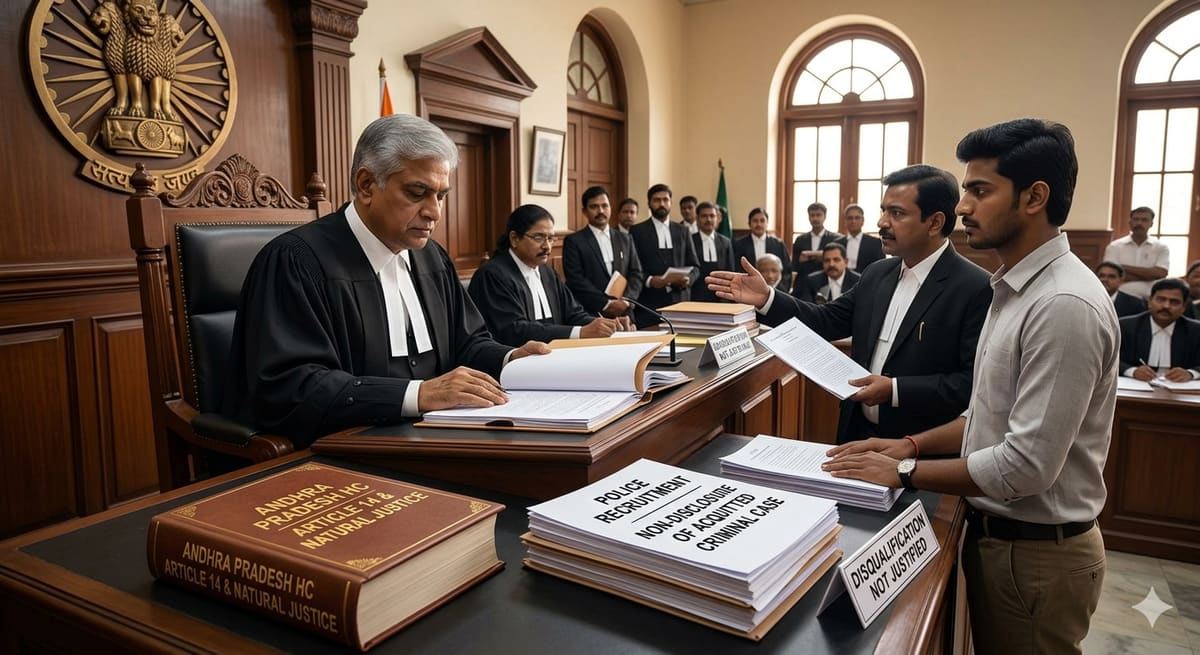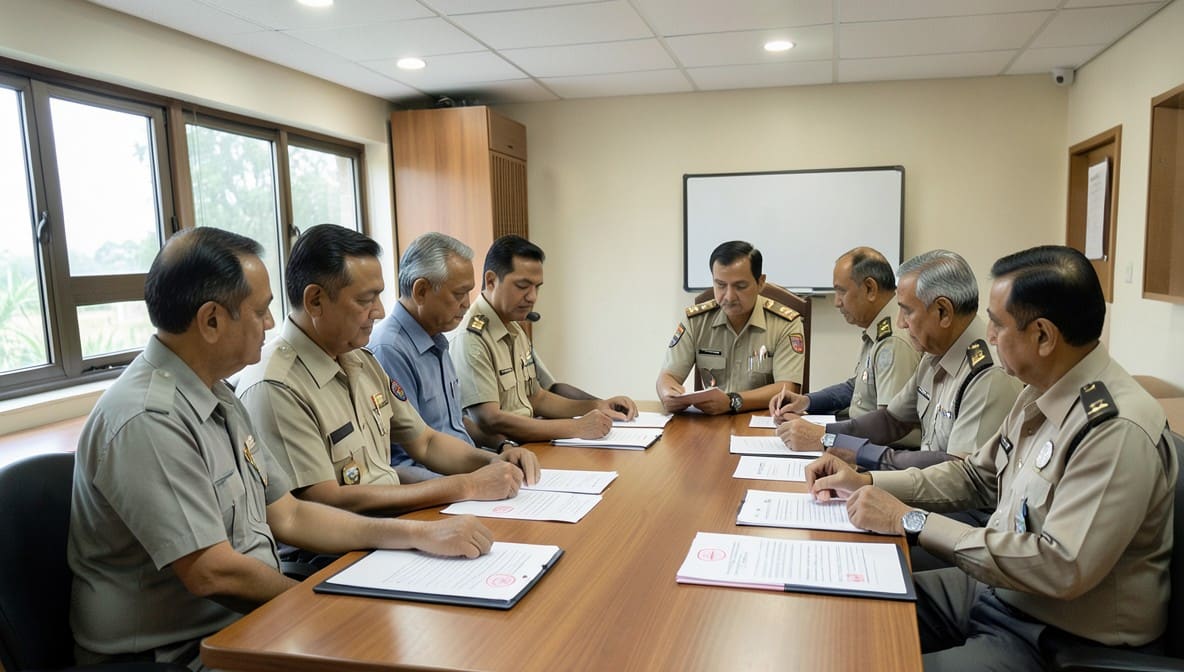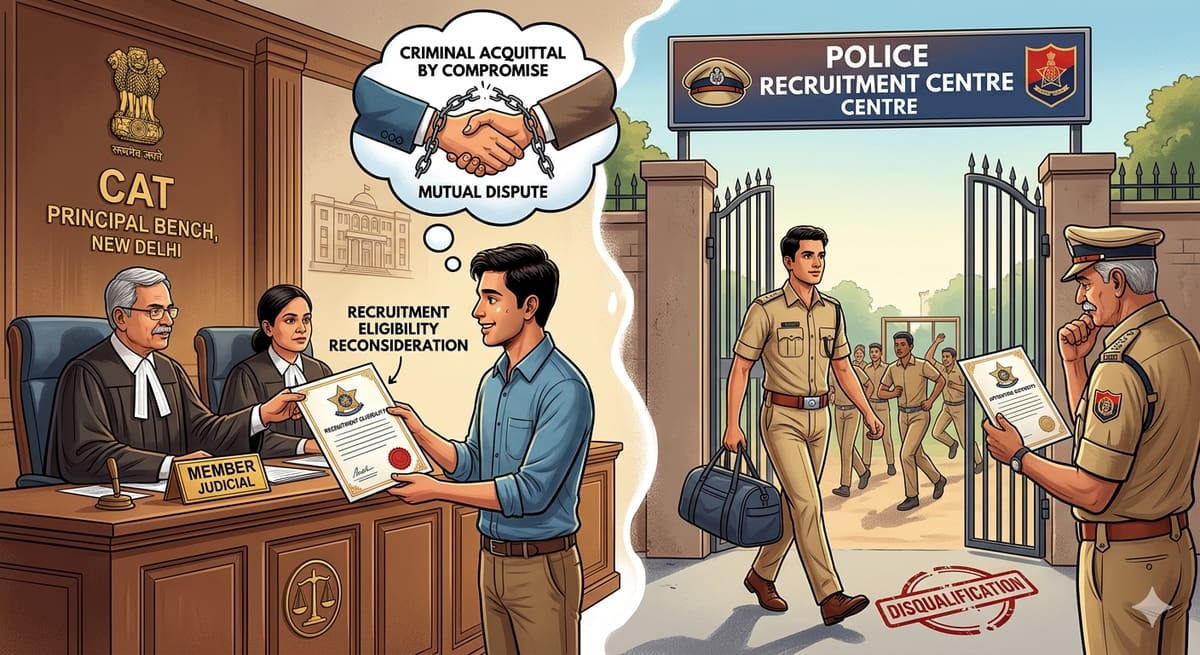
The Allahabad High Court has affirmed that the pendency of serious criminal cases, even without conviction, can justify cancellation of candidature for appointment in a disciplined force like the Civil Police. This ruling reinforces the state’s authority to prioritize character integrity over procedural completion in recruitment to positions of public trust.
Background & Facts
The Dispute
The petitioner, Shekhar, applied for the post of Constable (Civil Police) through an advertisement issued by the Uttar Pradesh Police Recruitment and Promotion Board. After successfully clearing all stages of selection - including written examination, physical efficiency test, and medical examination - he was recommended for appointment. However, his candidature was cancelled on 10.07.2025 due to the pendency of two criminal cases against him.
Key Facts
- The petitioner disclosed the pendency of two criminal cases in his application form.
- Case Crime No. 0018 of 2021, registered on 13.01.2021 at Police Station Kandhai, District Pratapgarh, involved charges under Sections 392/411/34/201 IPC (robbery, receiving stolen property, criminal conspiracy, and destruction of evidence).
- Case Crime No. 0156 of 2021, registered under Sections 2 and 3 of the Uttar Pradesh Gangsters and Anti-Social Activities (Prevention) Act, 1986, pertains to gangsterism and anti-social activities.
- Charge Sheet No. 140 of 2021 was filed in Case Crime No. 0018 of 2021 on 21.05.2021.
- The petitioner did not disclose the nature of the charges, only their pendency.
- On 21.05.2025, the Superintendent of Police, Pratapgarh, sought the District Magistrate’s opinion under Government Order No. 4694/1-B-321-1947 dated 28.04.1958.
- The District Magistrate, Pratapgarh, vide letter No. 37/50 JA-2025 dated 09.06.2025, opined that the seriousness of the charges rendered the petitioner unsuitable for appointment.
- The appointing authority, Superintendent of Police, Ghazipur, cancelled the petitioner’s selection by order dated 10.07.2025.
Procedural History
- 13.01.2021: FIR registered at Police Station Kandhai, District Pratapgarh (Case Crime No. 0018 of 2021).
- 21.05.2021: Charge sheet filed in Case Crime No. 0018 of 2021.
- 2023: Advertisement issued for Constable (Civil Police) recruitment.
- 23.12.2023: Notification No. PRPB:E-1(150)/2023 issued, mandating suitability in character.
- 13.03.2025: Final selection list published by the Recruitment Board.
- 21.05.2025: Superintendent of Police, Pratapgarh, sought District Magistrate’s opinion.
- 09.06.2025: District Magistrate opined that petitioner was unsuitable due to serious charges.
- 10.07.2025: Appointment order cancelled by Superintendent of Police, Ghazipur.
- 10.07.2025: Writ Petition (No. 10936 of 2025) filed before the Allahabad High Court.
- 17.02.2026: Case reserved for judgment.
- 15.05.2026: Judgment delivered.
Relief Sought
The petitioner sought quashing of the order dated 10.07.2025, restoration of his selection, and direction for appointment to the post of Constable (Civil Police).
The Legal Issue
The central question was whether the pendency of serious criminal cases, even when truthfully disclosed, justifies cancellation of candidature for appointment to a disciplined force like the Civil Police, absent a conviction or acquittal.
Arguments Presented
For the Petitioner
The petitioner argued that since he had truthfully disclosed the pendency of the cases in his application, cancellation of his candidature was arbitrary and violative of natural justice. He relied on Avtar Singh v. Union of India (2016) 8 SCC 471, particularly paragraph 38.6, which permits appointment during pendency of trivial cases. He contended that disclosure negates any claim of suppression and that the state cannot deny appointment merely due to pending proceedings.
For the Respondent
The State relied on Avtar Singh (supra), particularly paragraph 38.4.2 and 38.7, and Satish Chandra Yadav v. Union of India (2023) 7 SCC 536, to argue that the nature of the offences - robbery, gangsterism, and conspiracy - was grave and incompatible with the integrity expected of police personnel. It emphasized that the appointing authority is under a statutory and constitutional duty to ensure candidates possess impeccable character, especially for disciplined forces. The District Magistrate’s opinion, formed after due process including opportunity of hearing, was binding and reasonable.
The Court's Analysis
The Court undertook a detailed examination of the legal framework governing character verification in police recruitment. It emphasized that the post of Constable (Civil Police) is not merely a service position but one that demands absolute integrity, as the officer is entrusted with maintaining public order and enforcing the law.
"A person joining a police force must be of impeccable character and must not have any criminal antecedents."
The Court noted that while Avtar Singh permits discretion in cases of trivial offences during pendency, the present case involved offences under Sections 392/411/34/201 IPC and the Uttar Pradesh Gangsters and Anti-Social Activities (Prevention) Act, 1986, which are inherently serious and indicative of moral turpitude and threat to public safety.
The Court further relied on Satish Chandra Yadav (2023) 7 SCC 536, which clarified that even truthful disclosure of a concluded criminal case does not entitle a candidate to appointment. The Court held that the same logic applies with greater force where the case is pending and the charges are grave.
The Court also examined Government Order No. 4694/1-B-321-1947 dated 28.04.1958, which mandates that the appointing authority must satisfy itself regarding the candidate’s character and consult the District Magistrate in cases of adverse reports. The procedure was followed: the District Magistrate obtained police input, afforded the petitioner an opportunity to be heard, and rendered a reasoned opinion.
The Court rejected the petitioner’s argument that disclosure alone immunizes him from scrutiny. It held:
"The mere disclosure of pendency does not compel the employer to appoint. The nature of the charges, the stage of proceedings, and the nature of the post are all relevant factors."
The Court concluded that the appointing authority acted within its statutory and constitutional mandate, applying its independent mind in accordance with established guidelines.
The Verdict
The writ petition was dismissed. The order dated 10.07.2025 cancelling the petitioner’s candidature for the post of Constable (Civil Police) was upheld. No costs were awarded. The petitioner’s selection remains cancelled, and no direction for appointment was issued.
What This Means For Similar Cases
Character Supersedes Disclosure
- Truthful disclosure of pending criminal cases does not guarantee appointment, especially for disciplined forces.
- The nature of the offence, not merely the procedural stage, determines suitability.
- Practitioners must advise clients that even if a case is pending, serious charges under IPC or special statutes like the UP Gangsters Act can disqualify candidates.
Employer’s Discretion Is Broad and Legally Valid
- Appointing authorities are not bound to appoint even if the candidate has cleared all selection stages.
- The District Magistrate’s opinion, formed after hearing, carries substantial weight and is not subject to judicial interference absent mala fide or procedural illegality.
- Recruitment notifications must be read alongside Government Orders and judicial precedents on character requirements.
Risk Mitigation for Applicants
- Candidates applying for police or disciplined force posts must assess the gravity of pending cases before applying.
- Legal counsel should advise clients to seek early resolution of criminal matters before applying for such posts.
- Employers may rely on Avtar Singh and Satish Chandra Yadav to justify non-appointment in cases involving moral turpitude or public safety concerns.