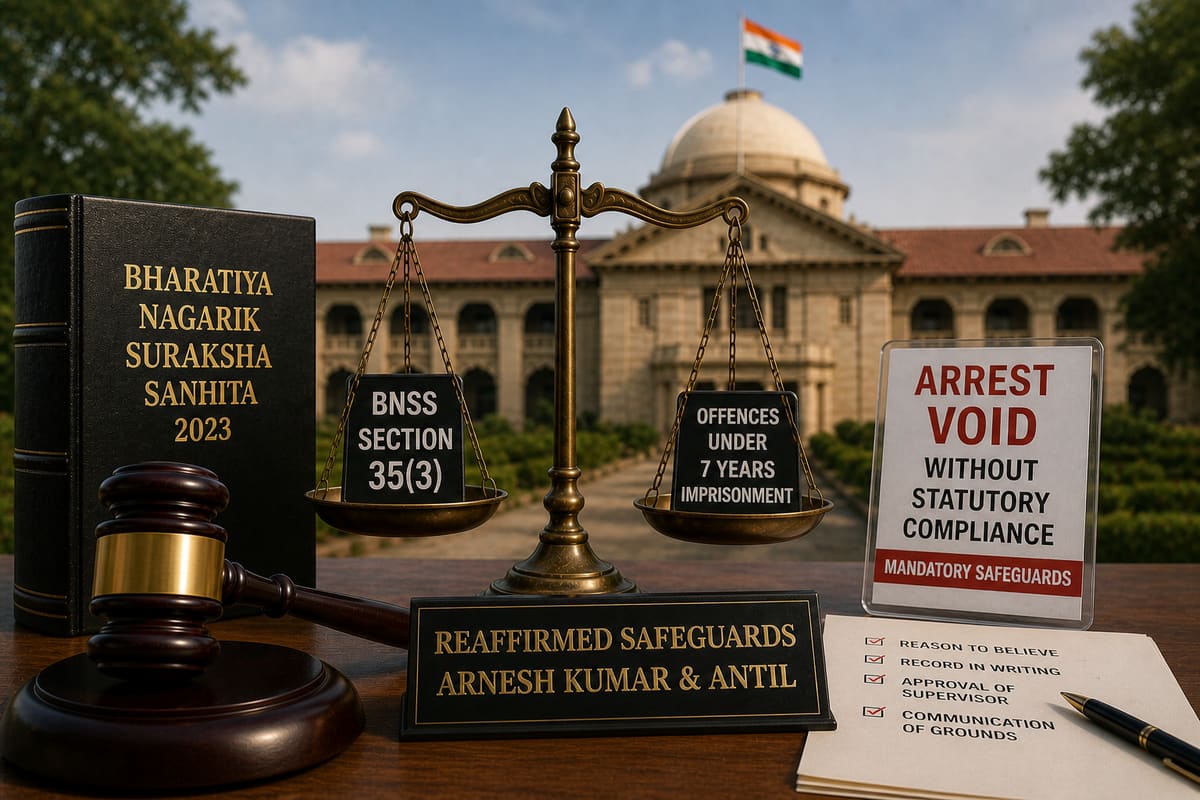
The Andhra Pradesh High Court has reinforced the mandatory compliance with Section 35(3) of the Bharatiya Nagarik Suraksha Sanhita, 2023 (BNSS) and the directions issued by the Supreme Court in Arnesh Kumar v. State of Bihar. The judgment underscores that arrest cannot be a routine measure, even in offences punishable with imprisonment of seven years or less, without adherence to procedural safeguards.
Background & Facts
The Dispute
The petitioners, three journalists based in Vijayawada, sought anticipatory bail in connection with FIR No. 183 of 2026, registered on 05.05.2026 at Peddakakani Police Station, Guntur District. The FIR was lodged for offences punishable under Sections 329(3), 329(4), 308(2), and 351(3) read with Section 3(5) of the Bharatiya Nyaya Sanhita, 2023 (BNS). The petitioners approached the High Court under Sections 437, 438, 439, and 482 of the Code of Criminal Procedure, 1973 (CrPC), and Section 528 of the BNSS, seeking protection from arrest.
Key Facts
- FIR Details: Crime No. 183 of 2026, dated 05.05.2026, Peddakakani Police Station, Guntur District
- Offences Alleged: Sections 329(3), 329(4), 308(2), and 351(3) r/w 3(5) of BNS
- Maximum Punishment: Offences punishable with imprisonment of seven years or less
- Petitioners' Profiles: All three petitioners are journalists residing in Vijayawada
Procedural History
- 05.05.2026: FIR registered against the petitioners
- Date of Filing: Criminal Petition No. 4433 of 2026 filed before the Andhra Pradesh High Court
- Relief Sought: Anticipatory bail and direction to the police not to arrest the petitioners
Relief Sought
The petitioners sought the following reliefs:
- Enlargement on bail in the event of arrest
- Direction to the police not to arrest them without complying with Section 35(3) of BNSS and the Arnesh Kumar directions
The Legal Issue
The central question before the Court was whether the police could arrest the petitioners for offences punishable with imprisonment of seven years or less without complying with the procedural safeguards under Section 35(3) of BNSS and the directions issued in Arnesh Kumar v. State of Bihar.
Arguments Presented
For the Petitioners
The counsel for the petitioners argued that:
- The offences alleged are punishable with imprisonment of seven years or less, and thus, arrest should not be automatic
- The police must comply with Section 35(3) of BNSS, which mandates that no arrest shall be made in such cases without recording reasons in writing
- The directions in Arnesh Kumar v. State of Bihar must be followed, which require the police to satisfy themselves about the necessity of arrest based on parameters such as the nature of the offence, the accused's antecedents, and the likelihood of tampering with evidence
For the Respondent
The Public Prosecutor, representing the State, did not present specific counter-arguments in the judgment. The focus of the Court was on ensuring compliance with statutory and judicial directions.
The Court's Analysis
The Court observed that the offences alleged against the petitioners are punishable with imprisonment of seven years or less. Relying on Section 35(3) of BNSS, the Court emphasized that arrest in such cases cannot be routine or automatic. The provision mandates that the police must record reasons in writing for the necessity of arrest, considering factors such as the nature of the offence, the accused's antecedents, and the likelihood of tampering with evidence or influencing witnesses.
The Court further relied on the landmark judgment in Arnesh Kumar v. State of Bihar, which laid down guidelines to prevent arbitrary arrests. The Supreme Court in Arnesh Kumar held that:
"No arrest should be made merely because the offence is non-bailable and cognizable. The police officer must be satisfied that arrest is necessary to prevent the accused from committing any further offence, for proper investigation, or to prevent tampering with evidence or influencing witnesses."
The Court noted that these directions are binding on all police officers and must be strictly followed. The judgment underscored that non-compliance with these safeguards would render the arrest illegal and arbitrary.
The Verdict
The Court disposed of the criminal petition with the following directions:
- The respondent (police) is directed to comply with the mandate under Section 35(3) of BNSS before arresting the petitioners
- The police must adhere to the directions issued by the Supreme Court in Arnesh Kumar v. State of Bihar and other related rulings
- The petitioners are protected from arrest unless the procedural safeguards are followed
- Miscellaneous petitions, if any, pending in the criminal petition, stand closed
What This Means For Similar Cases
Mandatory Compliance with Section 35(3) of BNSS
- No Automatic Arrest: Police officers cannot arrest individuals accused of offences punishable with imprisonment of seven years or less without recording reasons in writing. The arrest must be justified based on specific parameters such as the nature of the offence, the accused's antecedents, and the likelihood of tampering with evidence.
- Judicial Oversight: Courts will scrutinize whether the police have complied with Section 35(3) of BNSS before sanctioning arrest. Non-compliance can lead to the quashing of arrest and potential action against erring officers.
Reinforcement of Arnesh Kumar Directions
- Binding Nature: The directions in Arnesh Kumar v. State of Bihar remain binding on all police officers across India. The judgment reaffirms that these directions are not mere guidelines but mandatory procedural safeguards.
- Protection Against Arbitrary Arrest: Accused persons, especially in cases involving offences with lesser punishment, can seek protection under Arnesh Kumar to prevent arbitrary or routine arrests.
Practical Implications for Practitioners
- Bail Applications: Lawyers filing anticipatory bail applications in cases involving offences punishable with ≤7 years imprisonment should emphasize compliance with Section 35(3) of BNSS and Arnesh Kumar directions.
- Challenging Arrests: If the police arrest an accused without complying with these safeguards, practitioners can challenge the arrest as illegal and seek appropriate remedies, including quashing of the arrest.
- Police Training: The judgment highlights the need for police officers to be trained on the procedural requirements under BNSS and the Arnesh Kumar directions to avoid arbitrary arrests.