Topic

Non-Bailable Offences

Non-bailable offences under Indian law are serious crimes where bail is not a right and requires judicial discretion, typically for offences punishable by seven years or more, but recent judgments have expanded bail eligibility under specific conditions.

16 articlesLatest June 2026
BNSS Section 483 | Bail Granted Under SC/ST Act When Investigation Concludes and Co-Accused Are on Bail, No Flight Risk : Rajasthan HC
Case Law Analysis
|Rajasthan High Court

BNSS Section 483 | Bail Granted Under SC/ST Act When Investigation Concludes and Co-Accused Are on Bail, No Flight Risk : Rajasthan HC

The Rajasthan High Court has ruled that completion of investigation under the SC/ST Act, combined with the absence of flight risk and the fact that co-accused are already on bail, justifies release even in non-bailable offences. This clarifies that procedural finality and equitable treatment of co-accused can override the presumption of detention under the Act, offering critical relief to accused in prolonged pre-trial custody.


BNS Section 483 | Bail Granted Where Accused Named in FIR But No Overt Act Proven: Rajasthan HC
Case Law Analysis
|Rajasthan High Court

BNS Section 483 | Bail Granted Where Accused Named in FIR But No Overt Act Proven: Rajasthan HC

The Rajasthan High Court granted bail to three accused in a BNS case where the investigation confirmed no direct participation in the alleged offense, despite their names appearing in the FIR. This reinforces that mere inclusion in an FIR without concrete evidence of active involvement cannot justify prolonged pre-trial detention, setting a critical precedent for low-level accused in non-bailable offenses.

Section 483 BNSS | Mere Pendency of Unconvicted Criminal Antecedents Cannot Deny Bail for Magistrate-Triable Non-Bailable Offences : Rajasthan HC
Case Law Analysis
|Rajasthan High Court

Section 483 BNSS | Mere Pendency of Unconvicted Criminal Antecedents Cannot Deny Bail for Magistrate-Triable Non-Bailable Offences : Rajasthan HC

The Rajasthan High Court has ruled that unconvicted pending cases, no matter their number, cannot justify denial of bail under Section 483 BNSS when the alleged offence is triable by a Magistrate. This reinforces the presumption of innocence and prevents pre-trial detention from becoming punishment by association, directly impacting accused persons in low-gravity criminal cases facing prolonged investigations.

BNS Sections 333, 78, 126(2), 351(4) | Bail Granted in Stalking Cases Despite Non-Bailable Status, No Prior Record, and Non-Violent Nature : Bombay HC
Case Law Analysis
|Bombay High Court

BNS Sections 333, 78, 126(2), 351(4) | Bail Granted in Stalking Cases Despite Non-Bailable Status, No Prior Record, and Non-Violent Nature : Bombay HC

The Bombay High Court has ruled that even non-bailable stalking offences under the Bharatiya Nyaya Sanhita do not automatically bar bail when the accused has no prior criminal record and the conduct, while persistent, lacks physical violence or threat to life. This sets a critical precedent for bail jurisprudence in cyber and emotional stalking cases, affirming that proportionality and personal liberty must guide judicial discretion under BNS.

Arnesh Kumar Guidelines | Automatic Arrest Unjustified in Non-Bailable Offences with Max 7-Year Punishment: Tripura HC Grants Bail Under BNS, POCSO & Disabilities Act
Case Law Analysis
|Tripura High Court

Arnesh Kumar Guidelines | Automatic Arrest Unjustified in Non-Bailable Offences with Max 7-Year Punishment: Tripura HC Grants Bail Under BNS, POCSO & Disabilities Act

Tripura High Court reinforces that arrest in offences punishable by up to 7 years cannot be mechanical, even under stringent laws like POCSO and the Disabilities Act. The ruling mandates judicial scrutiny of arrest necessity, extending Arnesh Kumar principles to hybrid offences and setting a precedent for bail in cases involving serious allegations without custodial justification.

BNSS Section 35(3) | Mandatory Notice Before Arrest Extends to Spouses Under Parity Principle : Meghalaya HC Grants Anticipatory Bail
Case Law Analysis
|Meghalaya High Court

BNSS Section 35(3) | Mandatory Notice Before Arrest Extends to Spouses Under Parity Principle : Meghalaya HC Grants Anticipatory Bail

The Meghalaya High Court ruled that Section 35(3) of the BNSS, which mandates prior notice before arrest for offences punishable up to seven years, applies equally to spouses implicated alongside the primary accused. The court emphasized the parity principle, ensuring similar relief for co-accused already granted bail, reinforcing procedural safeguards in non-bailable offences.

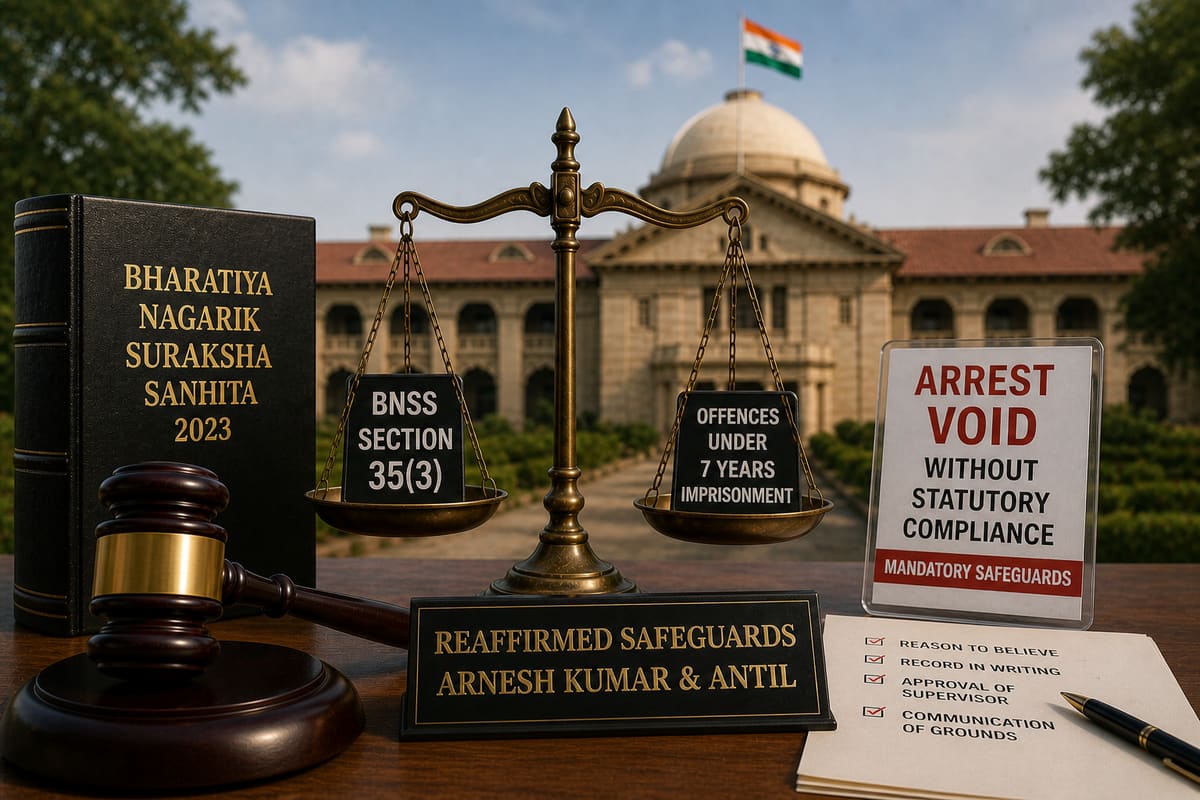
BNSS Section 35(3) | Arrest for Offences Under 7 Years Imprisonment Void Without Statutory Compliance: Allahabad HC Reaffirms Arnesh Kumar & Antil Safeguards
Case Law Analysis
|Allahabad High Court

BNSS Section 35(3) | Arrest for Offences Under 7 Years Imprisonment Void Without Statutory Compliance: Allahabad HC Reaffirms Arnesh Kumar & Antil Safeguards

Allahabad HC rules that arrests for offences punishable by less than seven years imprisonment are illegal unless BNSS 2023's Section 35(3) safeguards are strictly followed. The court mandated compliance with Arnesh Kumar and Satender Kumar Antil guidelines, reinforcing procedural protections against arbitrary arrests and ensuring natural justice for accused persons.

Bail as Default for Non-Bailable Offences Under BNS & Arms Act Absent Life/Death Penalty : Karnataka HC
Case Law Analysis
|Karnataka High Court

Bail as Default for Non-Bailable Offences Under BNS & Arms Act Absent Life/Death Penalty : Karnataka HC

Karnataka High Court rules that offences under Bharatiya Nyaya Sanhita and Arms Act not punishable by life imprisonment or death must follow bail-as-rule principle, granting relief to a 20-year-old student accused of armed robbery. The judgment reinforces that statutory non-bailability cannot override constitutional bail protections where maximum penalties are lower.

BNSS Section 35(3) | Mandatory Notice & Written Reasons Required Before Arrest in Offences Below 7 Years : Telangana HC Reaffirms Arnesh Kumar Safeguards
Case Law Analysis
|Telangana High Court

BNSS Section 35(3) | Mandatory Notice & Written Reasons Required Before Arrest in Offences Below 7 Years : Telangana HC Reaffirms Arnesh Kumar Safeguards

Telangana High Court rules that police must issue a notice and record written reasons before arresting accused in offences punishable by less than seven years under BNSS Section 35(3). The judgment reinforces that arrest is not automatic even during investigation, aligning with the Arnesh Kumar principles to prevent arbitrary detention and uphold due process for non-bailable offences.