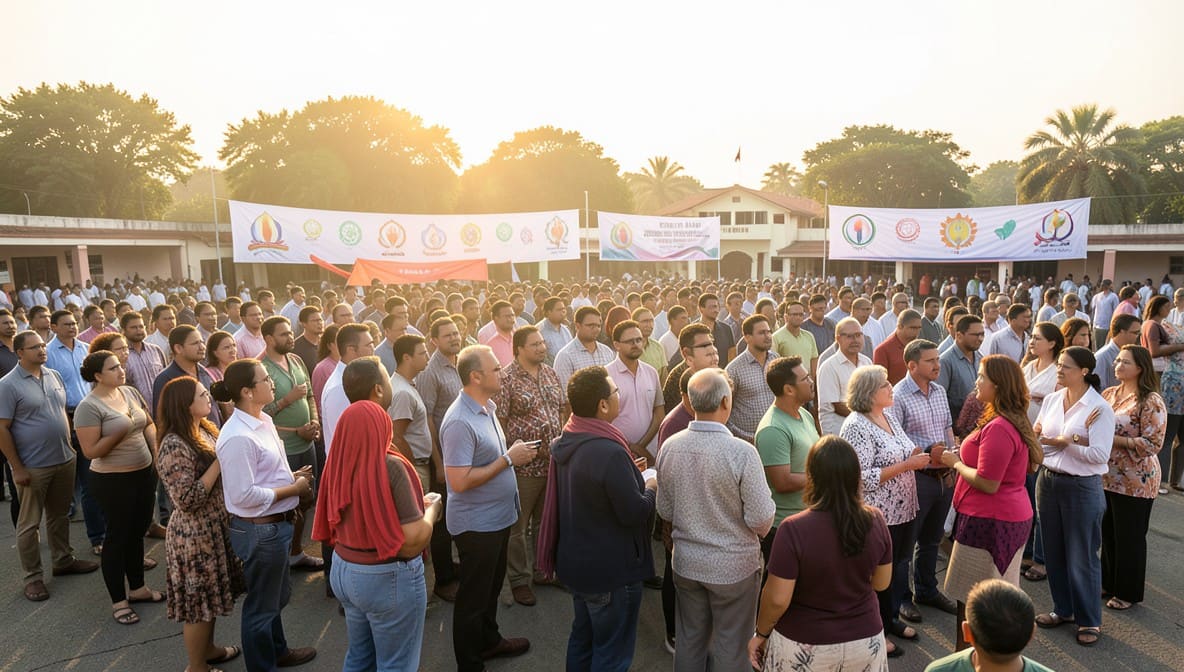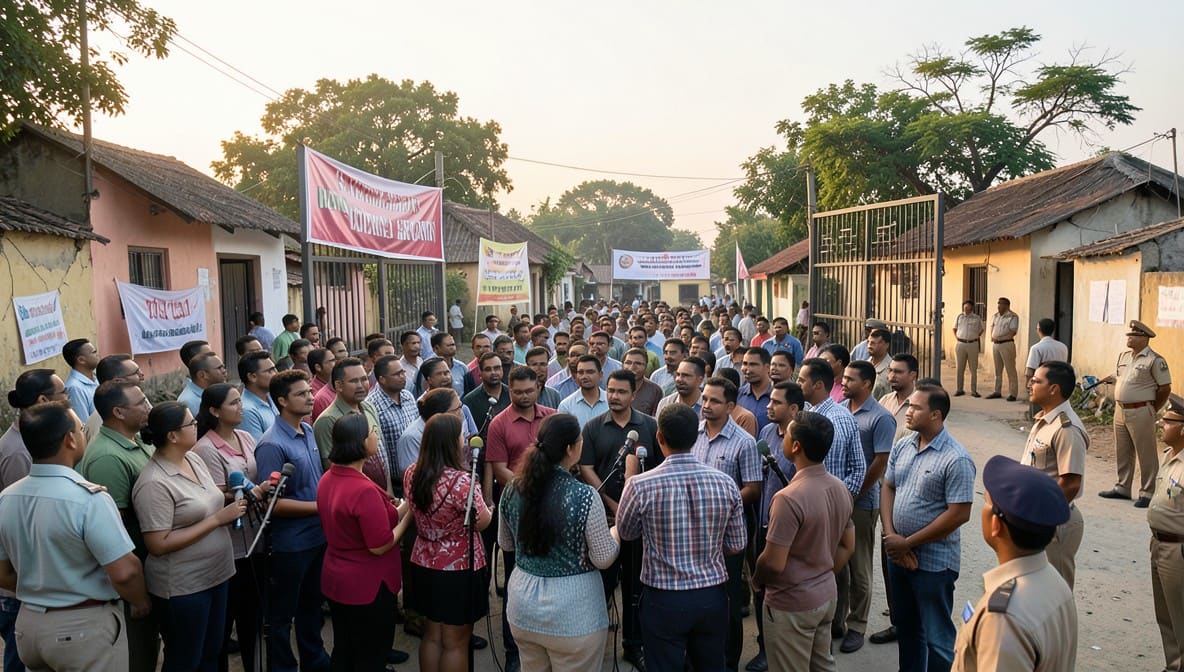
The Telangana High Court has reaffirmed that the state cannot cancel a lawfully granted permission for a public meeting based on vague, unsubstantiated fears of public disorder. The judgment underscores that preventive restrictions on fundamental rights under Article 19 must be grounded in specific, objective intelligence - not generalized apprehension.
Background & Facts
The Dispute
The petitioner, A. Gattu Yadav, President of the BRS Party in Wanaparthy District, Telangana, applied to the local police authorities for permission to conduct a public meeting on 09.04.2026 at Dharna Chowk, Gollapally Village Gate, Revally Mandal. The meeting was scheduled from 05:00 p.m. to 09:00 p.m. and was to be addressed by T.H. Harish Rao, MLA, Siddipet, and former Irrigation Minister S. Niranjan Reddy, along with other public representatives.
Key Facts
- The petitioner submitted a formal application seeking permission to hold the meeting and to use a microphone and box-type speaker system.
- The petitioner also requested adequate police bandobast to ensure law and order during the event.
- Respondent No.3, the Sub-Divisional Police Officer (SDPO), Wanaparthy, granted permission vide Proceedings No.73lMike/SDPO-WNP/2026 dated 03.04.2026, subject to 26 conditions.
- On 07.04.2026, Respondent No.2, the Superintendent of Police, Wanaparthy District, issued impugned proceedings No.121/SB-XI/WNPY/2026 cancelling the permission without prior notice or hearing.
- The cancellation order stated only: "Whereas, present Law & Order situations and circumstances, it is considered necessary to take preventive measures in the interest of maintenance of public order and tranquility."
- No specific threat, credible intelligence, or incident was cited to justify the cancellation.
- The petitioner was not afforded any opportunity to be heard before the cancellation.
Procedural History
- 03.04.2026: Permission granted by SDPO (Respondent No.3) for public meeting.
- 07.04.2026: Impugned order issued by Superintendent of Police (Respondent No.2) cancelling permission.
- 08.04.2026: Writ Petition No.10749 of 2026 filed before the Telangana High Court.
- 08.04.2026: Hearing conducted on the same day; judgment delivered on the same day.
The Parties' Positions
For the Petitioner:
- The cancellation was arbitrary, non-transparent, and violated the principles of natural justice.
- The SDPO had already assessed the situation and imposed 26 conditions - indicating the meeting could be safely managed.
- The State’s reliance on speculative crowd estimates (7,000 - 10,000 persons) without evidence of past violence or specific threats was legally insufficient.
- The order violated Article 19(1)(a) (freedom of speech) and Article 19(1)(b) (right to assemble peaceably without arms).
- Relied on W.P.No.32799 of 2024 and W.P.No.1518 of 2025 (both Telangana HC) where similar cancellations were struck down.
For the Respondents:
- Intelligence inputs indicated potential mobilization of 7,000 - 10,000 persons, exceeding permissible limits.
- There was a risk of crowd mismanagement and recurrence of past violence in Lagacherla Village.
- The local political functionary, Dodla Ramulu, with multiple criminal antecedents including unlawful assembly and rioting, was allegedly leading the agitation.
- The State has a duty to act preventively under Section 144 CrPC and other statutory powers to maintain public order.
- The cancellation was a lawful preventive measure.
Relief Sought
The petitioner sought:
- A writ of mandamus declaring the cancellation order illegal and violative of Articles 14, 19(1)(a), and 19(1)(b).
- Setting aside of the impugned order dated 07.04.2026.
- Direction to permit the public meeting to proceed as originally sanctioned by Respondent No.3.
- Suspension of the cancellation order pending disposal of the writ petition under Section 151 CPC.
The Legal Issue
The central question was whether the cancellation of a lawfully granted permission for a public meeting, based solely on generalized apprehension of public disorder and without specific, cogent reasons or prior hearing, violates Article 19(1)(b) of the Constitution and whether such action can be justified as a reasonable restriction under Article 19(3).
Arguments Presented
For the Petitioner
The petitioner’s counsel argued that the right to assemble peaceably is a fundamental right protected under Article 19(1)(b). The State may impose reasonable restrictions only if there is a clear, proximate, and imminent threat to public order. Mere speculation about crowd size or the criminal antecedents of a participant, without evidence of incitement or past violence linked to this event, does not meet the threshold. The SDPO’s prior grant of permission with 26 conditions demonstrated that the event could be managed lawfully. The cancellation without notice or hearing violated the principles of natural justice. Reliance was placed on W.P.No.32799 of 2024 and W.P.No.1518 of 2025, where this Court had held that preventive action must be based on concrete intelligence, not vague fears.
For the Respondent
The Government Pleader contended that the State has a constitutional duty to maintain public order under Article 21 and Section 144 CrPC. The intelligence inputs suggesting mobilization of 7,000 - 10,000 persons, coupled with the involvement of a known rowdy with criminal history, created a reasonable apprehension of violence. The State is not required to wait for violence to occur before acting. The cancellation was a proportionate preventive measure. The petitioner’s right to assemble is not absolute and must yield to the larger public interest in safety.
The Court's Analysis
The Court observed that while the State has the authority to impose reasonable restrictions on fundamental rights under Article 19(3), such restrictions must be narrowly tailored and based on specific, objective grounds. The impugned order dated 07.04.2026 contained no factual basis, no reference to any specific threat, no mention of prior incidents at the venue, and no assessment of the conditions imposed by Respondent No.3.
"A bare reading of the impugned proceedings dated 07.04.2026 shows that, respondent No.2 has not assigned any specific valid and cogent reasons for cancelling the permission granted to the petitioner for conducting Public meeting except stating that it is a preventive measure to maintain public order and tranquility."
The Court emphasized that the mere possibility of a large gathering does not justify outright prohibition. It is the duty of the police to manage crowds through adequate deployment, not to suppress lawful expression. The Court distinguished between preventive action and prohibitive action: the former requires evidence of imminent danger; the latter, without justification, becomes censorship.
The Court further noted that the involvement of a person with criminal antecedents does not, by itself, render an entire assembly unlawful. The State must demonstrate direct incitement or a pattern of violence linked to the specific event. The reference to Lagacherla Village was speculative and not tied to the location or nature of the proposed meeting.
The Court held that the failure to afford the petitioner an opportunity of hearing before cancellation rendered the order procedurally flawed. The principles of audi alteram partem are not optional in matters affecting fundamental rights.
The Verdict
The writ petition is allowed. The impugned proceedings No.121/SB-XI/WNPY/2026 dated 07.04.2026 issued by Respondent No.2 are set aside. The petitioner is directed to conduct the public meeting on 09.04.2026 from 05:00 p.m. to 09:00 p.m. strictly in accordance with the 26 conditions imposed by Respondent No.3. The official respondents are permitted to take lawful action in case of any violation of law during the meeting. There shall be no order as to costs.
What This Means For Similar Cases
Preventive Action Requires Concrete Intelligence
- Practitioners must challenge cancellations of public meetings where authorities rely on vague phrases like "law and order situation" without citing specific threats, intelligence reports, or prior incidents.
- The burden shifts to the State to produce documented, time-bound, and location-specific evidence of imminent danger.
Crowd Size Alone Is Not a Ground for Prohibition
- Estimates of attendance (e.g., 7,000 - 10,000 persons) cannot justify outright bans. The State must demonstrate capacity to manage the crowd through adequate police deployment.
- Courts will not uphold prohibitions merely because an event is large or politically sensitive.
Natural Justice Is Non-Negotiable in Fundamental Rights Cases
-
Any order curtailing Article 19(1)(b) rights must be preceded by a hearing, even if brief.
-
Post-facto justifications will not cure procedural illegality.
-
Always demand production of the intelligence report underlying the cancellation.
-
Cite W.P.No.32799 of 2024 and W.P.No.1518 of 2025 as binding precedents from the Telangana High Court.
-
Argue that Section 144 CrPC cannot be used as a blanket tool to suppress lawful assembly.