The Tripura High Court has delivered a significant ruling affirming that the State cannot arbitrarily bypass the lowest bidder in a public tender unless a compelling, verifiable public interest justifies such deviation. The judgment underscores that financial savings to the exchequer, procedural fairness, and transparency are non-negotiable pillars of public procurement, and that post-hoc justifications, especially when contradicted by evidence, amount to mala fide exercise of power.
Background & Facts
The Dispute
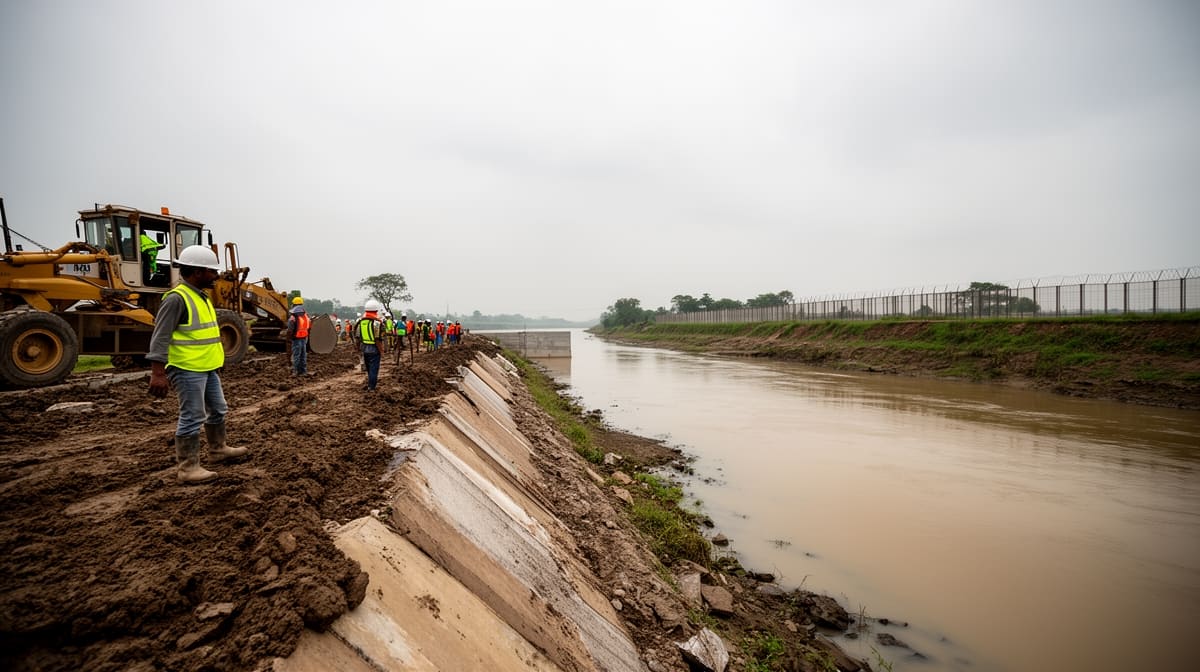
The petitioner, Abu Sufian, a Class-1(A) category government contractor enlisted in Assam, participated in an e-tender issued by the Public Works Department (PWD), Tripura, for raising and strengthening embankments along the Kailashahar border with Bangladesh. The estimated cost of the work was Rs.6,58,53,370, with a 90-day completion deadline. The petitioner submitted the lowest bid at Rs.3,10,23,523, which was 52.89% below the estimated cost. The second lowest bidder, M/s S.N. Bhattacharjee & Sons, quoted Rs.3,93,73,730, which was Rs.83,50,207 higher than the petitioner’s bid.
Key Facts
- The tender explicitly permitted contractors enlisted in other states, including Assam, to participate.
- The petitioner submitted a valid Class-1(A) contractor certificate issued by the Additional Chief Engineer, PWD(R&B), Assam, dated 25.11.2024 (Annexure-3).
- On 05.03.2025, the Executive Engineer informed the petitioner that his bid was provisionally accepted but that a complaint had been lodged regarding the authenticity of his enlistment.
- On 10.03.2025, the PWD(R&B), Assam, confirmed via letter (Annexure-5) that the petitioner’s registration was genuine and valid.
- Despite this confirmation, the 4th respondent issued the Letter of Acceptance on 11.03.2025 to the L2 bidder, M/s S.N. Bhattacharjee & Sons.
- The petitioner filed complaints on 11.03.2025 and a legal notice on 12.03.2025, all of which were ignored.
- A work order was issued to the L2 bidder on 13.03.2025.
Procedural History
- 31.01.2025: Tender notice issued for embankment works.
- 28.02.2025: Bid submission deadline.
- 05.03.2025: Petitioner informed his bid was provisionally accepted.
- 10.03.2025: Assam PWD confirms validity of petitioner’s Class-1(A) registration.
- 11.03.2025: Letter of Acceptance issued to L2 bidder.
- 11.03.2025: Petitioner files complaint and representation.
- 12.03.2025: Legal notice sent to respondents.
- 13.03.2025: Work order issued to L2 bidder.
- 13.03.2025: Writ Petition (WP(C) No.183 of 2025) filed before Tripura High Court.
- 08.04.2025: Court asks Government Advocate to explain why L2 was selected over L1.
- 25.04.2025: First counter affidavit filed by respondents 1 - 5.
- 03.05.2025: Additional counter affidavit filed, claiming national emergency and poor bidding trends.
- 20.02.2026: Counter affidavit filed by respondent no.6.
- 27.02.2026: Third affidavit filed by respondents 1 - 5, admitting only 36.36% work completed during stipulated period.
- 13.03.2026: Judgment pronounced.
The Parties' Positions
Petitioner: Argued that his bid was the lowest, his eligibility was verified by Assam PWD, and the selection of L2 was arbitrary, mala fide, and violative of Article 14. He contended that the alleged national emergency was fabricated and unsupported by evidence.
Respondents 1 - 5: Claimed the petitioner’s dual enlistment (Tripura Class-IV(A) and Assam Class-1(A)) violated CPWD Rules, that low bids were undesirable, and that a national emergency due to Bangladesh’s embankment construction justified selecting L2. Later admitted work progress was only 36.36% by the deadline.
Respondent No.6: Adopted respondents 1 - 5’s arguments and admitted completing only 71% of work by February 2026.
Relief Sought
The petitioner sought quashing of the work order dated 13.03.2025, declaration that he was the rightful lowest bidder, issuance of work order to him, and costs. In the alternative, he sought blacklisting of respondent no.6 and compensation for loss of opportunity.
The Legal Issue
The central question was whether the State can reject the lowest bidder in a public tender without a demonstrable, objective, and verifiable public interest justification, and whether post-hoc claims of national emergency and non-compliance with contractor rules can validate an arbitrary selection that violates Article 14 of the Constitution.
Arguments Presented
For the Petitioner
The petitioner relied on Tata Cellular v. Union of India and Michigan Rubber v. State of Karnataka to argue that while courts do not interfere with policy decisions, they must intervene where selection is arbitrary, mala fide, or violates the principle of equal treatment. He emphasized that the tender conditions explicitly permitted inter-state enlistment, and the Assam PWD’s confirmation rendered the disqualification ground invalid. He contended that the alleged national emergency was temporally disconnected from the tender process and contradicted by the respondents’ own admission of minimal work progress.
For the Respondent/State
The respondents argued that low bids vitiate the working environment and that the petitioner’s dual enlistment violated CPWD Rules. They invoked a national emergency due to Bangladesh’s embankment construction as justification for selecting the L2 bidder, despite the higher cost. They claimed the L2 bidder had better resource mobilization and that the work was urgent. However, they failed to provide any contemporaneous documentation supporting the emergency claim or evidence of the L2 bidder’s superior capacity.
The Court's Analysis
The Court undertook a rigorous analysis of the principles of judicial review in public procurement, drawing extensively from Tata Cellular, Asia Foundation, and Municipal Corporation, Ujjain. It held that while the State has discretion to reject any tender, this power is not absolute and must be exercised reasonably, fairly, and without arbitrariness.
"The duty of the court is to confine itself to the question of legality... whether the decision is such that no responsible authority acting reasonably and in accordance with relevant law could have reached."
The Court found that the petitioner’s eligibility was not in doubt. The tender did not restrict enlistment to Tripura alone, and the Assam PWD’s verification was conclusive. The respondents’ reliance on CPWD Rule 6.1.4 was dismissed as an afterthought, since the State of Assam had validly issued the registration and no prohibition existed in the tender documents.
The Court further rejected the national emergency justification as factually baseless. The alleged change in Bangladesh’s policy occurred in August 2024, five months before the tender, yet no urgency was expressed until after the petitioner’s bid was rejected. The respondents’ initial claim that 50% of work was completed by April 2025 was directly contradicted by their later affidavit admitting only 36.36% completion by the deadline of 12.06.2025. This inconsistency was held to be a deliberate attempt to mislead the Court.
The Court emphasized that repeated extensions granted to the L2 bidder, despite its failure to meet deadlines, demonstrated clear favoritism. The failure to terminate the contract despite gross delay further indicated mala fide intent.
"The plea of possible emergency... is being used to draw wool over the eyes of the Court and somehow justify the arbitrary and illegal decision to disqualify the petitioner."
The Court concluded that the selection of the higher bidder was not based on any legitimate criterion but on bias and favoritism, violating the constitutional guarantee of non-arbitrariness under Article 14.
The Verdict
The Tripura High Court quashed the work order dated 13.03.2025 issued to respondent no.6, declared the rejection of the petitioner’s bid as mala fide and arbitrary, and directed the respondents to blacklist respondent no.6 for one year from future government contracts. The Court ordered the respondents to pay costs of Rs.50,000 to the petitioner. The Court did not direct the issuance of a work order to the petitioner, holding that the tender process must be restarted to ensure fairness.
What This Means For Similar Cases
Public Interest Must Be Documented, Not Alleged
- Practitioners must now demand contemporaneous, verifiable evidence for any claim of "national emergency" or "public interest" justifying deviation from lowest bid.
- Post-hoc justifications, especially when contradicted by progress reports, will be treated as mala fide.
- Government departments must maintain audit trails for emergency declarations tied to tender decisions.
Dual Enlistment Is Not Per Se Illegal
- Contractors holding valid registrations in multiple states cannot be disqualified unless the tender document explicitly prohibits it.
- Disqualification based on internal CPWD rules without express inclusion in tender conditions is invalid.
- State authorities must adhere strictly to the terms of the tender document, not impose hidden conditions.
Judicial Review Extends to Post-Award Conduct
-
Courts will examine not only the award decision but also subsequent conduct - including delays, extensions, and false affidavits - to determine mala fide intent.
-
Repeated extensions to an inefficient contractor, coupled with misleading court affidavits, constitute grounds for blacklisting.
-
Costs and blacklisting are now viable remedies for procedural fraud in public tenders.
-
Always verify tender conditions against statutory rules - discrepancies favor the bidder.
-
Document all communications with tendering authorities; silence after verification is not consent to rejection.
-
Challenge false progress claims in court affidavits with independent evidence or official records.