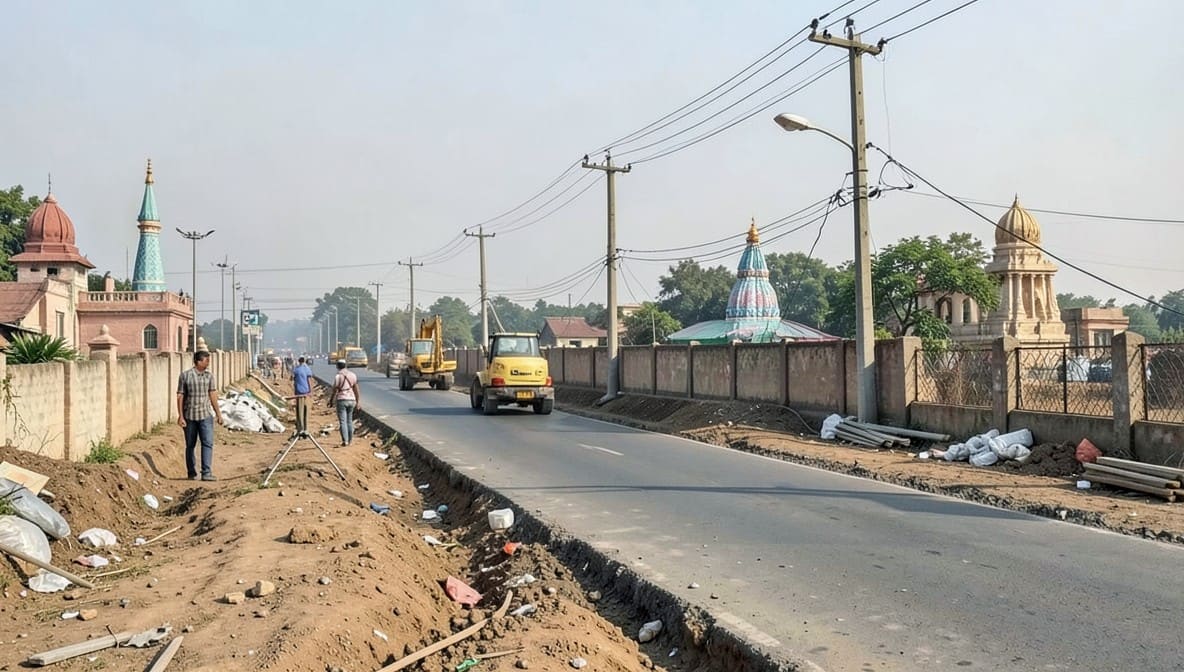
The Allahabad High Court's judgment in Tata Projects Limited v. Union of India marks a significant intervention in contractual disputes involving state authorities. The Court held that National Highway Authority of India (NHAI) acted arbitrarily by terminating an Engineering, Procurement, and Construction (EPC) contract mid-term, despite its own failure to provide hindrance-free land as mandated under the agreement. The ruling underscores that state authorities cannot unilaterally terminate contracts when their own non-compliance with contractual obligations is the primary cause of delays, especially in projects of public importance.
Background & Facts
The Dispute
The petitioner, Tata Projects Limited, was awarded an EPC contract by NHAI on 12 March 2021 for the widening and strengthening of NH-709A (Garhmukteshwar to Meerut), covering a stretch of 50.254 km at a cost of Rs. 940.68 crores. The project's appointed day was 10 October 2021, with a completion deadline of 10 October 2023. The contract required NHAI to provide 90% of the land free from encumbrances within 30 days of the agreement and hindrance-free stretches of at least 5 km to facilitate smooth execution.
Key Facts
- Contract Terms: Under Article 3.1(iii)(a) of the EPC agreement, NHAI was obligated to provide 90% of the land in contiguous 5 km stretches within 30 days of the agreement. Article 8.2 required the preparation of a Handover Memorandum detailing vacant and encumbered land.
- Land Handover Issues: Despite NHAI's claim of handing over 94.76% of the land via a Handover Memorandum dated 21 September 2021, subsequent correspondence and reports revealed that only 29.914 km (59.5%) was actually hindrance-free. Hindrances included:
- Private constructions (mosques, temples, boundary walls)
- Land acquisition disputes (farmer agitations, compensation delays)
- Utilities (electric poles, pipelines, trees)
- Delays and Extensions: The petitioner repeatedly sought time extensions citing NHAI's failure to provide hindrance-free land:
- 7 July 2022: Petitioner requested 248 days extension due to hindrances.
- 8 August 2022: NHAI granted only 42 days extension, acknowledging only 29.914 km of land as available.
- 21 November 2023: Authority’s Engineer recommended 196 days extension due to persistent hindrances.
- 10 July 2024: Authority’s Engineer proposed 248 days extension, citing 7.998 km of land still encumbered.
Procedural History
- 11 December 2024: NHAI issued a curative notice under Article 23.1(i) of the EPC agreement, alleging slow progress and poor maintenance.
- 19 November 2024: Petitioner submitted a detailed reply, citing NHAI’s failure to provide hindrance-free land and requesting further time.
- 11 December 2024: NHAI rejected the request for further extension.
- 23 December 2024: NHAI issued a show-cause notice for termination.
- 3 January 2025: Petitioner replied, reiterating land issues and assuring completion if granted time.
- 14 January 2025: NHAI terminated the contract without considering the petitioner’s reply.
- 18 March 2025: High Court granted interim relief, directing NHAI to file an affidavit specifying land handover dates.
- 26 November 2025: Court issued strict warnings for non-compliance with its orders.
- 30 November 2025: NHAI filed a supplementary affidavit with the Handover Memorandum.
- 15 May 2026: Judgment reserved.
- 8 July 2026: Judgment delivered, quashing the termination order.
Relief Sought
The petitioner sought:
- Quashing of NHAI’s termination order dated 14 January 2025.
- Restoration of the contract and direction to NHAI to re-schedule the project timeline.
- Compensation for losses incurred due to arbitrary termination.
The Legal Issue
The Court framed two key questions:
- Whether NHAI complied with its obligation under Articles 8.1 and 8.2 of the EPC agreement to provide hindrance-free land, and if the Handover Memorandum reflected the actual possession of the site.
- Whether the dispute involved purely factual questions requiring arbitration under Article 26 of the agreement, or if NHAI’s termination was arbitrary and unlawful, warranting judicial review under Article 226.
Arguments Presented
For the Petitioner
- Non-Compliance by NHAI: NHAI failed to provide hindrance-free land as per Article 8.1 and 8.2, rendering the Handover Memorandum misleading. The appendix to the Memorandum did not disclose private constructions (mosques, temples) or land disputes, which were later acknowledged in NHAI’s own letters.
- Authority’s Engineer Reports: The Engineer’s reports (26 September 2022, 10 July 2024) confirmed persistent hindrances, yet NHAI ignored these and granted only 42 days extension instead of the 248 days requested.
- Arbitrary Termination: NHAI did not consider the petitioner’s detailed reply to the show-cause notice, indicating pre-determined intent to terminate the contract.
- Public Interest: Completing the project with the petitioner would save Rs. 200+ crores compared to re-tendering, and the petitioner undertook to finish the work by December 2025.
- Judicial Precedents: Relied on ABL International Ltd v. Export Credit Guarantee Corporation of India Ltd (2004 3 SCC 553), MP Power Management Company Ltd v. Sky Power Southeast Solar India Pvt Ltd (2023 2 SCC 703), and A.P. Electrical Equipment Corporation v. Tehsildar (2025 SCC Online SC 447) to argue that writ jurisdiction is maintainable where state action is arbitrary.
For the Respondent (NHAI)
- Contractual Compliance: NHAI argued that 94.76% of the land was handed over as per the Handover Memorandum, and the petitioner acknowledged receipt via a letter dated 21 September 2021. Hindrances like utilities and trees were the petitioner’s responsibility to remove under Article 9.2.
- Arbitration Clause: Disputes should be resolved via arbitration under Article 26 of the agreement, as the matter involved factual disputes unsuitable for writ jurisdiction.
- Precedent: Cited Union of India v. Puna Hinda (2021 10 SCC 690) to argue that writ courts should not interfere in purely contractual disputes.
The Court's Analysis
The Court conducted a detailed examination of the EPC agreement, NHAI’s obligations, and the chronology of events leading to the termination:
-
Obligations Under the EPC Agreement
- Article 3.1(iii)(a): NHAI was to provide 90% of the land in 5 km contiguous stretches within 30 days of the agreement.
- Article 8.2: Required a Handover Memorandum detailing vacant and encumbered land, with an appendix specifying hindrances and timelines for their removal.
- Article 10.5: Allowed time extensions for delays caused by NHAI’s failure to provide Right of Way or remove hindrances.
-
Discrepancies in the Handover Memorandum
- The Handover Memorandum dated 21 September 2021 claimed 94.76% land handover, but its appendix was sketchy and did not disclose private constructions or land disputes.
- NHAI’s letter dated 8 August 2022 acknowledged that only 29.914 km (59.5%) was hindrance-free.
- The Authority’s Engineer’s report dated 10 July 2024 confirmed 7.998 km still encumbered, including mosques, temples, and land disputes.
-
NHAI’s Arbitrary Conduct
- NHAI ignored repeated requests for extensions and Authority’s Engineer’s recommendations for 196 and 248 days.
- The termination order dated 14 January 2025 was identical to the show-cause notice, indicating non-application of mind.
- NHAI did not consider the petitioner’s detailed reply, which cited photographic evidence and hindrance reports.
-
Judicial Precedents on Arbitrariness The Court relied on ABL International Ltd to hold that state authorities must act fairly and reasonably under Article 14. Arbitrariness was established because:
- NHAI failed to discharge its contractual obligations.
- The termination was pre-determined and ignored material evidence.
- The public interest in completing the highway outweighed NHAI’s contractual rights.
"The act of a party which is State under Article 12 in this case is found to be arbitrary one against affect work of public importance and so this Court will not shirk away from its responsibility in arresting any miscarriage of justice in larger public interest."
The Verdict
The Court allowed the writ petition and:
- Quashed the termination order dated 14 January 2025 and subsequent actions, including forfeiture of bank guarantees and issuance of fresh tender.
- Directed NHAI and the petitioner to conduct a joint site inspection within one month and re-schedule the project timeline based on:
- The Authority’s Engineer’s report dated 10 July 2024.
- Articles 13, 15, 16, and 17 of the EPC agreement (pertaining to change of scope, time extensions, and dispute resolution).
- No costs were awarded.
What This Means For Similar Cases
State Authorities Cannot Evade Contractual Obligations
- Handover Memorandum Must Reflect Reality: State authorities entering into EPC or infrastructure contracts must ensure that Handover Memorandums accurately reflect actual possession of land. Misrepresentations in such documents can vitiate termination actions.
- Burden of Proof on the State: If the state claims compliance with land handover obligations, it must provide date-wise evidence of possession. Vague affidavits or sketchy appendices will not suffice.
Arbitrary Termination Attracts Judicial Scrutiny
- Non-Application of Mind is Fatal: Termination orders that reproduce show-cause notices verbatim or ignore detailed replies will be set aside for arbitrariness.
- Public Interest Overrides Contractual Formalities: Courts will intervene in contractual disputes where state action is arbitrary, especially in infrastructure projects involving public funds.
Writ Jurisdiction vs. Arbitration in Contractual Disputes
-
Writ Maintainable for Arbitrariness: Even in commercial contracts, if the state’s action is arbitrary, unreasonable, or mala fide, writ jurisdiction under Article 226 is maintainable (ABL International Ltd).
-
Arbitration Not Mandatory for Pure Questions of Law: If the dispute involves interpretation of contractual clauses or admission of non-compliance, courts may adjudicate without relegating parties to arbitration.
-
Complex Factual Disputes May Still Require Arbitration: Where oral evidence or detailed factual adjudication is necessary, courts may decline jurisdiction and direct parties to arbitration.
-
Practitioners should argue that state authorities cannot terminate contracts without first fulfilling their own obligations (e.g., land handover, approvals).
-
Documentary evidence (e.g., Authority’s Engineer reports, NHAI’s own letters) trumps self-serving affidavits.
-
Public interest in completing infrastructure projects justifies judicial intervention even in contractual disputes.
-
Termination orders must demonstrate application of mind - cut-and-paste orders will be struck down.