The Rajasthan High Court has delivered a landmark ruling affirming that statutory urban development authorities cannot forfeit massive earnest money deposits when they fail to deliver encroachment-free, accurately demarcated land as explicitly promised in public auction notices. The judgment underscores the constitutional obligation of state instrumentalities to act fairly and non-arbitrarily, even in commercial transactions.
Background & Facts
The Dispute
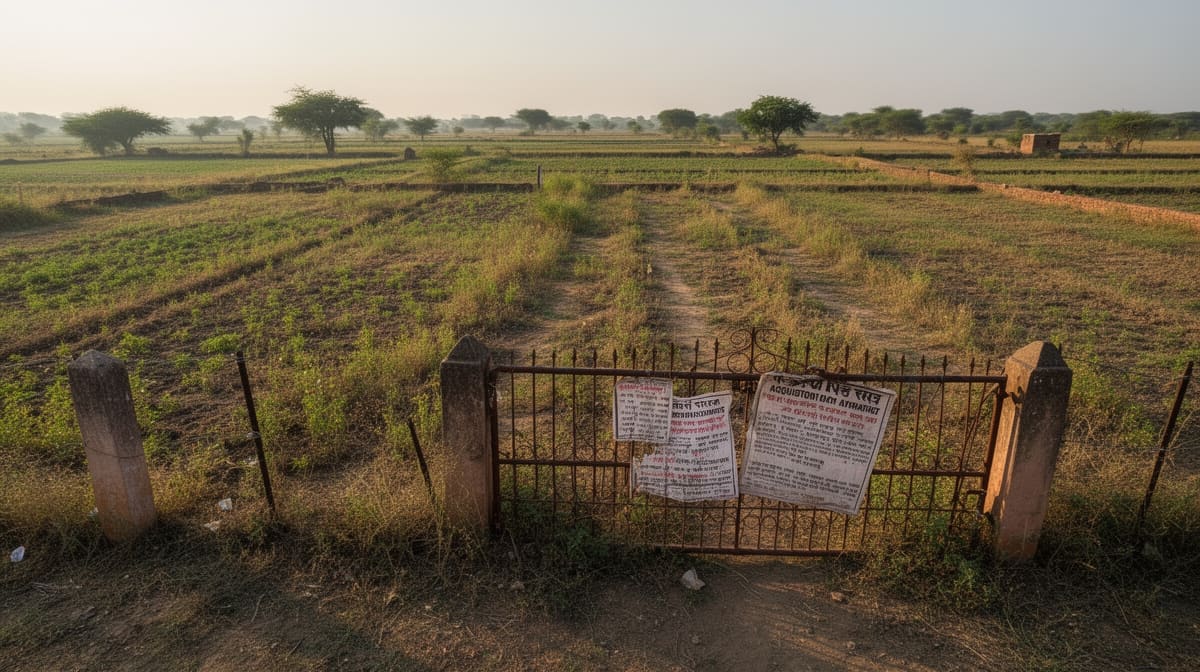
The dispute arose from two commercial land auctions conducted by the Kota Development Authority (KDA), formerly known as the Urban Improvement Trust, Kota. The KDA issued e-auction notices on 15.06.2023 and 27.06.2023 for two adjacent plots - Plot CP-01 (7,376 sq. meters) and Plot CP-02 (7,346 sq. meters) - located in Village Kunhadi, Kota, adjacent to the Pratap Smarak Commercial Scheme. The reserve price was set at Rs. 12,500 per square meter, but the bidding was initiated at Rs. 40,000 per sq. m for Plot CP-01 and Rs. 44,000 per sq. m for Plot CP-02.
Key Facts
- The petitioners, M/s. Akansha Infra Housing Project and M/s. Akansha Empire, participated in both auctions.
- On 15.06.2023, the petitioners deposited earnest money of Rs. 59,00,800 for Plot CP-01.
- On 27.06.2023, they deposited earnest money of Rs. 64,64,500 for Plot CP-02.
- After being declared successful bidders, the petitioners deposited 15% of the total auction amount within three days as required: Rs. 4,46,43,240 for Plot CP-01 and Rs. 4,99,71,165 for Plot CP-02, aggregating to Rs. 9,46,14,405.
- On 06.11.2023, an allotment letter for Plot CP-01 was issued to M/s. Akansha Empire, the sister entity.
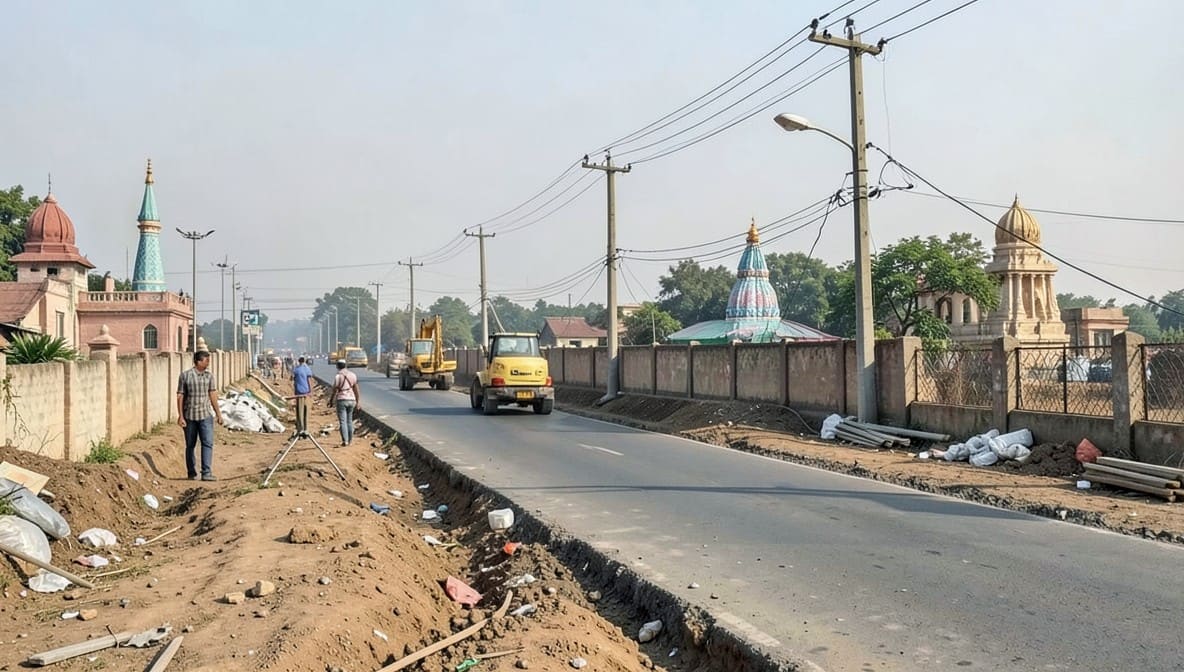
- The petitioners discovered severe physical encroachments on both plots, with actual land area significantly less than advertised.
- Access to the plots was obstructed, rendering them commercially unusable.
- The petitioners submitted formal representations on multiple occasions, including on 13.11.2025, requesting withdrawal and refund.
- Internal KDA note-sheets dated 01.05.2024 and other communications confirmed the existence of encroachments and discrepancies in land demarcation.
- KDA proposed to forfeit the entire Rs. 9.46 Crores and issue a demand notice for the remaining 85% of the bid amount.
Procedural History
- 15.06.2023: E-auction notice issued for Plot CP-01
- 27.06.2023: E-auction notice issued for Plot CP-02
- 06.11.2023: Allotment letter issued for Plot CP-01
- 13.11.2025: Petitioners formally requested withdrawal and refund
- Early 2026: KDA internal committees recommended forfeiture of deposits
- 2026: Writ Petitions No. 5754/2026 and 5753/2026 filed before the Rajasthan High Court
- 23.04.2026: Arguments concluded
- 16.05.2026: Judgment pronounced
Relief Sought
The petitioners sought quashing of KDA’s proposal to forfeit Rs. 9,46,14,405, a direction for immediate refund of the entire deposited amount, and interest on the same.
The Legal Issue
The central question was whether a statutory authority can forfeit earnest money aggregating to Rs. 9.46 Crores when it fails to deliver encroachment-free, accurately measured land as explicitly represented in its own auction notices, and whether such forfeiture violates Article 14 of the Constitution of India.
Arguments Presented
For the Petitioner
The petitioners argued that the KDA, as a state instrumentality, had a constitutional duty to provide land free of encroachments and matching the advertised dimensions. They relied on internal KDA note-sheets (Annexures 18 and 19) that admitted the existence of encroachments and directed their removal. They cited Dr. Shailendra Birla v. Prahlad Gujral (2021), where this Court had ordered a full refund in a nearly identical scenario. They emphasized that time is of the essence in commercial real estate and that the State cannot impose rigid timelines for payment while failing to fulfill its own foundational obligations. They invoked Kailash Nath Associates v. DDA (2015) to argue that forfeiture without proof of actual loss is arbitrary and violative of Article 14.
For the Respondent
The KDA contended that the matter was purely contractual and outside the purview of Article 226. It relied on UT Chandigarh v. Amarjeet Singh (2009) and Punjab UDA v. Raghu Nath Gupta (2012) to invoke the doctrine of caveat emptor and the ‘as is where is’ principle, arguing that the petitioners should have inspected the land before bidding. It dismissed the internal note-sheets as mere administrative opinions, not binding decisions, and claimed the petitioners’ grievances were a post-hoc excuse to avoid contractual liability.
The Court's Analysis
The Court rejected the respondents’ threshold argument that the dispute was purely contractual and beyond judicial review under Article 226. It held that when a state instrumentality engages in commercial activity, it remains bound by Article 14 and cannot act arbitrarily. The Court emphasized that the State cannot hide behind contractual formalities when its own failure to deliver the core subject matter of the contract - encroachment-free, accurately sized land - renders the transaction commercially impossible.
"The proposal qua forfeiture of a colossal sum of Rs. 9.46 Crores by an instrumentality of the State, amidst severe, substantiated allegations of structural administrative failure, unquestionably warrants strict constitutional scrutiny."
The Court found the internal note-sheets of the KDA to be critical admissions of fact. The note-sheet dated 01.05.2024 explicitly acknowledged encroachments, discrepancies in land demarcation, and the failure to remove them despite directives. The Court held that such documents, though internal, constitute undeniable evidence of the State’s own failure.
"When the respondent-authority has categorically stated in its own internal note-sheets that encroachments should be removed, it amounts to an irrefutable admission that the land was indeed encroached at the time of the auction."
The Court distinguished Amarjeet Singh and Raghu Nath Gupta, noting those cases involved demands for ancillary amenities like water or electricity on otherwise clear land. Here, the failure was foundational: the land itself was not as represented. The Court held that a bidder is entitled to rely on the solemn representations of a state authority and cannot be expected to conduct forensic surveys before participating in a public auction.
The Court further relied on Kailash Nath Associates v. DDA to hold that forfeiture of earnest money without proof of actual loss is arbitrary and violative of Article 14. It noted that the State would not suffer any loss upon refund, as the land, located near the upcoming Chambal River Front Project, would appreciate in value and fetch a higher price in a future auction.
The Court also drew parity with its own judgment in Dr. Shailendra Birla, where a full refund with interest was ordered under similar circumstances.
The Verdict
The petitioners succeeded. The Court quashed the KDA’s proposal to forfeit the deposited amount and directed the immediate refund of the entire sum of Rs. 9,46,14,405 (Nine Crores Forty Six Lakh Fourteen Thousand Four Hundred and Five Rupees). The KDA was ordered to process and release the refund within three months from the date of judgment. In the event of delay, the Court directed that interest shall accrue at the rate of 10% per annum from the date of judgment until actual payment.
What This Means For Similar Cases
State Authorities Cannot Hide Behind 'As Is Where Is' for Core Defects
- Practitioners must now argue that caveat emptor does not apply when the State misrepresents the fundamental condition of land - such as encroachments or area discrepancies - in official auction notices.
- Any forfeiture of earnest money without proof of actual loss is prima facie arbitrary under Article 14.
- Internal administrative notes admitting defects can be used as binding admissions against the State.
Time Is of the Essence - Reciprocal Obligations Matter
- If a buyer is bound by strict timelines to pay the balance, the State must equally discharge its obligation to deliver usable land within the same timeframe.
- Delayed remediation after the contractual deadline does not cure the initial breach.
- Commercial viability is a legitimate consideration in public procurement disputes.
Precedent Now Extends to All Public Auctions
- This judgment sets a binding precedent for all Urban Development Authorities across India.
- Developers can now challenge forfeitures where land is not as advertised, even if auction terms contain standard clauses.
- Authorities must now conduct rigorous pre-auction verification and disclose known encumbrances, or risk full refund liability.