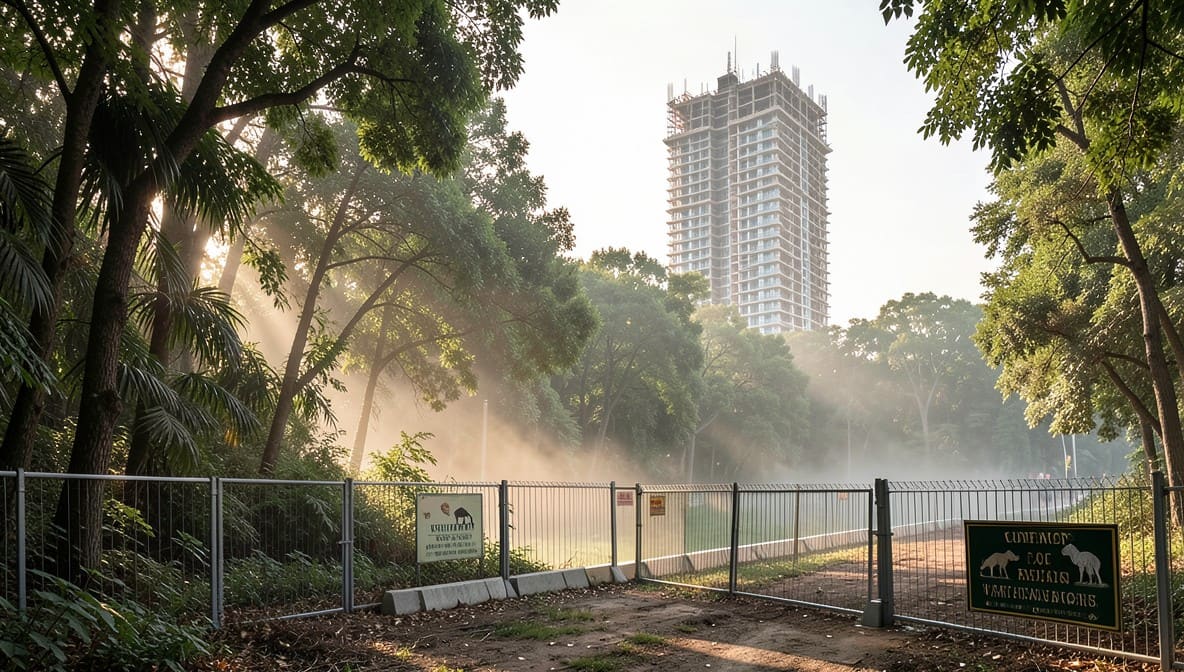
The Punjab & Haryana High Court has clarified that petitions challenging environmental clearances for projects near protected wildlife areas must be filed before the National Green Tribunal, not through writ jurisdiction. This ruling reinforces the statutory exclusivity of the NGT under the National Green Tribunal Act, 2010, and sets a critical precedent for future environmental litigation in India.
Background & Facts
The Dispute
The petitioner, Ashok Kumar Tiwari, filed a Public Interest Litigation challenging the grant of environmental clearance for the "India Trade Tower and International Trade Tower" project located in the revenue estate of Village Bharonjia, Mullanpur Sailba Majri, District SAS Nagar (Mohali). The project, developed by M/s Bhanu Infrabuild (P) Ltd., is situated within 10 kilometers of the Sukhna Wildlife Sanctuary, an ecologically sensitive zone protected under the Wildlife Protection Act, 1972 and the Environment (Protection) Act, 1986.
Key Facts
- The project was granted environmental clearance by the State Environment Impact Assessment Authority (SEIAA), Punjab
- The petitioner alleges that the clearance was granted without mandatory approval from the National Board for Wildlife, as required under Section 35 of the Wildlife Protection Act, 1972
- The project site lies within the 10-kilometer buffer zone around Sukhna Wildlife Sanctuary, triggering stricter environmental scrutiny
- No evidence was presented that the SEIAA conducted a site inspection or disclosed distance calculations to the public
- The petitioner claims the clearance was obtained through manipulation of spatial data and possible bribery
Procedural History
- 2025: Petition filed as CWP-PIL-383-2025 (O&M) before the Punjab & Haryana High Court
- 07.04.2026: Hearing conducted before a Division Bench comprising Chief Justice Sheel Nagu and Justice Sanjiv Berry
- No prior proceedings were initiated before the National Green Tribunal
The Parties' Positions
For the Petitioner
The petitioner, represented by Mr. Nikhil Ghai, argued that:
- The project violates the mandatory 10-km buffer rule around protected wildlife areas
- The SEIAA failed to obtain prior approval from the National Board for Wildlife
- The environmental clearance process was opaque, lacking transparency in distance calculations and site inspections
- Public interest demands judicial intervention due to the scale of ecological harm
For the Respondents
The State of Punjab, represented by Mr. Salil Sabhlok, Sr. Deputy Advocate General, and the Union of India, represented by Mr. Satya Pal Jain, Addl. Solicitor General of India, contended that:
- The matter falls squarely within the exclusive jurisdiction of the National Green Tribunal under Section 14 of the National Green Tribunal Act, 2010
- The High Court cannot entertain a PIL challenging environmental clearances when a statutory remedy exists
- The petitioner has not exhausted the statutory alternative before approaching the High Court
Relief Sought
The petitioner sought:
- A writ of mandamus directing demolition of the project for lack of wildlife clearance
- Constitution of an independent expert committee to assess environmental damage and recommend restoration
- Constitution of a Court-monitored SIT or CBI probe into alleged bribery and manipulation in the clearance process
- Directive to MoEF&CC and Punjab Government to overhaul SEIAA’s transparency and accountability framework
The Legal Issue
The central question was whether the High Court can entertain a Public Interest Litigation challenging the grant of environmental clearance for a project near a wildlife sanctuary, when the National Green Tribunal has been granted exclusive jurisdiction under the National Green Tribunal Act, 2010.
Arguments Presented
For the Petitioner
The petitioner relied on the principle of public trust doctrine and the right to a healthy environment under Article 21 of the Constitution. He argued that the gravity of ecological harm - particularly to a protected sanctuary - justifies direct judicial intervention. He cited M.C. Mehta v. Union of India to assert that environmental protection transcends procedural technicalities. He contended that the SEIAA’s failure to consult the National Board for Wildlife rendered the clearance illegal ab initio, and that the High Court’s writ jurisdiction under Article 226 remains available to enforce fundamental rights.
For the Respondent
The respondents emphasized the statutory framework established by the National Green Tribunal Act, 2010. They cited In re: National Green Tribunal (2015) and K. S. Puttaswamy v. Union of India to argue that the NGT is a specialized tribunal with exclusive jurisdiction over matters arising under the Environment (Protection) Act, 1986 and the Wildlife Protection Act, 1972. They stressed that bypassing the NGT undermines legislative intent and creates forum shopping. The State further noted that the petitioner had not approached the NGT at all, making the PIL premature and legally unsustainable.
The Court's Analysis
The Court undertook a detailed examination of the statutory architecture governing environmental adjudication in India. It observed that the National Green Tribunal Act, 2010 was enacted to provide a specialized, expert-driven forum for environmental disputes, replacing the fragmented jurisdiction of High Courts and civil courts.
"The National Green Tribunal has been vested with exclusive jurisdiction to adjudicate all matters arising under the enactments specified in Schedule I of the Act, which includes the Environment (Protection) Act, 1986 and the Wildlife Protection Act, 1972."
The Court noted that the SEIAA, as a body constituted under the Environment (Protection) Act, operates within this statutory framework. Any challenge to its decision - whether on grounds of procedural irregularity, lack of wildlife clearance, or alleged corruption - must first be brought before the NGT.
The Court rejected the petitioner’s argument that the gravity of the alleged environmental harm justifies direct High Court intervention. It held that while public interest is paramount, it cannot override the legislative mandate establishing a specialized tribunal. The Court emphasized that the NGT is empowered to appoint expert committees, order investigations, and grant relief - including demolition or restoration - which the petitioner sought.
The Court further clarified that allegations of bribery or corruption, while serious, do not transform an environmental dispute into a criminal matter warranting writ jurisdiction. Such allegations, if substantiated, may be investigated by the CBI or SIT, but only after the environmental legality of the clearance is determined by the NGT.
The Court also rejected the request to direct the MoEF&CC to overhaul SEIAA’s functioning, noting that such systemic reform falls within the domain of the executive and legislature, not judicial review in a PIL.
The Verdict
The petition was dismissed. The Court held that the National Green Tribunal has exclusive jurisdiction over the matter and directed the petitioner to approach the NGT with all claims, including those relating to environmental clearance, ecological damage, and alleged procedural violations. The Court granted liberty to the petitioner to file an appropriate application before the NGT within 60 days. All pending applications were disposed of.
What This Means For Similar Cases
Environmental Disputes Must Go Through the NGT First
- Practitioners must file challenges to environmental clearances exclusively before the National Green Tribunal, even if allegations of corruption or procedural fraud are involved
- Writ petitions under Article 226 will be dismissed if the NGT has exclusive jurisdiction under Schedule I of the NGT Act, 2010
- Failure to approach the NGT first renders a PIL non-maintainable, regardless of public interest
Allegations of Corruption Do Not Bypass Statutory Forums
- Allegations of bribery or manipulation in environmental clearances cannot be used to invoke High Court writ jurisdiction
- Such allegations may be raised before the NGT, which may then recommend investigation to CBI or SIT
- The NGT has the power to stay projects, order forensic audits, and refer matters to investigative agencies
Transparency Demands Must Be Addressed Statutorily
- Requests to mandate disclosure of distance calculations or inspection reports must be made as part of an NGT application
- Courts will not direct ministries to overhaul administrative systems through PILs unless a fundamental right is directly violated
- Systemic reform must be pursued through legislative or executive channels, not judicial fiat