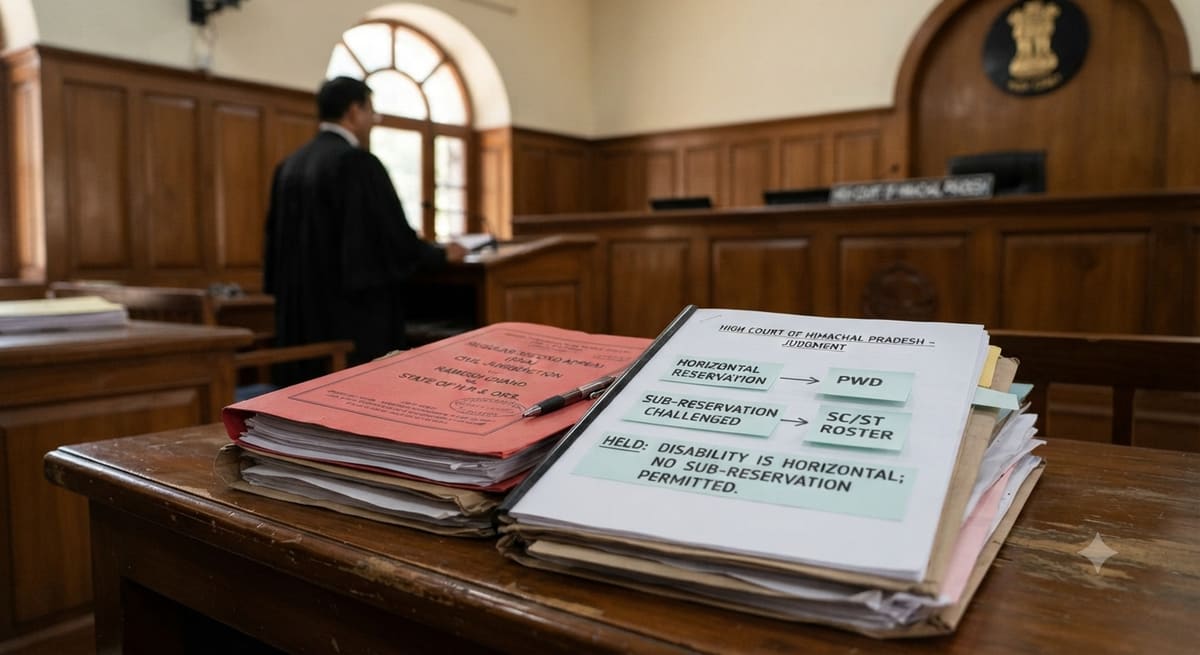
The Central Administrative Tribunal, Bangalore Bench, has held that vertical reservation for Scheduled Castes must be applied before horizontal reservation for Persons with Benchmark Disabilities, ruling that a candidate who qualifies on merit under the SC category cannot be denied appointment merely because he fails to meet the 40% disability benchmark for PwBD reservation. The decision reinforces the Supreme Court's principle in Rajesh Kumar Daria v. Rajasthan Public Service Commission that horizontal reservations operate within vertical quotas, not as a prior filter.
Background & Facts
The Dispute
The applicant, Vasanth Kumar G, a Scheduled Caste candidate with locomotor disability (dwarfism), applied for the Civil Services Examination (CSE) 2023 under both the SC category and the Persons with Benchmark Disability (PwBD) - Locomotor Disability sub-category. He cleared all stages of the examination, securing an aggregate score of 908 (743 in Mains, 165 in Personality Test) and was placed at Serial No. 902 in the UPSC's recommended list dated 16.04.2024. Despite his higher merit, he was not allocated any service, while two candidates ranked below him - Aishwarya Dadarao Ukey (Rank 943, Score 901) and Praduman Kumar (Rank 941, Score 901) - were allotted the Indian Revenue Service (Income Tax) under the SC category. The Union of India contended that the applicant's candidature was recommended only under the PwBD category and, having failed the 40% disability benchmark, he was ineligible for allocation.
Key Facts
- 01.02.2023: Department of Personnel and Training notified the Civil Services Examination Rules, 2023; UPSC issued recruitment notification for approximately 1,105 vacancies, with 37 reserved for PwBD (15 for locomotor disability including dwarfism).
- 28.05.2023: Applicant appeared for Preliminary Examination, securing 87.54 (Paper I) and 82.50 (Paper II); SC cut-off was 59.25.
- 15.09.2023 to 24.09.2023: Main Examination held; applicant secured 743 marks.
- DAF-I: Applicant declared community as SC (1), opted not to change to unreserved, and claimed PwBD under Locomotor Disability with disability percentage "Greater or Equal to 40%" (Form VII certificate).
- DAF-II: Service preferences indicated - IAS as first choice, IRS (IT) as second.
- 15.02.2024: Central Standing Medical Board (CSMB), AIIMS, recorded applicant's disability as 29% (below 40% benchmark).
- 18.03.2024: Appellate Disability Medical Board (ADMB), Army Hospital (R&R), Delhi, confirmed disability at 23%.
- 16.04.2024: UPSC published recommended list; applicant shown at Sl. No. 902 with score 908, category columns reflecting both "SC" and "PwBD-1".
- 31.07.2024: Applicant submitted representation to authorities regarding non-allocation; no response.
- 05.08.2024: RTI query filed seeking reasons for non-allocation; declined.
- 16.10.2024: RTI appeal rejected.
- Private Respondents 4 and 5 (both SC category, ranks 941 and 943, scores 901) allotted IRS (IT).
Procedural History
- 2024: Original Application (OA No. 170/00605/2024) filed before Central Administrative Tribunal, Bangalore Bench, under Section 19 of the Administrative Tribunals Act, 1985.
- 23.10.2026: Order reserved.
- 03.11.2026: Order pronounced.
The Parties' Positions
Applicant: Contended that having qualified on merit under the SC category (score 908, rank 902, well above the SC cut-off of 890), he is entitled to allocation under vertical reservation. The PwBD category is a horizontal reservation that operates within the SC vertical quota; failure to meet the PwBD benchmark does not extinguish his SC candidature. Relied on Rajesh Kumar Daria v. Rajasthan Public Service Commission (2007) 8 SCC 785 and this Tribunal's decision in Bhyrappa P.V. v. Union of India (OA No. 872/2017, dated 20.12.2019).
Respondent Nos. 1 & 3 (Union of India & Department of Revenue): Argued that the applicant applied under the PwBD-LD sub-category; UPSC recommended him only against PwBD vacancies. Having been declared ineligible under PwBD (disability < 40%), he cannot claim allocation under SC category. Cited Rule 26(1) of CSE Rules, 2023 prohibiting change of category after application. Contended that a candidate claiming reservation in a specific category cannot be considered against another reserved category's vacancies.
Respondent No. 2 (UPSC): Through counsel, admitted that the applicant's recommendation was made under both SC and PwBD categories. No written affidavit filed despite Tribunal's direction.
Private Respondents 4 & 5: Remained ex-parte.
Relief Sought
The applicant sought: (a) quashing of the service allocation order dated 13.09.2024 insofar as it allotted IRS (IT) to Respondents 4 and 5; (b) a writ of mandamus directing Respondent No. 1 to appoint him to IRS (IT) considering his merit under the SC category with consequential benefits; (c) costs.
The Legal Issue
The central question was whether a candidate who applies under both a vertical reservation category (Scheduled Caste) and a horizontal reservation category (PwBD), qualifies on merit under the vertical category but fails the benchmark disability threshold for the horizontal category, can be denied appointment under the vertical category. Specifically, whether horizontal reservation for PwBD must be fixed before vertical reservation for SC, or whether the Rajesh Kumar Daria principle - vertical first, then horizontal - governs service allocation under the CSE Rules, 2023.
Arguments Presented
For the Applicant
Learned Senior Counsel Shri P.S. Rajagopal submitted that the applicant, having secured 908 marks (rank 902), outperformed the last SC candidate recommended (cut-off 890) and the two private respondents allotted IRS (IT) (ranks 941 and 943, scores 901). The applicant did not avail any age relaxation or attempt relaxation available to PwBD candidates; he competed on his own merit under the SC category. Under Rule 20(4)(a)(1) of the CSE Rules, 2023, candidates belonging to SC, ST, OBC, EWS, and PwBD who meet the general qualifying standard without concessions are first recommended against unreserved vacancies and then adjusted against reserved vacancies. The principle in Rajesh Kumar Daria mandates that vertical reservation quotas (SC, ST, OBC) be filled first in order of merit; horizontal reservations (PwBD, women) are then satisfied from within those vertical lists. The Tribunal's precedent in Bhyrappa P.V. applied this exact logic to an OBC-PwBD candidate. Rule 26(1) does not apply because the applicant is not seeking a change of category; he applied under both categories ab initio and his candidature was recommended under both.
For the Respondents
Learned Counsel Shri S. Prakash Shetty for Respondents 1 and 3 contended that the applicant's application was processed under the PwBD-LD sub-category. The UPSC recommended him only against PwBD vacancies. Once a candidate chooses a reserved category, Rule 26(1) bars any change to another reserved category. A candidate claiming PwBD reservation cannot be considered against SC category vacancies. The medical boards' findings (29% and 23% disability) conclusively disentitle him from PwBD benefits. The allocation process requires fixing PwBD vacancies first because functional classification and physical requirements for each service are prescribed by Cadre Controlling Authorities. The applicant's reliance on Rajesh Kumar Daria is misplaced as that case concerned women's reservation within general category, not PwBD within SC.
Learned Counsel Shri Vishnu Bhat for UPSC orally submitted (no affidavit filed) that the Commission's recommendation specified both categories - SC and PwBD - for the applicant.
The Court's Analysis
The Tribunal, per Justice S. Sujatha (Member J), conducted a structured interpretation of the CSE Rules, 2023. Rule 20(1) establishes the general qualifying standard for unreserved vacancies and permits relaxation for reserved categories. The proviso to Rule 20(1) states that reserved category candidates who meet the general standard without concessions shall be recommended against unreserved vacancies in the first instance. Rule 20(2) allows such candidates to be adjusted against reserved vacancies if they secure a higher-preference service. Rule 20(4)(a)(1) directs that the total recommended candidates be reduced by the number of reserved category candidates who qualify on general standard without concessions - this is the "own merit" principle.
The Tribunal held that Rule 20(4)(a)(1) is in pari materia with Rule 16(4) of the CSE Rules, 2016, interpreted in Bhyrappa P.V. In that case, an OBC candidate with locomotor disability who scored higher than the last selected OBC candidate for IRS (IT) was denied allocation because the respondents fixed PwBD posts first. This Tribunal rejected that approach, holding that "the category of PH is clearly a horizontal reservation and the order of merit has to be organized first in terms of the various services in a vertical manner for all the social categories namely SC, ST & OBC."
The Tribunal quoted extensively from Rajesh Kumar Daria, where the Supreme Court explained: "Where a vertical reservation is made in favour of a Backward Class under Article 16(4), the candidates belonging to such Backward Class may compete for non-reserved posts and if they are appointed on their own merit, their number will not be counted against the quota... The proper procedure is first to fill up the quota for Scheduled Castes in order of merit and then find out the number of candidates among them who belong to the special reservation group." The illustration in Daria - 19 SC posts with 4 for SC women - demonstrates that the vertical list is prepared first; horizontal quota is satisfied from within it.
Applying this, the Tribunal found that the applicant, ranked 902 with 908 marks, was well within the SC vertical quota. The private respondents ranked 941 and 943 with 901 marks were allotted IRS (IT) under SC. Denying the applicant allocation because he failed the PwBD benchmark "runs contrary to the established principles of law" and "defies logic and is against all judicial wisdom."
The Tribunal rejected the Union of India's reliance on Rule 26(1). That rule bars change of category after application (e.g., SC to ST, OBC to SC, reserved to unreserved). The applicant here is not seeking a change; he applied under both SC and PwBD from the outset, and the UPSC's own recommended list records both categories against his name. Rule 26(1) is "totally misconceived" on these facts.
The Tribunal also noted that the UPSC, despite being directed to file an affidavit clarifying the recommendation categories, failed to do so. The oral admission by UPSC's counsel that the recommendation was under both categories, coupled with the documentary evidence (the recommended list showing "SC" and "PwBD-1"), was deemed sufficient.
"The logic of the Respondent No.1 in fixing first the post for physically challenged category - horizontal reservation and then for social reservation - vertical reservation is illegal. Denying appointment to SC candidate who claimed reservation under SC category and scored higher merit than the selected candidates is wholly untenable. The same runs against CSE Rules, 2023 and the judicial dictums."
The Verdict
The Tribunal allowed the Original Application. It directed Respondent Nos. 1 and 3 (Union of India and Department of Revenue) to issue necessary orders appointing the applicant to the Indian Revenue Service (Income Tax) considering his candidature under the SC category based on the results of the Civil Services Examination, 2023, with appropriate seniority and all consequential benefits. Compliance was ordered within eight weeks from the date of receipt of the certified copy of the order. No costs were awarded.
What This Means For Similar Cases
Vertical Reservation Must Be Applied First
The judgment reaffirms that the constitutional architecture of reservation - vertical (social) quotas under Article 16(4) filled first, horizontal (special) quotas under Article 16(1)/15(3) satisfied from within - is mandatory in service allocation. Authorities cannot invert this sequence by fixing horizontal reservation posts (PwBD, women, ex-servicemen) before completing vertical reservation lists. Practitioners should challenge any allocation order that treats horizontal reservation as a prior filter.
- Actionable takeaway: In CSE and similar multi-category selections, verify the sequence followed in the allocation order. If horizontal reservation was applied before vertical lists were finalized, the order is vulnerable.
- Actionable takeaway: Candidates applying under multiple categories (e.g., SC + PwBD, OBC + Ex-serviceman) must ensure their application reflects all eligible categories; the UPSC recommendation list should record each.
Own-Merit Candidates Retain Vertical Category Entitlement
A reserved category candidate who meets the general qualifying standard without availing concessions (age, attempts, relaxed cut-off) is an "own merit" candidate. Such a candidate is first recommended against unreserved vacancies and then adjusted against their vertical reserved category. Failure to qualify under a horizontal category (e.g., PwBD benchmark disability) does not extinguish their vertical category candidature.
- Actionable takeaway: Advise clients not to avail horizontal-category concessions (age relaxation, extra attempts, relaxed standards) if they are confident of meeting the general standard. This preserves their "own merit" status and strengthens their claim under the vertical category.
- Actionable takeaway: If a client has already availed horizontal concessions, the Daria principle still applies: the vertical list is prepared first from all candidates (including those who availed concessions), and horizontal quota is then counted from within that list.
Rule 26(1) Does Not Bar Dual-Category Candidates
Rule 26(1) of the CSE Rules, 2023 prohibits post-application change of category. It does not prohibit a candidate from initially applying under multiple eligible categories. Where a candidate has done so and the UPSC has recommended them under both, the allocating authority must consider the candidate under each category independently. The Union of India's argument that Rule 26(1) locks a candidate into the PwBD category once chosen was rejected.
- Actionable takeaway: In the DAF, candidates should claim all categories for which they are eligible (SC/ST/OBC/EWS + PwBD sub-category). Do not assume claiming PwBD waives SC/ST/OBC status.
- Actionable takeaway: If the UPSC recommendation list ambiguously records categories, seek clarification immediately via RTI or representation; the Tribunal here drew adverse inference from UPSC's failure to file an affidavit.