Topic

Reservation Policy

Reservation policy in India governs affirmative action for socially and educationally backward classes, Scheduled Castes, Scheduled Tribes, and persons with disabilities in public education and employment, as defined by constitutional provisions and statutory frameworks.

49 articlesLatest 4 hours ago
Vertical Reservation Precedes Horizontal | SC Candidate Qualifying on Merit Not Barred by Failed PwBD Benchmark : CAT Bangalore
Case Law Analysis
|Central Administrative Tribunal

Vertical Reservation Precedes Horizontal | SC Candidate Qualifying on Merit Not Barred by Failed PwBD Benchmark : CAT Bangalore

The CAT Bangalore ruled that vertical reservation (SC) must be applied before horizontal reservation (PwBD), holding that a candidate qualifying on SC merit cannot be denied appointment for failing the PwBD benchmark. This clarifies the hierarchy between vertical and horizontal quotas in Civil Services appointments, protecting SC candidates who meet merit criteria from exclusion due to disability benchmark shortfalls.


Religious Conversion Alone Cannot Grant Backward Class Reservation Under Article 16(4) : SC
Case Law Analysis
|Supreme Court of India

Religious Conversion Alone Cannot Grant Backward Class Reservation Under Article 16(4) : SC

The Supreme Court held that a person’s conversion from Hinduism to Islam does not automatically carry forward their former Hindu backward-caste status for claiming Muslim reservation benefits under Article 16(4). The ruling clarifies that caste identity is religion-specific and cannot be transferred across faiths, affecting individuals seeking community certificates after conversion.

Article 16(4) Disability Reservation Is Horizontal; Cannot Be Sub-Reserved for SC Candidates | HP HC
Case Law Analysis
|Himachal Pradesh High Court

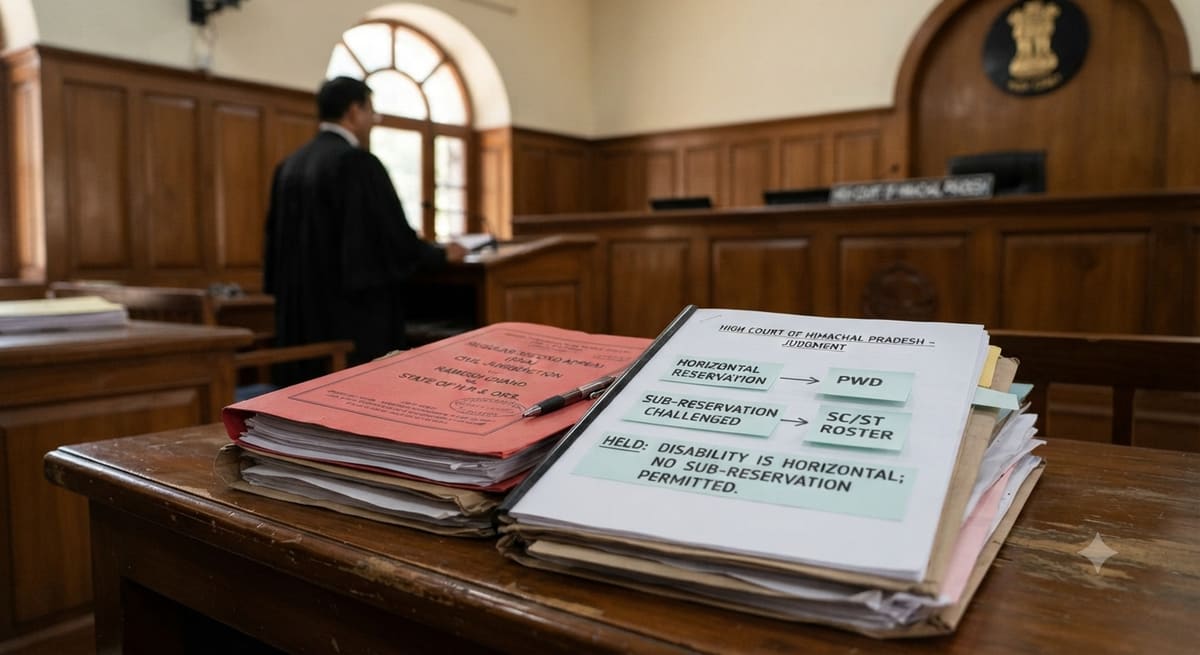
Article 16(4) Disability Reservation Is Horizontal; Cannot Be Sub-Reserved for SC Candidates | HP HC

The Himachal Pradesh High Court ruled that reservations for persons with physical disabilities are a horizontal reservation under Article 16(4) and therefore cannot be further earmarked for Scheduled Caste candidates. This invalidates any sub-reservation scheme that tries to allocate a share of disability seats to SCs, affecting future recruitment drives that combine disability and caste criteria.

OBC-reserved DNB seats cannot be de-reserved for general-category candidates after counselling | Medical PG admission reservation : Delhi HC
Case Law Analysis
|Delhi High Court

OBC-reserved DNB seats cannot be de-reserved for general-category candidates after counselling | Medical PG admission reservation : Delhi HC

The Delhi High Court affirmed that the executive alone may adjust reservation allocations, barring the de-reservation of OBC-reserved DNB seats for unreserved candidates after counselling. This safeguards OBC candidates’ entitlement in medical postgraduate admissions and limits unilateral seat reallocation by institutions.

Halba ST Claims | Bombay HC Directs Time-Bound Adjudication and Interim Admission Without Caste Validity Certificates : Bombay HC
Case Law Analysis
|Bombay High Court

Halba ST Claims | Bombay HC Directs Time-Bound Adjudication and Interim Admission Without Caste Validity Certificates : Bombay HC

Bombay High Court directs the Scheduled Tribe Caste Certificate Scrutiny Committee to decide Halba ST claims within three months and permits interim admission to petitioners without caste validity certificates pending adjudication. The ruling ensures timely resolution of caste claims while safeguarding educational opportunities for eligible candidates.

Promotions Under General Policy Not Voidable Under Reservation Cancellation Order | Legitimate Expectation Protected: Allahabad HC
Case Law Analysis
|Allahabad High Court

Promotions Under General Policy Not Voidable Under Reservation Cancellation Order | Legitimate Expectation Protected: Allahabad HC

The Allahabad High Court held that cancelling reservations under Rule 8-A cannot retroactively invalidate promotions made under a prior, general government order that did not rely on reservation quotas. This protects the legitimate expectation of employees promoted through transparent, non-reservation-based processes, reinforcing that administrative reversals must respect the legal basis of the original appointment.

Valid Caste Certificates for Internal Reservation | Karnataka HC Directs CET Authorities to Accept 2017-18 Certificates Under Writ Jurisdiction : Karnataka HC
Case Law Analysis
|Karnataka High Court

Valid Caste Certificates for Internal Reservation | Karnataka HC Directs CET Authorities to Accept 2017-18 Certificates Under Writ Jurisdiction : Karnataka HC

Karnataka High Court mandates acceptance of valid 2017-18 caste certificates for Common Entrance Test registration, ensuring students' educational rights under internal reservation categories. The ruling grants a 21-day compliance window, reinforcing administrative accountability in caste certificate validation.

Reservation Policy | Caste Certificate Submission Deadline Must Be Strictly Followed Without Retrospective Relief : MP HC Indore
Case Law Analysis
|Madhya Pradesh High Court

Reservation Policy | Caste Certificate Submission Deadline Must Be Strictly Followed Without Retrospective Relief : MP HC Indore

MP High Court reinstates an Anganwadi Sahayika whose appointment was cancelled for late caste certificate submission, emphasizing that administrative fairness does not extend to condoning procedural lapses post-deadline. The ruling underscores that reservation eligibility hinges on timely compliance with documentary requirements, protecting merit-based selections from retrospective challenges.

Reservation Category Inadvertent Error Without Benefit Availed | Candidature Cannot Be Cancelled : Allahabad HC
Case Law Analysis
|Allahabad High Court

Reservation Category Inadvertent Error Without Benefit Availed | Candidature Cannot Be Cancelled : Allahabad HC

The Allahabad High Court ruled that a candidate's inadvertent selection of an incorrect reservation category, without availing any benefit under it, does not justify cancellation of candidature. This protects applicants from punitive consequences for clerical mistakes when they remain eligible under their true category, reinforcing procedural fairness in public recruitment.

Delimitation Act Section 9(1)(c) | Reservation of SC/ST Constituencies Based on Population Proportion Upheld as Non-Arbitrary : Allahabad HC
Case Law Analysis
|Allahabad High Court

Delimitation Act Section 9(1)(c) | Reservation of SC/ST Constituencies Based on Population Proportion Upheld as Non-Arbitrary : Allahabad HC

Allahabad High Court ruled that the methodology under Section 9(1)(c) of the Delimitation Act, 2002, for reserving SC/ST constituencies based on population proportion is constitutionally valid and not arbitrary. The judgment reinforces judicial deference to legislative policy in electoral reservation matters, impacting future delimitation exercises.

Article 341 | Only Parliament Can Amend Scheduled Castes List; Courts Cannot Deem Unlisted Castes as Synonyms: Allahabad HC
Case Law Analysis
|Allahabad High Court

Article 341 | Only Parliament Can Amend Scheduled Castes List; Courts Cannot Deem Unlisted Castes as Synonyms: Allahabad HC

Allahabad High Court reaffirms that under Article 341 of the Constitution, only Parliament holds the power to amend the Scheduled Castes list. The court dismissed a petition seeking inclusion of castes like Nishad, Kewat, Mallah, and Bind, ruling that judicial authorities cannot treat unlisted castes as synonyms of listed ones, reinforcing the exclusive legislative authority in reservation matters.

Article 14 & 16 | Reserved Category Cut-off Higher Than General Category in Prelim Exam Violates Equality: Allahabad HC
Case Law Analysis
|Allahabad High Court

Article 14 & 16 | Reserved Category Cut-off Higher Than General Category in Prelim Exam Violates Equality: Allahabad HC

The Allahabad High Court has ruled that if reserved category cut-off marks exceed those of the general category in a preliminary examination, it undermines constitutional equality under Articles 14 and 16. Candidates scoring above the general category cut-off but barred from proceeding due to an inflated reserved category threshold must be afforded relief after result declaration, ensuring merit and equity are not in conflict.