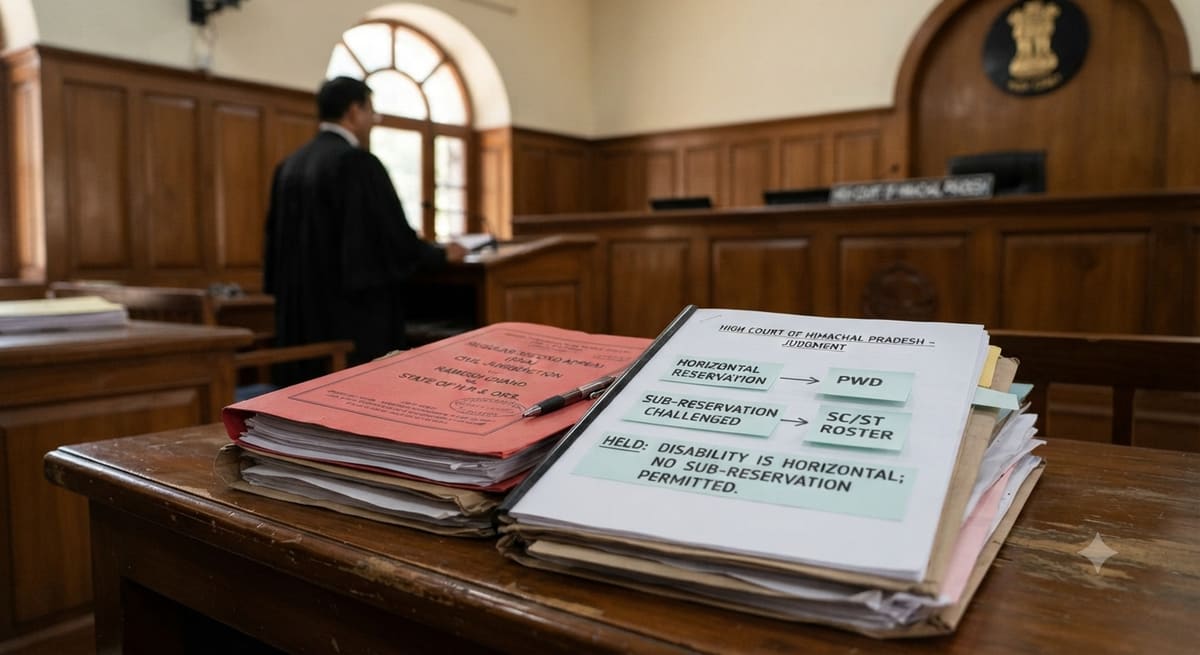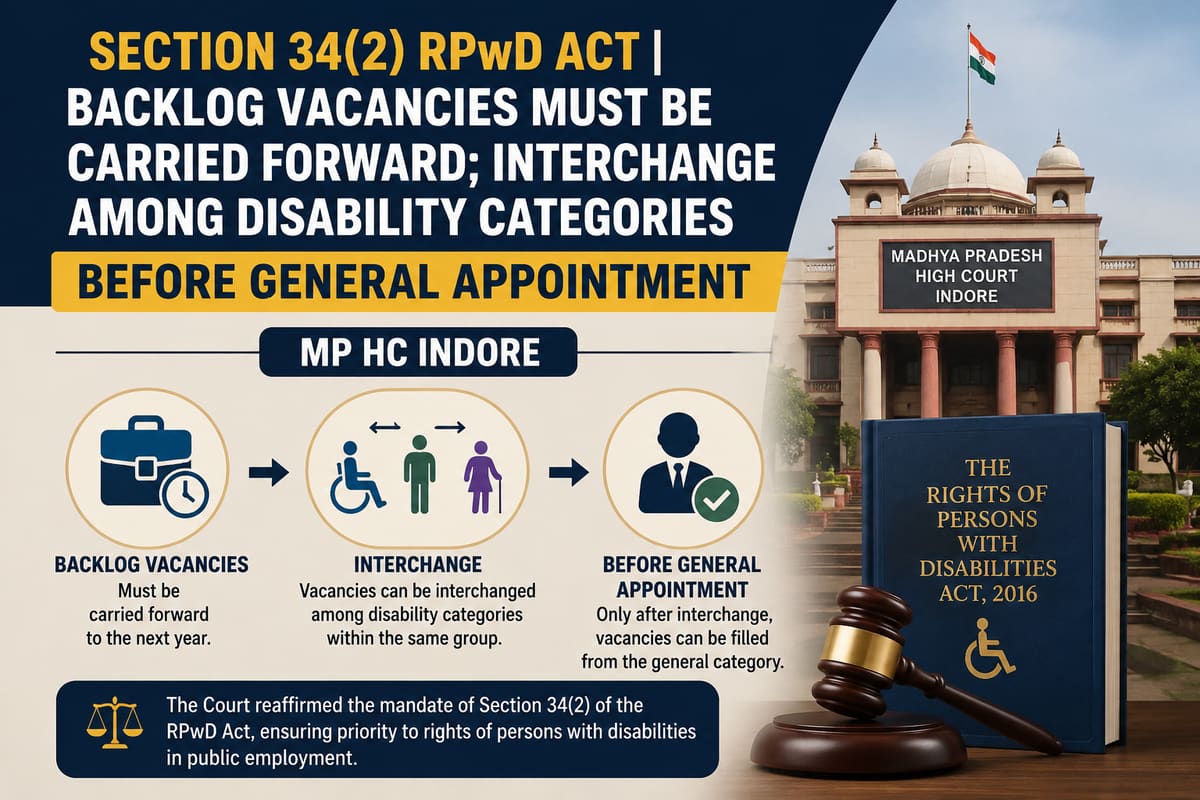
The Tripura High Court has clarified that reservation for persons with benchmark disabilities under the Rights of Persons with Disabilities Act, 2016, must operate as a horizontal reservation that cuts across vertical quotas, and selection must be based on merit before any adjustment into SC/ST/UR categories. The judgment invalidates the practice of pre-earmarking reserved posts and restores the primacy of merit in recruitment.
Background & Facts
The Dispute
The petitioner in WP(C) 694 of 2024, Joyjit Chowdhury, and other petitioners across four consolidated writ petitions, challenged the selection process conducted by the Joint Recruitment Board of Tripura (JRBT) for filling 2,500 posts of Multi Tasking Staff (Group-D) and 2,410 Group-C posts (including LDC, Agriculture Assistant, Junior Operator, and Junior Multi Tasking Operator). The petitioners, all persons with benchmark disabilities under Section 34 of the RPwD Act, 2016, secured higher marks than several candidates selected under the Persons with Disabilities (PH) quota but were denied appointment. The core grievance was that the JRBT, acting on instructions from the Directorate of Social Welfare and Social Education, had compartmentalized the 4% horizontal reservation for PWDs into fixed slots within SC, ST, and UR vertical categories before merit-based selection, thereby selecting lower-scoring candidates over higher-scoring ones.
Key Facts
- The JRBT issued two key advertisements: Advertisement No. 2/2020 dated 03.12.2020 for 2,500 Group-D posts and Advertisement No. Nil dated 12.02.2021 for 2,410 Group-C posts.
- Both advertisements stated that reservation would follow State Government policy, including the RPwD Act, 2016.
- The Directorate of Social Welfare and Social Education issued Office Memorandum dated 09.01.2019, which defined 4% horizontal reservation for benchmark disabilities and mandated interlocking with vertical quotas.
- The Directorate, in a letter dated 29.11.2021 (Annexure R-6), allocated fixed numbers of PWD posts within SC, ST, and UR categories for each group of posts, effectively creating compartmentalized vertical sub-quotas.
- Joyjit Chowdhury (UR category, low vision) scored 49.738 marks for Group-D and 86 marks for Group-C, but was not selected despite higher scores than selected candidates such as Tapan Biswas (SC, 49.682), Bishnu Pada Das (SC, 49.627), and Lovely Bardhan (SC, 49.1282).
- Ranjit Debnath (UR, locomotor disability) scored 50.529 marks for Group-D but was not selected, while lower-scoring ST candidates like Badal Tripura (49.158) and Tuhina Kalai (48.714) were appointed.
- Rajesh Chakraborty (UR, low vision) scored 37.109 marks for Group-D, higher than selected ST candidates Baku Mog (36.666), Prasenjit Debbarma (33.7102), and Sapi Debbarma (33.7102), yet remained unselected.
- In Group-C, seven posts under blindness and low vision remained vacant despite qualified candidates like Joyjit Chowdhury scoring 86 marks, while a candidate with 82 marks was selected.
- The application forms required candidates to declare their vertical category (UR/SC/ST) when applying under the PWD quota.
Procedural History
- 03.12.2020: Advertisement No. 2/2020 issued for 2,500 Group-D posts.
- 12.02.2021: Advertisement No. Nil issued for 2,410 Group-C posts.
- 29.11.2021: Directorate of Social Welfare and Social Education communicated compartmentalized reservation roster to JRBT.
- 07.09.2024: Final selection list for Group-D posts published, including lower-scoring PWD candidates.
- 13.09.2023: Final selection list for Group-C posts published, with similar anomalies.
- 2024: WP(C) 694, 695, 784, and 785 of 2024 filed before the Tripura High Court.
- 24.02.2026: Hearing conducted.
- 30.04.2026: Judgment delivered.
The Parties' Positions
Petitioners: Argued that the State violated the principles of horizontal reservation as laid down in Indra Sawhney v. Union of India and subsequent judgments. They contended that PWD reservation must be applied after merit-based selection, and candidates must be adjusted into SC/ST/UR categories only after being selected on merit. The compartmentalization of PWD quota into fixed vertical slots was illegal and discriminatory.
Respondents: Contended that the 4% reservation was correctly implemented as per the 09.01.2019 Office Memorandum, which they interpreted as permitting compartmentalization. They argued that candidates were required to declare their SC/ST/UR category at application, and posts were earmarked accordingly to ensure representation across all vertical categories.
Relief Sought
The petitioners sought:
- Quashing of the selection lists dated 07.09.2024 and 13.09.2023.
- A direction to prepare fresh selection lists based on merit, without pre-earmarking PWD posts within SC/ST/UR quotas.
- Inclusion of petitioners in the final selection lists based on their merit scores.
- A direction to complete the revised selection process within a stipulated time.
The Legal Issue
The central question was whether reservation for persons with benchmark disabilities under the RPwD Act, 2016, must be applied as a horizontal reservation that cuts across vertical quotas (SC/ST/UR) after merit-based selection, or whether it may be compartmentalized into fixed sub-quotas within those vertical categories prior to selection.
Arguments Presented
For the Petitioner
Mr. Arijit Bhaumik, learned counsel, relied on Indra Sawhney v. Union of India (1992 Supp (3) SCC 217), which distinguished horizontal reservation (under Article 16(1)) from vertical reservation (under Article 16(4)). He cited Rajesh Kumar Daria v. Rajasthan PSC (2007) 8 SCC 785, which clarified that horizontal reservations must be interlocked, not compartmentalized. He further relied on Rekha Sharma v. Rajasthan HC (2024 SCC OnLine SC 2109) and Tishan Jangid v. Rajasthan HC (2024 SCC OnLine SC 4826), which reaffirmed that PWD candidates must be selected on merit first and then adjusted into SC/ST/UR categories. He emphasized that the 09.01.2019 Office Memorandum explicitly prohibited compartmentalization and required interlocking. He also cited Prabir Datta v. State of Tripura (WP(C) 1166/2016), a coordinate bench judgment of the same court, which held that PWD reservation must be applied post-merit.
For the Respondent
Mr. Mangal Debbarma and Mr. D. Sarma, Additional Government Advocates, relied on the 09.01.2019 Office Memorandum and argued that the compartmentalization was necessary to ensure representation of PWD candidates across SC/ST/UR categories. They cited Union of India v. National Federation of the Blind (2013) 10 SCC 772 and Rajeev Kumar Gupta v. Union of India (2016) 13 SCC 153 to argue that the 4% reservation is not subject to the 50% ceiling, but did not address the distinction between horizontal and vertical reservation. They also cited State of Tripura v. Md. Suruk Ali (WA 451/2020), which they claimed supported their approach, but the Court distinguished this case as involving a different factual matrix.
The Court's Analysis
The Court undertook a detailed analysis of the legal framework governing reservation for persons with disabilities. It emphasized that horizontal reservation under Article 16(1) for PWDs is distinct from vertical reservation under Article 16(4) for SCs/STs/OBCs. The Court held that the Supreme Court in Indra Sawhney had clearly stated that horizontal reservations cut across vertical reservations, and candidates selected under the PWD quota must be placed in the appropriate vertical category after selection, not before.
"The persons selected against this quota will be placed in the appropriate category; if he belongs to SC category he will be placed in that quota by making necessary adjustments; similarly, if he belongs to open competition (OC) category, he will be placed in that category by making necessary adjustments."
The Court found that the Directorate of Social Welfare and Social Education had fundamentally misapplied the 09.01.2019 Office Memorandum. Clause 9.1 and 9.2 of the Memorandum explicitly mandated interlocking reservation and provided an illustration: if a PWD candidate belonging to SC is selected, he is adjusted against the SC quota - not that an SC-specific PWD slot is created in advance. The compartmentalization practiced by the State, which allocated fixed numbers of PWD posts to SC, ST, and UR categories before merit-based selection, was a direct violation of this principle.
The Court further noted that the RPwD Act, 2016, under Section 34, requires identification of posts for PWDs and reservation of 4% of total vacancies - not fixed sub-quotas. The State’s practice of creating a roster with pre-allocated PWD slots for each vertical category effectively created a new layer of reservation, undermining merit and violating the constitutional scheme.
The Court also rejected the respondents’ reliance on State of Tripura v. Md. Suruk Ali, distinguishing it on the ground that it involved a vacancy in a specific disability category (hearing) that could not be filled by a candidate with a different disability (locomotor). In the present case, the issue was not about mismatched disabilities but about the illegal pre-allocation of PWD posts within vertical categories.
The Court concluded that the selection process was legally flawed because it prioritized quota fulfillment over merit. The result was that higher-scoring candidates were excluded while lower-scoring candidates were selected - a clear violation of Article 14 and the principle of equality.
The Verdict
The writ petitions are allowed. The Court directs:
- For WP(C) 694, 784, and 785 of 2024 (Group-D posts), the respondents shall prepare a fresh selection list based on merit, selecting PWD candidates in order of their scores, and then adjusting them into the appropriate SC/ST/UR vertical categories.
- For WP(C) 695 of 2024 (Group-C posts), the State shall first determine the number of posts reserved for PWDs in each distinct cadre (LDC, Agriculture Assistant, Junior Operator, Junior Multi Tasking Operator) as required under Section 34 of the RPwD Act, 2016, and then follow the same merit-based, interlocking process.
- Any candidate previously selected under the flawed process who scores lower than a petitioner and is already appointed may be removed after due procedure.
- The entire exercise must be completed within four months from the date of receipt of this order.
- No costs are awarded.
What This Means For Similar Cases
Horizontal Reservation Must Be Applied Post-Merit
- Practitioners must argue that any pre-allocation of PWD posts into SC/ST/UR categories is illegal.
- Selection lists must be prepared in descending order of merit among all PWD applicants, irrespective of their vertical category.
- Only after selection should the candidate’s vertical category be used to adjust the seat against the relevant SC/ST/UR quota.
Compartmentalization Is Unlawful
- State guidelines or administrative instructions that create sub-quotas within PWD reservation are void if they contradict Indra Sawhney and the RPwD Act.
- The 09.01.2019 Tripura Office Memorandum correctly prohibited compartmentalization - any deviation by implementing agencies is ultra vires.
- Recruitment bodies must ensure that their reservation rosters reflect interlocking, not compartmentalization.
Merit Is Non-Negotiable in PWD Selection
- A candidate’s score must be the sole criterion for selection within the PWD quota.
- Even if a lower-scoring PWD candidate belongs to a reserved category (SC/ST), they cannot be selected over a higher-scoring PWD candidate from UR.
- This principle applies equally to Group A, B, C, and D posts, as affirmed in Rajeev Kumar Gupta.