The Supreme Court has delivered a landmark judgment clarifying the interplay between horizontal and vertical reservations, particularly concerning Persons with Disabilities (Low Vision) (PWD-LV). The Court held that PWD-LV candidates from reserved categories (OBC, SC, ST) are eligible to compete for unreserved PWD-LV posts based on merit, overturning a restrictive interpretation by the Calcutta High Court that prioritized unreserved PWD-LV candidates over more meritorious reserved category candidates.
Background & Facts
The Dispute
The dispute arose from a recruitment notification issued by the West Bengal State Electricity Transmission Co. Ltd. (Appellant) for the post of Junior Engineer (Civil) Grade II. The notification reserved 30 vacancies, including:
- 1 post for Unreserved (PWD-LV)
- 5 posts for Other Backward Classes-A (OBC-A)
The notification included two critical notes:
- In case of non-availability of qualified UR (PWD-HH) candidate, the vacancy will be filled by PWD candidates of other categories as per merit.
- # In case of non-availability of qualified UR (PWD-LV) candidate, the vacancy will be filled by PWD candidates of other categories as per merit.
Key Facts
- Respondent No. 1, a PWD-LV candidate, applied under the Unreserved (UR) category for the UR (PWD-LV) post.
- Respondent No. 3, an OBC-A candidate who also belonged to the PWD-LV category, applied for the OBC-A posts but was not selected due to more meritorious OBC-A candidates.
- Respondent No. 3 scored 66.667 marks, while Respondent No. 1 scored 55.667 marks.
- The Appellant offered the UR (PWD-LV) post to Respondent No. 3 on merit grounds, as he was a PWD-LV candidate with higher marks.
Procedural History
- 11.12.2023: Respondent No. 1 filed WPA 26312/2023 before the Calcutta High Court, challenging the appointment of Respondent No. 3 to the UR (PWD-LV) post. The Single Bench dismissed the writ petition, holding that Respondent No. 3, being a PWD-LV candidate, was eligible for the post.
- MAT 69/2024 with CAN 1/2024: Respondent No. 1 appealed to the Division Bench of the Calcutta High Court.
- 07.05.2024: The Division Bench allowed the appeal, holding that since Respondent No. 1 (an unreserved PWD-LV candidate) was available, the vacancy could not be filled by a PWD-LV candidate from a reserved category.
- Present Appeal: The Appellant challenged the Division Bench’s order before the Supreme Court.
Relief Sought
The Appellant sought to set aside the Division Bench’s order dated 07.05.2024 and restore the Single Bench’s decision, which upheld the appointment of Respondent No. 3 to the UR (PWD-LV) post.
The Legal Issue
The central question was whether a PWD-LV candidate from a reserved category (OBC-A) could be appointed to an unreserved PWD-LV post when a less meritorious unreserved PWD-LV candidate was available, given the recruitment notification’s stipulation that the vacancy would be filled by PWD candidates of other categories as per merit in case of non-availability of a qualified unreserved PWD-LV candidate.
Arguments Presented
For the Appellant
- The recruitment notification’s condition should be interpreted in consonance with the principle of merit and migration in reservation, as established in Saurav Yadav v. State of UP and Indra Sawhney v. Union of India.
- The UR (PWD-LV) post is open to all PWD-LV candidates, irrespective of their social category, provided they meet the merit criteria.
- The Division Bench’s interpretation was arbitrary and violated Articles 14 and 16 of the Constitution by denying appointment to a more meritorious candidate.
For the Respondent No. 1
- The recruitment notification’s condition created an absolute bar on filling the UR (PWD-LV) post with candidates from reserved categories if an unreserved PWD-LV candidate was available.
- The vacancy should be filled exclusively by an unreserved PWD-LV candidate, regardless of merit.
The Court's Analysis
The Supreme Court undertook a detailed examination of reservation jurisprudence, particularly the interplay between vertical and horizontal reservations and the principle of migration to unreserved posts.
Vertical and Horizontal Reservations
The Court relied on Indra Sawhney v. Union of India to distinguish between the two types of reservations:
- Vertical Reservations: Social categories (SC, ST, OBC) where posts are filled exclusively by candidates from that category.
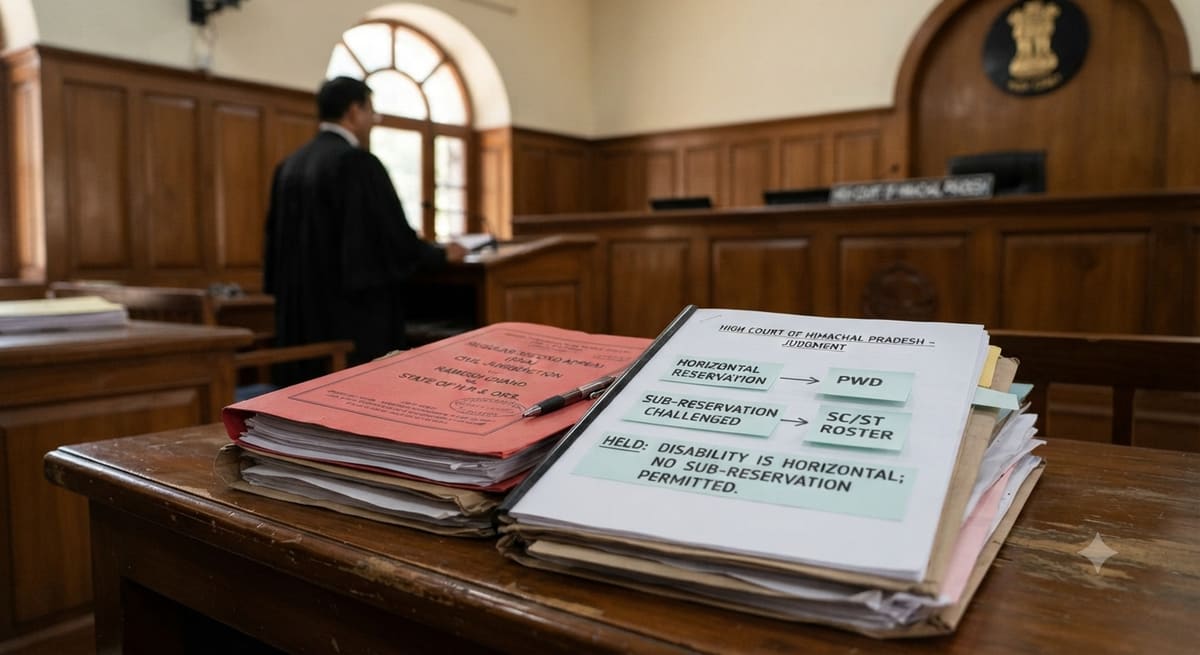
- Horizontal Reservations: Special categories (PWD, Ex-Servicemen) that cut across vertical reservations, creating interlocking reservations.
"Horizontal reservations cut across the vertical reservations - that is called inter-locking reservations... Even after providing for these horizontal reservations, the percentage of reservations in favour of backward class of citizens remains - and should remain - the same."
Unreserved Category and Merit
The Court emphasized that the Unreserved/Open category is not a social category but an open pool available to all candidates, irrespective of their social categorization. However, when a post under the Unreserved category is reserved for a special (horizontal) category (e.g., PWD-LV), it becomes open to all candidates belonging to that special category, regardless of their social category.
"A post earmarked for special (horizontal) reservation under the Unreserved category will be open to every candidate possessing the attribute or character of the special (horizontal) reservation."
Principle of Migration
The Court reiterated the principle of migration, where reserved category candidates can compete for unreserved posts based on merit. This principle applies equally to horizontal reservations under the Unreserved category. Thus, a more meritorious PWD-LV candidate from a reserved category can be appointed to an unreserved PWD-LV post, provided they meet the essential qualifications without availing relaxations.
"The principle of migration in reservation will be applicable in this scenario also. Thus, even though there are candidates under the Unreserved category who are Persons with Disabilities, if there are more meritorious candidates belonging to any of the social categories like SC, ST or OBC who are also Persons with Disabilities, such more meritorious persons from the SC, ST or OBC category can be appointed against the Unreserved quota meant for Person with Disabilities by virtue of merit."
Interpretation of the Recruitment Notification
The Court held that the recruitment notification’s condition - "In case of non-availability of qualified UR (PWD-LV) candidate, the vacancy will be filled by PWD candidates of other categories as per merit" - should be interpreted in light of the principle of merit and migration. The condition does not create an absolute bar on appointing reserved category PWD-LV candidates if an unreserved PWD-LV candidate is available. Instead, it allows all PWD-LV candidates to compete for the post, with the most meritorious candidate being appointed.
"What is stipulated in the recruitment notification is merely stating the obvious. Certainly, if there is no eligible and qualified unreserved candidate available under PWD-LV category, this vacancy can be filled by anyone belonging to any social reserved category, but belonging to PWD-LV category. Thus, it cannot be read to insist that so long as any PWD-LV candidate under the Unreserved category is available, there will be an absolute bar to consider any other meritorious PWD-LV candidate belonging to any of the social reserved categories and only such Unreserved category PWD-LV candidate can be appointed irrespective of the merit."
Arbitrariness of the Division Bench’s Interpretation
The Court held that the Division Bench’s interpretation was patently arbitrary and violated Articles 14 and 16 of the Constitution. It defied the principle of merit, which is the sole criterion for appointment to unreserved posts. A less meritorious unreserved PWD-LV candidate cannot steal a march over a more meritorious reserved category PWD-LV candidate.
The Verdict
The Supreme Court allowed the appeal, setting aside the Division Bench’s order dated 07.05.2024 and restoring the Single Bench’s decision dated 11.12.2023. The Court upheld the appointment of Respondent No. 3 (the more meritorious OBC-A PWD-LV candidate) to the UR (PWD-LV) post, rejecting the claim of Respondent No. 1 (the less meritorious unreserved PWD-LV candidate).
What This Means For Similar Cases
Unreserved Posts Are Open to All Eligible Candidates
- Horizontal reservations under the Unreserved category (e.g., PWD-LV) are open to all candidates belonging to that special category, irrespective of their social categorization (SC, ST, OBC, UR).
- Merit is the sole criterion for appointment to unreserved posts, even if they are reserved for a special category.
- Practitioners must argue that reserved category candidates who meet the essential qualifications (without availing relaxations) are equally eligible to compete for unreserved horizontal reservation posts.
Migration Principle Applies to Horizontal Reservations
- The principle of migration, as established in Saurav Yadav v. State of UP, applies to horizontal reservations under the Unreserved category.
- More meritorious reserved category candidates can be appointed to unreserved horizontal reservation posts, provided they belong to the same special category (e.g., PWD-LV).
- Courts must reject interpretations that create an absolute bar on reserved category candidates competing for unreserved horizontal reservation posts.
Compartmentalized vs. Overall Horizontal Reservations
- Compartmentalized reservations (e.g., PWD-LV under OBC-A) are exclusive to candidates from that social category and do not allow migration from other categories.
- Overall horizontal reservations under the Unreserved category are open to all candidates belonging to the special category, regardless of their social categorization.
- Recruitment notifications must clearly specify whether horizontal reservations are compartmentalized or overall to avoid ambiguity.