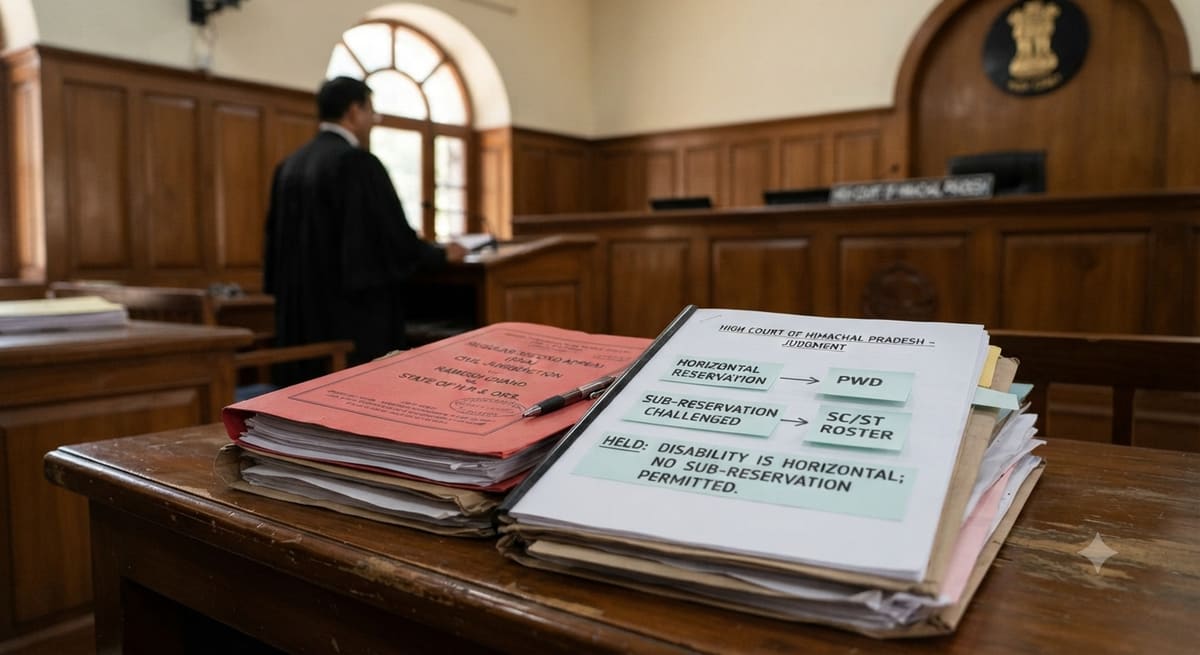
The Himachal Pradesh High Court has clarified a critical principle in public recruitment: a candidate belonging to a vertically reserved category (such as SC) who applies for a horizontally reserved post (such as General BPL) is entitled to be considered for that post if no separate post exists for their vertical category. This judgment reinforces the constitutional guarantee of equal opportunity under Article 14 and prevents arbitrary exclusion based on misinterpretation of reservation categories.
Background & Facts
The Dispute
The dispute arises from a recruitment process conducted by the Himachal Pradesh Staff Selection Board (HPSSSB) for six contract posts in the Home Guard Department: five for General (UR) and one for General (BPL). The advertisement, issued vide No. 32-3/2016, invited online applications between 18.10.2016 and 17.11.2016. The essential qualifications required candidates to hold an Honorary Rank of Platoon Commander or above in the Home Guards for at least three years, or be a serving Havildar Instructor/Quarter Master Havildar, or be a retired Indian Army officer with Naib Subedar rank or above and three years of service. The closing date for eligibility determination was 17.11.2016, while age eligibility was to be assessed as on 01.01.2016.
Key Facts
- The recruitment process included an objective-type screening test (85 marks) on 27.03.2018, followed by a 15-mark evaluation (replacing personal interview for Class-III posts, as per Govt. notification dated 31.05.2017)
- Total 363 applications received; 258 provisionally admitted; 81 appeared for screening test; 18 shortlisted for evaluation
- Final results declared on 17.07.2018
- Cut-off marks: General (UR) - 44.00; General (BPL) - 35.50
- Petitioner Krishan Chand (CWPOA No. 5301 of 2020) secured 41.00 marks in the screening test
- Krishan Chand identified himself as belonging to SC (BPL) category in his application form
- Petitioners Sansar Chand (CWP No. 3862 of 2019) and Parkash Chand (CWPOA No. 5329 of 2020) secured 39.00 and 38.50 marks respectively, below the General (UR) cut-off
- Only three candidates were ultimately recommended for appointment
Procedural History
- 18.10.2016: Advertisement No. 32-3/2016 issued for recruitment
- 17.11.2016: Last date for submission of online applications
- 27.03.2018: Objective-type screening test conducted
- 25.05.2018: Results of screening test declared
- 17.07.2018: Final selection results declared
- 16.09.2018: CWPOA No. 5301 of 2020 filed by Krishan Chand
- 26.09.2018: CWPOA No. 5329 of 2020 filed by Parkash Chand
- 25.11.2019: CWP No. 3862 of 2019 filed by Sansar Chand
- 24.04.2026: Judgment delivered by the High Court
The Parties' Positions
For the Petitioners
- Krishan Chand argued that his 41.00 marks exceeded the General (BPL) cut-off of 35.50 and he was entitled to be considered for that post
- He contended that his rejection on the ground that no SC(BPL) post was advertised was legally unsustainable
- Sansar Chand and Parkash Chand challenged the inclusion of ineligible candidates in the interview list and the application of Clause 15.4 of HPSSSB’s Rules of Business (requiring 45% of total marks for consideration)
For the Respondent
- The State contended that Krishan Chand, being SC(BPL), could only compete for posts reserved for SC category, and since no such post was advertised, his candidature was invalid for General (BPL)
- The State argued that the General (BPL) post was meant only for economically weaker sections within the General category, not for those in vertical reservations
- The State also claimed that the petitioners’ challenges were barred by delay and that no vacancy existed at the time of filing
Relief Sought
- Krishan Chand sought reconsideration of his candidature for the General (BPL) post, appointment, and consequential benefits
- Sansar Chand and Parkash Chand sought quashing of the selection process, re-evaluation of the screening test, and inclusion of all candidates scoring above 45% of total marks (i.e., 38.25) in the interview list
The Legal Issue
Can a candidate belonging to a vertically reserved category (SC) who applies for a horizontally reserved post (General BPL) be denied consideration for that post solely because no separate post is advertised for their vertical category, when their marks exceed the cut-off for the horizontal category?
Arguments Presented
For the Petitioner
Krishan Chand relied on the principle of equal opportunity under Article 14 of the Constitution and the settled law that reserved category candidates are entitled to compete for unreserved posts. He cited that his application was accepted without objection, he appeared in the screening test, and his score (41.00) surpassed the General (BPL) cut-off (35.50). He argued that denying him consideration for the General (BPL) post on the ground of his SC identity was discriminatory and contrary to the spirit of horizontal reservation. He further contended that the State’s interpretation would render horizontal reservation ineffective and violate the constitutional mandate of non-discrimination.
For the Respondent
The State argued that the General (BPL) category was a horizontal reservation meant exclusively for economically weaker sections within the General category, and that vertical reservations (like SC) could not be merged into it. It relied on the application form where Krishan Chand had declared his category as SC(BPL), and claimed that the advertisement did not provide for any SC(BPL) post. The State further contended that allowing such candidates to compete for General (BPL) posts would dilute the purpose of horizontal reservation and create confusion in the reservation matrix.
The Court's Analysis
The Court undertook a detailed analysis of the nature of horizontal and vertical reservations. It observed that horizontal reservations (such as BPL, physically disabled, ex-servicemen) cut across vertical categories (SC, ST, OBC, General). Therefore, a candidate belonging to SC who also qualifies as BPL is eligible for posts reserved for General BPL, provided the post is not exclusively reserved for SC.
"A reserved category candidate is entitled to compete for all posts, however a general category candidate can only compete in general category posts."
The Court emphasized that the advertisement did not bar SC candidates from applying for the General (BPL) post. In fact, the application form did not require candidates to specify category at the time of submission, and Krishan Chand’s application was accepted without rejection. The Court held that the State’s subsequent rejection on the ground that "no SC(BPL) post was advertised" was legally untenable.
The Court further distinguished between eligibility to apply and eligibility to be considered. Krishan Chand was eligible to apply, was allowed to appear in the test, and scored above the cut-off. Denying him consideration at the final stage amounted to arbitrary discrimination. The Court relied on Rameshwar & Ors. v. Jot Ram & Ors. (AIR 1976 SC 49), holding that rights must be determined as on the date of filing the petition, not at the time of selection.
Regarding the argument based on Clause 15.4 of HPSSSB’s Rules, the Court clarified that the rule applied to merit-listing in competitive examinations, not to objective-type screening tests. The advertisement explicitly prescribed an objective screening test under Clause 15.5, and the State was bound by its own terms.
The Court also rejected the plea that no vacancy existed at the time of filing, noting that the right to be considered is a substantive right under Article 14, and the existence of a vacancy at the time of adjudication is irrelevant.
The Verdict
Krishan Chand succeeded. The Court allowed CWPOA No. 5301 of 2020 and directed the respondents to conduct the 15-mark evaluation within one month and grant consequential benefits, including appointment to the General (BPL) post, if found eligible. The Court held that Krishan Chand, having secured 41.00 marks and exceeding the General (BPL) cut-off of 35.50, was the sole eligible candidate for that post. CWP No. 3862 of 2019 and CWPOA No. 5329 of 2020 were dismissed. Pending miscellaneous applications were disposed of.
What This Means For Similar Cases
Horizontal Reservation Overrides Vertical Category Exclusion
- Practitioners must now argue that candidates from vertically reserved categories (SC/ST/OBC) are entitled to compete for horizontally reserved posts (BPL, PH, Ex-servicemen) even if no separate post exists for their vertical category
- Rejection on the ground of "no post for SC(BPL)" is legally invalid if the candidate meets the horizontal category criteria
- Recruitment authorities must assess eligibility based on the candidate’s actual qualifications, not rigid categorical boxes
Application Acceptance Implies Eligibility Recognition
- If a candidate’s application is accepted and they are permitted to appear in the selection process, the State cannot later reject them on grounds of category mismatch not raised at the time of application
- The principle of promissory estoppel and legitimate expectation applies: candidates who act in reliance on the advertisement’s terms cannot be arbitrarily excluded
- This applies equally to other horizontal reservations: e.g., an SC candidate who is also a woman or ex-serviceman must be considered for posts reserved for those categories
Cut-off Marks Are Binding, Not Discretionary
-
Once a cut-off is published for a category, it becomes the benchmark for eligibility
-
Candidates scoring above the cut-off for a horizontally reserved category must be considered for that category, irrespective of their vertical category
-
Recruitment authorities must maintain transparency: if a candidate qualifies on merit, they must be included in the final panel
-
Always verify whether a post is horizontally or vertically reserved before challenging selection
-
If a candidate qualifies for a horizontal category, file a writ petition asserting Article 14 rights, not merely procedural irregularities
-
Do not assume that category declarations in application forms override the constitutional framework of horizontal reservation