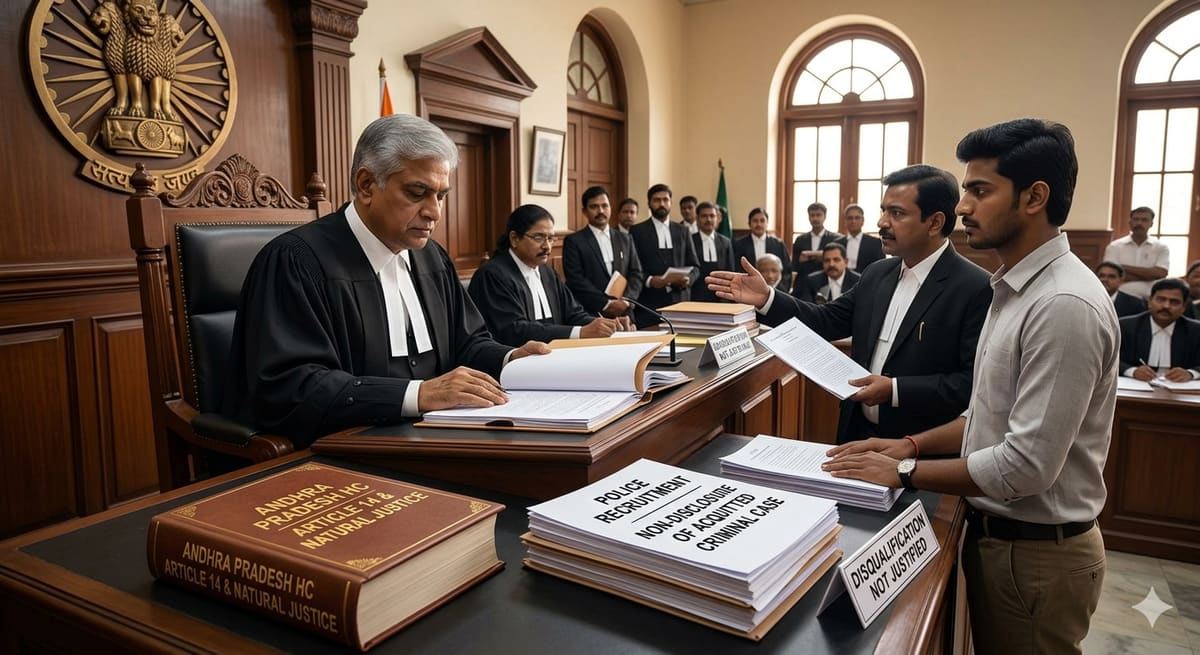
The Madhya Pradesh High Court has reaffirmed that an acquittal in a criminal case, even if obtained through compromise, does not create a legal entitlement to employment in a disciplined force like the police. The judgment underscores the state’s authority to assess a candidate’s suitability based on the nature of the offence and the circumstances of acquittal, reinforcing the primacy of character and integrity in public service appointments.
Background & Facts
The Dispute
The petitioner, Ramavtar Singh, applied for the post of Constable (Driver) in the Madhya Pradesh Police through the Constable (SAF) Recruitment Test, 2016, conducted by the Professional Examination Board, Bhopal. He successfully cleared the written examination and proceeded to the attestation and character verification stage. In his attestation form, he disclosed his involvement in a criminal case registered as Crime No. 221/2012 at Police Station Gormi, District Bhind, under Sections 325, 324, 323, 294, 506-B, 149, and 148 of the Indian Penal Code.
Key Facts
- The criminal case (Crime No. 221/2012) was registered on 15.04.2012.
- The petitioner was tried before the Judicial Magistrate First Class, Mehagaon, District Bhind.
- On 10.03.2017, the Trial Court acquitted the petitioner.
- The acquittal was partly based on compromise between the parties regarding offences under Sections 324, 149, and 148 IPC.
- For the remaining charges under Sections 325, 506-B, and 149 IPC, the acquittal was granted on merits due to insufficient evidence.
- The petitioner submitted his reply to the show cause notice dated 13.05.2017, disclosing the acquittal and attaching the order.
- The Screening Committee considered his candidature on 16.05.2017 and rejected it on 19.06.2017.
- The rejection order (Annexure P/1) was cryptic and did not specify reasons.
- The petitioner was not appointed and was excluded from the final merit list.
Procedural History
- 15.04.2012: Crime No. 221/2012 registered at PS Gormi, Bhind.
- 10.03.2017: Trial Court acquittal order passed.
- 13.05.2017: Show cause notice issued by Superintendent of Police, Bhind.
- 16.05.2017: Personal hearing granted to petitioner by Screening Committee.
- 19.06.2017: Screening Committee rejected candidature via order (Annexure P/1).
- 20.07.2017: Writ Petition No. 5571 of 2017 filed before the High Court at Gwalior.
- 01.04.2026: Judgment delivered by Justice Anand Singh Bahrawat.
The Parties' Positions
The petitioner contended that his honourable acquittal, even if partially based on compromise, should have entitled him to appointment. He argued that disclosure of the case demonstrated honesty and that the Screening Committee’s order was non-reasoned and arbitrary.
The State, through the Government Advocate, maintained that the Screening Committee was legally empowered to evaluate suitability based on the nature of the offence and the manner of acquittal. It emphasized that compromise-based acquittals do not equate to exoneration and that the police force requires candidates of impeccable character.
Relief Sought
The petitioner sought:
- Quashing of the order dated 19.06.2017 rejecting his candidature.
- Direction to the State to permit him to join as Constable (Driver) and send him for training.
- Costs in the interest of justice.
The Legal Issue
The central question was whether an acquittal in a criminal case, even if partially based on compromise between parties, automatically entitles a candidate to appointment in a disciplined force like the police, or whether the Screening Committee retains the discretion to assess suitability based on the nature of the offence and the circumstances of acquittal.
Arguments Presented
For the Petitioner
The petitioner’s counsel relied on the fact that the Trial Court had acquitted him, which he argued constituted a judicial determination of innocence. He cited Mehar Singh v. Commissioner of Police and Avtar Singh v. Union of India to argue that disclosure of criminal antecedents should be viewed as a mark of integrity. He contended that the Screening Committee’s order was non-reasoned and violated principles of natural justice.
For the Respondent/State
The State argued that the Screening Committee’s role is not mechanical but evaluative. It cited Union of India v. Methu Meda, State of M.P. v. Parvez Khan, and Union Territory, Chandigarh v. Pradeep Kumar to establish that acquittal does not equate to suitability. The State emphasized that compromise-based acquittals may mask underlying criminal conduct and that the police force must maintain the highest standards of integrity. It further argued that the Committee’s decision was not mala fide and thus beyond judicial interference.
The Court's Analysis
The Court undertook a comprehensive review of Supreme Court precedents, beginning with Methu Meda v. Union of India (2022) 1 SCC, where the Apex Court held that acquittal by benefit of doubt or due to hostile witnesses does not entitle a candidate to appointment in a disciplined force. The Court emphasized that the employer retains the right to evaluate suitability under the Screening Committee’s policy.
"The Screening Committee will be within its rights to cancel the candidature of a candidate if it finds that the acquittal is based on some serious flaw in the conduct of the prosecution case or is the result of material witnesses turning hostile."
The Court further relied on Commissioner of Police v. Mehar Singh (2013) 7 SCC, where the Supreme Court clarified that compromises, while socially desirable, cannot override the need for integrity in police recruitment. The Court noted that the word "generally" in the policy indicates a presumption against appointment, not a prohibition, but the burden lies on the candidate to demonstrate exceptional suitability.
The Court also examined State of M.P. v. Parvez Khan (2015) 2 SCC, which held that acquittal does not imply complete exoneration, and Union Territory v. Pradeep Kumar (2018) 1 SCC, which reiterated that the Screening Committee’s decision is final unless mala fide. The Court observed that the petitioner had not alleged mala fide or arbitrariness in the Committee’s decision-making process.
The Court distinguished Rohit Singh Raghuvanshi v. State of M.P. (2020), where no final verdict existed, from the present case where a final acquittal order was available. It also referenced Anil Bhardwaj v. High Court of M.P. (2020) 9 SCR, holding that "acquitted on merit" must mean acquittal on substantive grounds, not procedural or compromise-based outcomes.
Finally, the Court cited its own Full Bench decision in Ashutosh Pawar v. State of M.P. (2018) 2 MPLJ, affirming that judicial review under Article 226 examines the decision-making process, not the merits. The Court concluded that the Screening Committee had considered the relevant factors and that its decision, though cryptic, was not legally invalid.
The Verdict
The petition was dismissed. The Court held that the Screening Committee’s rejection of the petitioner’s candidature was lawful and not mala fide. No direction was issued for appointment, training, or compensation. The petitioner’s claim for costs was also rejected. The judgment upholds the Screening Committee’s exclusive authority to assess suitability in police recruitment, even where acquittal has been granted.
What This Means For Similar Cases
Acquittal ≠ Suitability for Police Service
- Practitioners must advise clients that acquittal, even if complete, does not guarantee eligibility for police or disciplined force roles.
- Candidates must be prepared to demonstrate why their case is exceptional, especially if acquittal resulted from compromise or technical grounds.
- Disclosure of criminal antecedents is mandatory but does not confer any advantage or entitlement.
Screening Committee Decisions Are Presumed Valid
- Challenges to Screening Committee decisions must focus on procedural illegality or mala fide intent, not substantive disagreement.
- Courts will not substitute their opinion for that of the Committee unless the decision is irrational, arbitrary, or based on extraneous considerations.
- Cryptic orders are not automatically invalid if the record shows due consideration was given.
Compromise-Based Acquittals Carry Weight Against Suitability
- Compromise in criminal cases, while encouraged in civil litigation, is viewed with suspicion in police recruitment.
- Employers may treat compromise as a sign of potential coercion, witness intimidation, or lack of genuine exoneration.
- Candidates involved in offences involving moral turpitude (e.g., violence, intimidation) face a higher burden to prove suitability.