Topic

writ petition maintainability

A writ petition under Articles 226 or 227 of the Indian Constitution is a remedy to challenge illegal or unconstitutional actions by state authorities or public functionaries, subject to territorial jurisdiction and the existence of alternative statutory remedies.

15 articlesLatest June 2026
Locus Standi | Directors of Educational Institutions Cannot File Writ Petitions on Behalf of Unsuccessful Recruitment Candidates : Patna HC
Case Law Analysis
|Patna High Court

Locus Standi | Directors of Educational Institutions Cannot File Writ Petitions on Behalf of Unsuccessful Recruitment Candidates : Patna HC

The Patna High Court has ruled that directors of a diploma institute lack legal standing to challenge a recruitment outcome on behalf of candidates they trained, emphasizing that only aggrieved individuals may invoke writ jurisdiction. This sets a clear boundary against third-party litigation in public employment disputes and deters institutions from acting as proxies in administrative contests.

Locus Standi Expires with Tenure | Former Chairperson of Haj Committee Cannot Challenge Post-Tenure Appointment Under Haj Committee Act, 2002 : MP HC Gwalior
Case Law Analysis
|Madhya Pradesh High Court

Locus Standi Expires with Tenure | Former Chairperson of Haj Committee Cannot Challenge Post-Tenure Appointment Under Haj Committee Act, 2002 : MP HC Gwalior

The Madhya Pradesh High Court holds that once a public officeholder's tenure ends, they lose all legal standing to challenge subsequent appointments-even if the appointment is allegedly ultra vires. This clarifies that only current officeholders or directly affected parties may seek judicial review of administrative appointments, reinforcing the principle that standing is tied to present legal interest, not past office.

Article 226 | Withdrawal of Writ Petition Without Leave Bars Fresh Petition on Same Cause of Action : AP HC
Case Law Analysis
|Andhra Pradesh High Court

Article 226 | Withdrawal of Writ Petition Without Leave Bars Fresh Petition on Same Cause of Action : AP HC

The Andhra Pradesh High Court ruled that withdrawing a writ petition under Article 226 without seeking leave to file a fresh petition precludes subsequent petitions on the same cause of action. This decision reinforces res judicata principles and discourages forum-shopping, impacting litigants seeking multiple remedies for identical disputes.

IBC Moratorium | Writ Petition Maintainable Against Recovery Officer's Order Despite Statutory Bar : Bombay HC
Case Law Analysis
|Bombay High Court

IBC Moratorium | Writ Petition Maintainable Against Recovery Officer's Order Despite Statutory Bar : Bombay HC

Bombay High Court holds that a writ petition challenging a Recovery Officer's order remains maintainable during an IBC moratorium, balancing the need for urgent relief against statutory remedies. The ruling clarifies that the moratorium under Section 14 of the IBC does not automatically oust High Court's writ jurisdiction, impacting creditors and corporate debtors seeking interim protection.

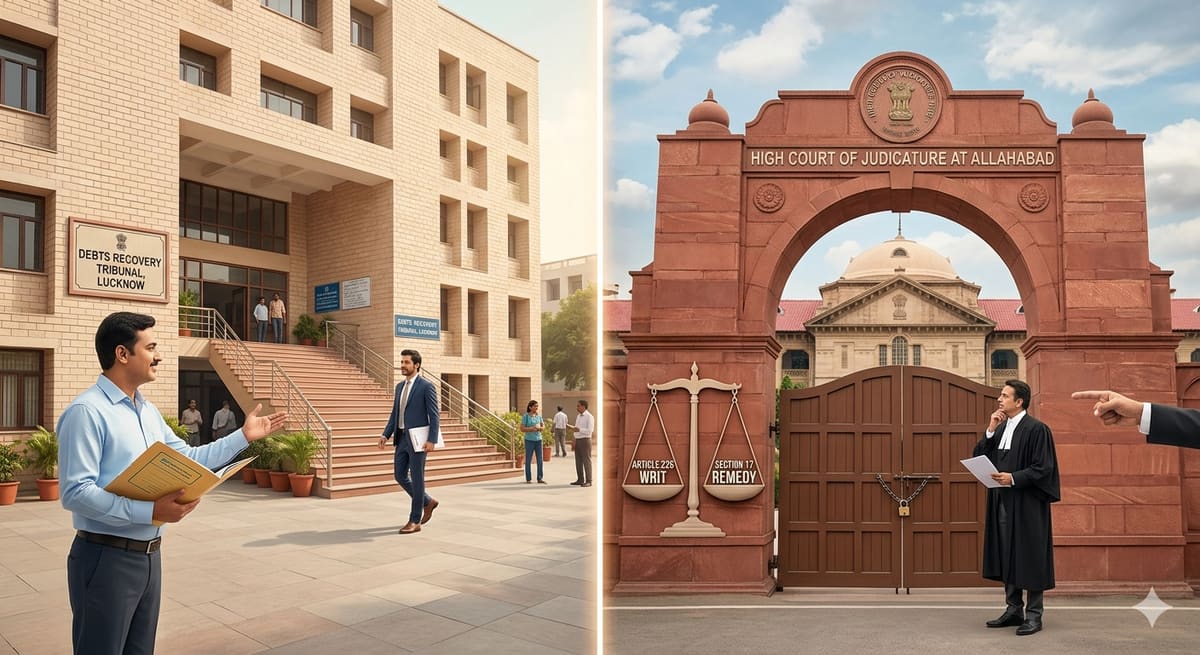
Section 14 SARFAESI Act | Writ Petition Under Article 227 Not Maintainable Against Possession Orders; Alternate Remedy Lies with DRT Under Section 17 : Allahabad HC
|Allahabad High Court

Section 14 SARFAESI Act | Writ Petition Under Article 227 Not Maintainable Against Possession Orders; Alternate Remedy Lies with DRT Under Section 17 : Allahabad HC

Borrowers cannot challenge Section 14 possession orders via writ petitions under Article 227 of the Constitution. The Allahabad High Court has firmly held that the exclusive remedy lies before the Debt Recovery Tribunal under Section 17 of the SARFAESI Act, reinforcing the statutory framework that bars collateral attacks on secured asset enforcement proceedings.

Section 34 U.P. Revenue Code | Mutation Entries Cannot Confer Title When Civil Suit Is Pending: Allahabad HC
Case Law Analysis
|Allahabad High Court

Section 34 U.P. Revenue Code | Mutation Entries Cannot Confer Title When Civil Suit Is Pending: Allahabad HC

The Allahabad High Court has reaffirmed that revenue records, including mutation orders under Section 34 of the U.P. Revenue Code, 2006, are purely fiscal and cannot override or pre-empt title disputes resolved in pending civil suits. This ruling protects property rights by ensuring that possession-based claims, like those under Section 229-B of the U.P. Zamindari Abolition Act, must be adjudicated in civil court - not decided by revenue officials.

Section 17 SARFAESI Act | Writ Petition Under Article 226 Barred Where Effective Statutory Remedy Exists : Allahabad HC
Case Law Analysis
|Allahabad High Court

Section 17 SARFAESI Act | Writ Petition Under Article 226 Barred Where Effective Statutory Remedy Exists : Allahabad HC

The Allahabad High Court has held that borrowers cannot bypass the Debt Recovery Tribunal’s statutory remedy under Section 17 of the SARFAESI Act by filing writ petitions under Article 226. This reinforces that writ jurisdiction is not a substitute for statutory appeals, protecting the legislative intent behind the SARFAESI framework and binding all secured creditors and borrowers in Uttar Pradesh.

Section 10 TN Land Encroachment Act | Exhaustion of Appellate Remedy Mandatory Before Writ Petition; Commercial Use of Grama Natham Land Illegal : Madras HC
Case Law Analysis
|Madras High Court

Section 10 TN Land Encroachment Act | Exhaustion of Appellate Remedy Mandatory Before Writ Petition; Commercial Use of Grama Natham Land Illegal : Madras HC

Madras High Court ruled that a writ petition challenging an eviction notice under Section 6 of the Tamil Nadu Land Encroachment Act is not maintainable without first exhausting the statutory appeal under Section 10. The court also held that commercial use of grama natham land is illegal, reinforcing the state's authority over such lands.

Article 12 | AIU as 'State' Under Constitution: Punjab & Haryana HC Upholds Writ Maintainability in Youth Festival Result Dispute
Case Law Analysis
|Punjab and Haryana High Court

Article 12 | AIU as 'State' Under Constitution: Punjab & Haryana HC Upholds Writ Maintainability in Youth Festival Result Dispute

Punjab & Haryana HC rules that the Association of Indian Universities (AIU), being substantially funded by the government, qualifies as 'State' under Article 12, making writ petitions maintainable against it. The judgment reinforces procedural fairness in academic competitions, ensuring students can challenge arbitrary result modifications through constitutional remedies.

Section 17 SARFAESI Act | Writ Petition Under Article 226 Barred When Statutory Remedy Exists : Allahabad HC
Case Law Analysis
|Allahabad High Court

Section 17 SARFAESI Act | Writ Petition Under Article 226 Barred When Statutory Remedy Exists : Allahabad HC

Allahabad High Court reinforces that borrowers cannot bypass the Debt Recovery Tribunal (DRT) under Section 17 of the SARFAESI Act by filing writ petitions under Article 226. The ruling clarifies that private financial institutions acting under the SARFAESI Act are not subject to writ jurisdiction when an efficacious alternative remedy is available, impacting recovery proceedings for banks and NBFCs.