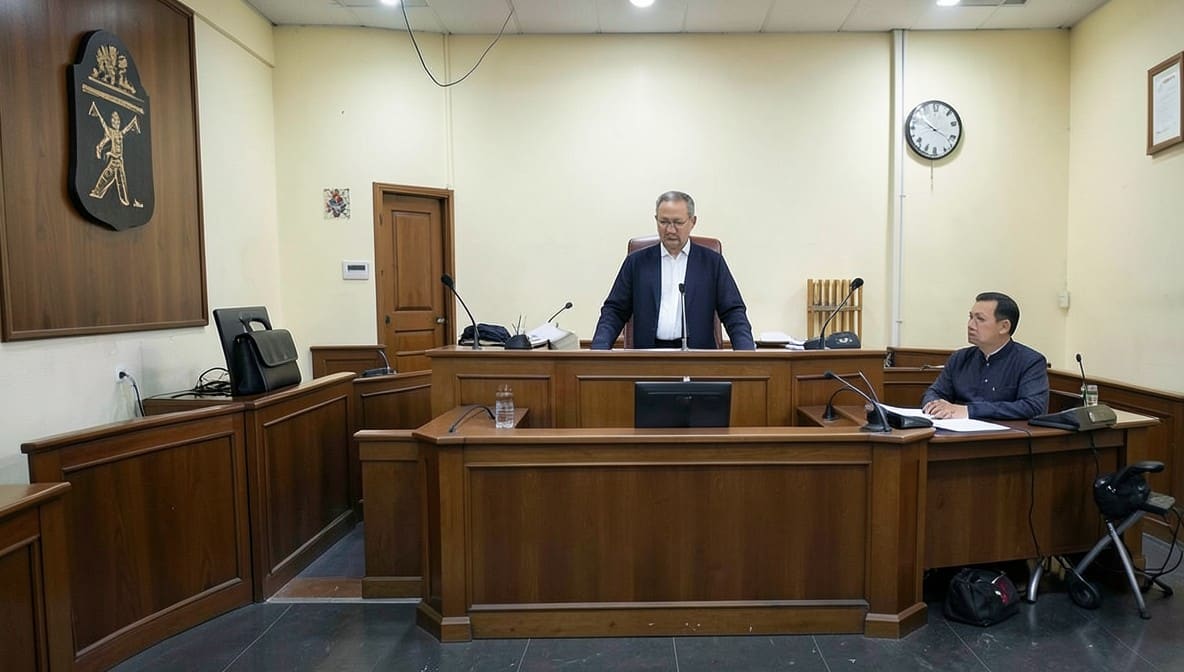
The Allahabad High Court has reaffirmed that writ petitions under Article 226 of the Constitution are not maintainable against private financial institutions initiating recovery proceedings under the SARFAESI Act, where a comprehensive statutory remedy exists before the Debts Recovery Tribunal. This judgment clarifies the limits of judicial review in debt recovery matters and reinforces the primacy of specialized tribunals.
Background & Facts
The Dispute
The petitioner, an individual borrower, availed two loan facilities from Save Financial Services Private Limited (Respondent No. 4), a non-banking financial company, on 12.12.2018 and 21.12.2018 for business expansion and working capital. The loans were secured by deposit of title deeds of immovable property bearing Municipal No. 25/269, Chakkipat, Agra, with the original sale deed dated 14.01.1998. The loan amounts were Rs. 4,50,000 and Rs. 8,80,000 respectively.
Key Facts
- The repayment schedules issued on 30.07.2019 and 23.01.2020 were initially complied with.
- The borrower defaulted on repayments, leading to classification of the loan accounts as Non-Performing Assets (NPA).
- The outstanding amount as of 13.11.2025 was Rs. 22,33,573.73.
- A demand notice under Section 13(2) of the SARFAESI Act was issued on 13.11.2025.
- Possession notice under Section 13(4) was issued on 15.01.2026, resulting in symbolic possession of the secured asset.
- The petitioner challenged the proceedings on grounds of jurisdiction, non-registration with CERSAI, insufficient stamping, forgery, and procedural irregularities.
Procedural History
- 12.12.2018: First loan facility sanctioned by Respondent No. 4.
- 21.12.2018: Second loan facility sanctioned.
- 30.07.2019: First repayment schedule issued.
- 23.01.2020: Second repayment schedule issued.
- 13.08.2025: Preliminary notice issued by Respondents.
- 13.11.2025: Demand notice under Section 13(2) SARFAESI Act issued.
- 15.01.2026: Possession notice under Section 13(4) issued.
- 26.01.2026: Online CERSAI search conducted by petitioner showing no registration.
- 28.02.2026: Writ Petition (No. 5496 of 2026) filed before the Allahabad High Court.
- 24.03.2026: Judgment delivered.
The Parties' Positions
For the Petitioner
- Argued that Respondent No. 4 is not a notified "financial institution" under Section 2(1)(m)(iv) of the SARFAESI Act.
- Contended that the notification dated 12.02.2021 did not cover Save Financial Services Private Limited.
- Asserted that the security interest was not registered with CERSAI under Section 26-D, rendering enforcement void.
- Alleged that loan agreements were insufficiently stamped under the Indian Stamp Act, 1899, making them inadmissible.
- Raised claims of forgery regarding co-borrower status and discrepancies in property description.
For the Respondent
- Maintained that Respondent No. 4 qualifies as a financial institution under the notification dated 24.02.2020, which superseded the 2016 notification.
- Argued that the 2021 notification only amended the monetary threshold, not the list of covered entities.
- Stated that CERSAI registration is procedural and does not invalidate the security interest between borrower and lender.
- Denied allegations of forgery and stamping irregularities as unsubstantiated and raised belatedly to evade repayment.
- Emphasized that Section 17 of the SARFAESI Act provides an efficacious statutory remedy.
Relief Sought
The petitioner sought quashing of the demand notice dated 13.11.2025, possession notice dated 15.01.2026, and all consequential recovery proceedings under the SARFAESI Act.
The Legal Issue
The central questions were: (1) whether Save Financial Services Private Limited qualifies as a "financial institution" under Section 2(1)(m)(iv) of the SARFAESI Act, 2002, and (2) whether a writ petition under Article 226 is maintainable when an efficacious statutory remedy exists under Section 17 of the SARFAESI Act.
Arguments Presented
For the Petitioner
The petitioner relied on the notification dated 05.08.2016, which listed notified financial institutions, and argued that Save Financial Services Private Limited was not included. It was contended that the notification dated 24.02.2020, which replaced the 2016 notification, applied only to NBFCs with assets of Rs. 100 crore and above, but did not automatically include all such entities without explicit naming. The petitioner further argued that non-registration with CERSAI under Section 26-D rendered the security interest unenforceable, and that insufficient stamping under the Indian Stamp Act, 1899, rendered the loan documents inadmissible under Section 35. Allegations of fraud and discrepancies were presented as jurisdictional defects.
For the Respondent
The respondent countered that the notification dated 24.02.2020, which superseded the 2016 notification, broadly classified all NBFCs meeting the asset threshold as financial institutions under the SARFAESI Act, without requiring individual listing. The 2021 notification merely reduced the minimum debt threshold from Rs. 50 lakh to Rs. 20 lakh. It was submitted that CERSAI registration is a procedural formality and does not affect the validity of the security interest between parties. The issue of stamp duty was argued to be curable and not a ground to invalidate recovery proceedings. The respondent emphasized that the Supreme Court in S. Shobha v. State Bank of India & Ors. (2025 SCCOnline SC 177) had held that writ jurisdiction under Article 226 is not available where a statutory remedy exists.
The Court's Analysis
The Court undertook a detailed statutory interpretation of Section 2(1)(m)(iv) of the SARFAESI Act, which empowers the Central Government to notify institutions as financial institutions. It examined the notifications dated 05.08.2016, 24.02.2020, and 12.02.2021 in sequence. The Court held that the 2020 notification, which superseded the 2016 notification, established a category-based approach: all NBFCs as defined under Section 45-I(f) of the RBI Act, with assets of Rs. 100 crore and above, are deemed financial institutions under the SARFAESI Act. The 2021 notification merely amended the monetary threshold for enforcement from Rs. 50 lakh to Rs. 20 lakh, without altering the definition of covered entities.
"The presence or absence of the name of the respondent no.4 in the notification dated 05.08.2016 becomes irrelevant after the notification dated 24.02.2020, which still holds the field regarding definition of the financial institution."
The Court further held that the petitioner’s challenges regarding CERSAI registration, stamp duty, and alleged forgery were factual and procedural in nature, and fell squarely within the purview of Section 17 of the SARFAESI Act, which provides a comprehensive mechanism for aggrieved persons to challenge enforcement measures before the Debts Recovery Tribunal. The Court relied on S. Shobha v. State Bank of India & Ors. to affirm that writ jurisdiction under Article 226 is not a substitute for statutory remedies, particularly where the dispute involves private parties and complex factual issues.
The Court emphasized that the SARFAESI Act is a self-contained code with its own appellate structure under Section 18, and that the High Court’s extraordinary jurisdiction must yield to such specialized statutory frameworks unless there is a patent lack of jurisdiction or violation of natural justice - neither of which was established here.
The Verdict
The writ petition was dismissed. The Court held that Save Financial Services Private Limited qualifies as a financial institution under the SARFAESI Act by virtue of the notification dated 24.02.2020. The petitioner’s challenges regarding CERSAI registration, stamp duty, and alleged fraud are to be adjudicated before the Debts Recovery Tribunal under Section 17 of the SARFAESI Act. No costs were awarded. The petitioner is entitled to file an application under Section 17 within 45 days of the possession notice dated 15.01.2026.
What This Means For Similar Cases
Statutory Remedy Overrides Writ Jurisdiction
- Practitioners must advise clients to exhaust remedies under Section 17 SARFAESI before approaching High Courts under Article 226.
- Writ petitions challenging SARFAESI proceedings on grounds of procedural irregularities, stamping, or registration defects will be dismissed unless they establish patent jurisdictional error.
Financial Institution Status Is Category-Based, Not List-Based
- NBFCs meeting the asset threshold under Section 45-I(f) of the RBI Act are automatically covered under SARFAESI Act via the 2020 notification.
- The absence of a name in the 2016 notification is no longer a defense; the 2020 notification operates as a general class notification.
CERSAI Registration Is Procedural, Not Substantive
- Non-registration with CERSAI does not invalidate the creation of a security interest or the right to enforce it under Chapter III.
- Such defects are curable and must be raised before the DRT under Section 17, not in writ petitions.
Stamp Duty Irregularities Are Not Jurisdictional Barriers
- Allegations of insufficient stamping cannot be used to quash SARFAESI proceedings.
- The DRT has jurisdiction to examine stamp duty issues under Section 17, and such challenges do not oust the tribunal’s authority.
Fraud Allegations Require Evidence, Not Mere Assertions
- Vague allegations of forgery or misrepresentation without documentary proof will not sustain a writ petition.
- Courts will not entertain speculative claims to delay recovery; substantive evidence must be adduced before the DRT.