
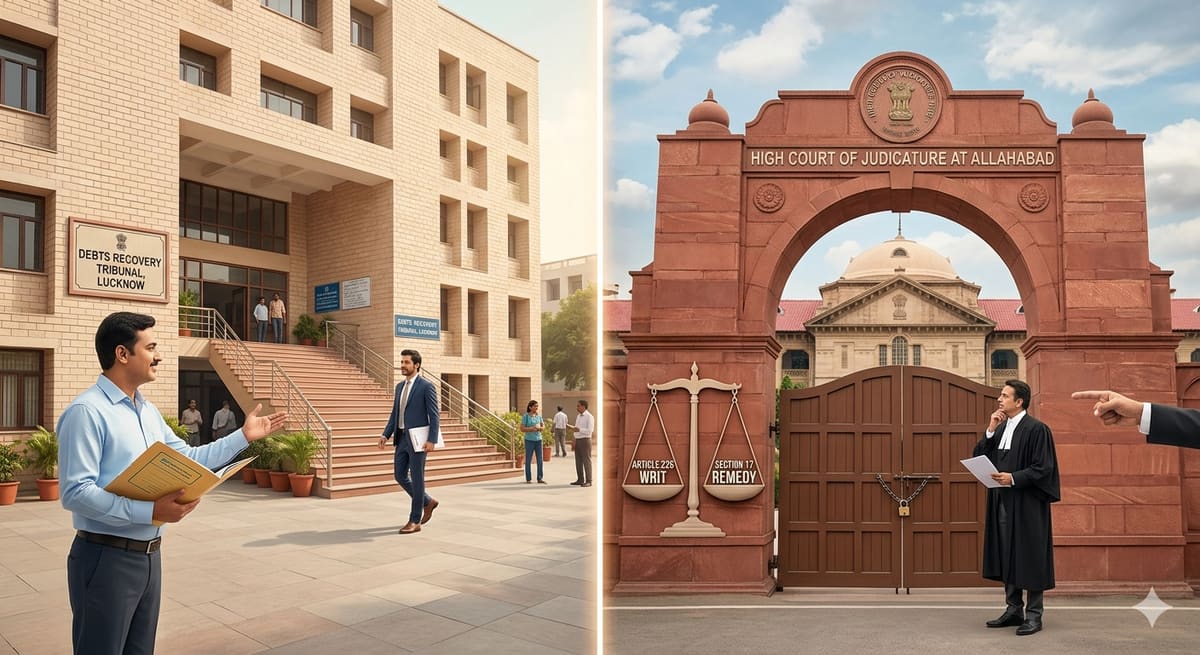
The Allahabad High Court has reaffirmed the well-settled principle that writ petitions under Article 226 of the Constitution cannot be entertained when an effective statutory remedy is available under the SARFAESI Act, 2002, and is already pending before the Debt Recovery Tribunal. The Court quashed an interim order restoring possession of a secured asset to a lessee and dismissed two writ petitions filed during the pendency of multiple securitization applications, emphasizing that such forum shopping undermines the legislative intent of a specialized adjudicatory mechanism.
Background & Facts
The Dispute
This case involves a complex web of financial transactions, leasehold rights, and enforcement proceedings concerning a commercial property at Khasra No. 1314, Shekhpur Kasaila, Faizabad Road, Lucknow, measuring 32,879 square feet. The property was originally mortgaged by Andes Town Planners Private Limited to Dewan Housing Finance Corporation Limited. The loan was subsequently assigned to Piramal Capital and Housing Finance Limited, then to Omkara Assets Reconstruction Private Limited, and finally to Phoenix Arc Private Limited, the current secured creditor and appellant. The guarantors of the loan were Smt. Rani Devi and Smt. Krishna Devi, both of whom have since passed away.
Bharat Petroleum Corporation Limited (BPCL) claimed to be the lessee of the property under a lease agreement that expired on 06.01.2025. M/s Arora Auto Center, Lucknow, operated a petrol pump on the premises as a sub-lessee of BPCL, having held the dealership since 1972, with the latest renewal on 15.07.2020.
Key Facts
The loan default triggered securitization proceedings under the SARFAESI Act, 2002.
Notices under Section 13(2) dated 31.05.2023 and Section 13(4) dated 07.10.2023 were issued by the secured creditor.
An auction was conducted on 27.10.2025, resulting in M/s Waheguru Projects Pvt. Ltd. becoming the highest bidder and receiving a sale certificate.
Physical possession of the property was handed over to the auction purchaser on 27.10.2025.
BPCL and M/s Arora Auto Center filed multiple securitization applications before the DRT, Lucknow, challenging the validity of the proceedings.
The DRT dismissed S.A. No. 958 of 2023 filed by M/s Arora Auto Center on 16.07.2024, citing a moratorium under the IBC.
An appeal against this dismissal is pending before the Debt Recovery Appellate Tribunal, Allahabad.
BPCL filed two securitization applications: S.A. No. 909 of 2023 and S.A. No. 487 of 2024, both still pending.
M/s Arora Auto Center filed S.A. No. 1067 of 2025 challenging the possession order dated 18.08.2025 and the sale certificate.
An interim relief application in S.A. No. 487 of 2024 was rejected on 01.11.2025 on grounds of lack of independent standing.
The last extension of interim relief in S.A. No. 487 of 2024 was on 03.04.2025, with no further extension recorded before the possession order of 18.08.2025.
BPCL filed a fresh interim application (IR No. 3157 of 2025) on 22.09.2025 seeking restraint on possession, indicating awareness that no interim order was then in force.
Procedural History
31.05.2023: Section 13(2) notice issued by secured creditor.
07.10.2023: Section 13(4) notice issued.
15.06.2024: Sale notice issued.
16.07.2024: DRT, Lucknow dismissed S.A. No. 958 of 2023 filed by M/s Arora Auto Center.
18.08.2025: Additional District Magistrate, Lucknow passed order under Section 14 of SARFAESI Act, authorizing possession.
27.10.2025: Physical possession handed over to auction purchaser M/s Waheguru Projects Pvt. Ltd.
10.11.2025: BPCL filed Writ C No. 11298 of 2025 before the High Court.
11.11.2025: M/s Arora Auto Center filed Writ C No. 11302 of 2025.
28.11.2025: Single Judge of High Court passed interim order restoring possession to BPCL and M/s Arora Auto Center within 24 hours.
12.02.2026: Writ petitions tagged with Special Appeals.
13.03.2026: Court reserved judgment on all appeals and writ petitions.
24.04.2026: Judgment delivered by Division Bench.
The Parties' Positions
Appellants (M/s Waheguru Projects Pvt. Ltd. and Phoenix Arc Pvt. Ltd.): Argued that the writ petitions were not maintainable because statutory remedies under Section 17 of the SARFAESI Act were pending before the DRT. They contended that the Single Judge had no jurisdiction to interfere with ongoing proceedings, especially when no order of the DRT had been challenged. They further argued that BPCL was a tenant in sufferance after expiry of lease and had no legal right to claim possession.
Respondents (BPCL and M/s Arora Auto Center): Contended that the securitization proceedings were illegal, void ab initio, and conducted against deceased persons. They claimed BPCL held a perpetual lease under the Burma Shell Act, 1976, and that the possession order was passed in violation of an existing interim order from the DRT. They also raised concerns about hazardous petroleum storage on the premises.
Relief Sought
The appellants sought quashing of the interim order dated 28.11.2025 and dismissal of the writ petitions. The respondents sought continuation of possession, restoration of business operations, and protection of petroleum assets.
The Legal Issue
The central question was whether a writ petition under Article 226 of the Constitution is maintainable when an effective statutory remedy under Section 17 of the SARFAESI Act, 2002, is already pending before the Debt Recovery Tribunal, and no order of the DRT or DRAT has been challenged.
Arguments Presented
For the Appellant/Petitioner
The appellants relied on the settled doctrine that writ jurisdiction under Article 226 is not available when an alternative statutory remedy exists and is being availed. They cited Bombay Metropolitan Region Development Authority v. Gokak Patel Volkart Ltd. (1995) 1 SCC 642 and Om Prakash Saini v. DCM Ltd. (2010) 11 SCC 622 to establish that filing a writ petition during pendency of a statutory appeal constitutes forum shopping and abuse of process. They further relied on Phoenix ARC (P) Ltd. v. Vishwa Bharati Vidya Mandir (2022) 5 SCC 345 to argue that private financial institutions like ARCs do not perform public functions, making writ jurisdiction inapplicable. They emphasized that BPCL, as a tenant in sufferance, had no legal standing under Section 17(3) and (4) of the SARFAESI Act to claim rights against the secured creditor.
For the Respondent/State
The respondents argued that the securitization proceedings were illegal because they were initiated against deceased guarantors and that the mortgage deed was forged. They contended that the interim order from the DRT was still operative and that the possession order violated it. They also invoked public interest concerns regarding hazardous petroleum storage and claimed BPCL’s lease was perpetual under the Burma Shell Act, 1976. They submitted that the writ petition was necessary to prevent irreparable harm.
The Court's Analysis
The Court conducted a comprehensive review of the statutory framework under the SARFAESI Act and the jurisprudence on writ jurisdiction. It held that the existence of a specific, efficacious remedy under Section 17 of the SARFAESI Act, which allows aggrieved parties to challenge any action taken by a secured creditor, precludes the invocation of writ jurisdiction under Article 226.
"The writ petitioner had an adequate alternative statutory remedy. The writ petitioner had in fact already taken advantage of alternative remedy provided by the statute and had preferred an appeal against the judgment of the Tribunal. While the said appeal was pending the writ petitioner invoked the writ jurisdiction of the Bombay High Court praying more or less the same remedy as was prayed in the appeal. We are of the view that the point taken by the appellant is of substance."
The Court emphasized that the writ petitions filed by BPCL and M/s Arora Auto Center sought identical reliefs as those pending before the DRT - including quashing of notices, setting aside of possession orders, and declaration of proceedings as void. The fact that multiple securitization applications were already pending rendered the writ petitions redundant and legally impermissible.
The Court further noted that the Single Judge had no jurisdiction to entertain the writ petitions under Article 226, as per the Chief Justice’s roster, and that the matter was cognizable only before a Division Bench. The Court decried the practice of counsel making informal endorsements to bypass procedural rules, stating that jurisdiction cannot be determined by counsel’s note but by the court’s official listing system.
Regarding the claim of an operative interim order, the Court found that no such order subsisted on 18.08.2025, as evidenced by BPCL’s own conduct in filing a fresh interim application on 22.09.2025. The Court rejected the argument that interim orders continue unless expressly vacated, holding that the DRT’s order of 01.04.2025 - stating "IR, if any is extended" - indicated no active interim relief.
The Court also dismissed BPCL’s claim of perpetual lease under the Burma Shell Act, noting that even if valid, such rights must be adjudicated by the DRT under Section 17, not by the writ court. Similarly, the issue of the mortgage deed’s validity, the death of guarantors, and the status of petroleum storage were all factual matters requiring evidence and were squarely within the DRT’s domain.
The Court concluded that the Single Judge’s interim order was not only without jurisdiction but also an impermissible interference with the statutory process, effectively deciding the merits of the dispute before the specialized tribunal.
The Verdict
The Special Appeals were allowed. The interim order dated 28.11.2025 passed by the Single Judge in Writ C No. 11298 of 2025 and Writ C No. 11302 of 2025 is quashed. The writ petitions are dismissed as not maintainable. The parties are directed to pursue their claims before the Debt Recovery Tribunal, Lucknow, and the Debt Recovery Appellate Tribunal, Allahabad, in the pending securitization applications. The Court directed that copies of this judgment be sent to the Registrar Generals of the Allahabad and Lucknow Benches for compliance.
What This Means For Similar Cases
Statutory Remedy Precludes Writ Jurisdiction
Practitioners must exhaust remedies under Section 17 of the SARFAESI Act before approaching the High Court under Article 226.
Filing a writ petition during pendency of a DRT application will result in dismissal, regardless of the nature of the grievance.
Courts will not entertain writ petitions merely because the statutory remedy is perceived as slow or inadequate.
Tenant in Sufferance Has No Standing
A lessee whose lease has expired and who continues in possession without consent is a tenant in sufferance and has no independent right to challenge SARFAESI proceedings.
Such parties must rely on the borrower or guarantor to raise defenses in DRT proceedings under Section 17(3) and (4).
Claims of leasehold interest must be raised before the DRT, not the writ court.
Procedural Compliance in Court Listing Is Mandatory
Counsel cannot override court roster rules by informal endorsements.
Reporting Sections must list matters strictly according to the Chief Justice’s orders, irrespective of counsel’s submissions.
Any deviation invites procedural invalidity and may lead to quashing of orders.
Jurisdictional Errors Cannot Be Ratified by Consent
Even if parties consent to hearing before a Single Judge, the Court retains the power to declare the order void if jurisdiction is lacking.
Consent does not cure a jurisdictional defect under constitutional law.
Petroleum Storage Is a Regulatory, Not Judicial, Issue
Concerns about hazardous material storage must be addressed under the Petroleum Rules, 2002, through the concerned authorities.
Courts will not grant interim possession orders on grounds of public safety unless the matter is before the appropriate regulatory body.





