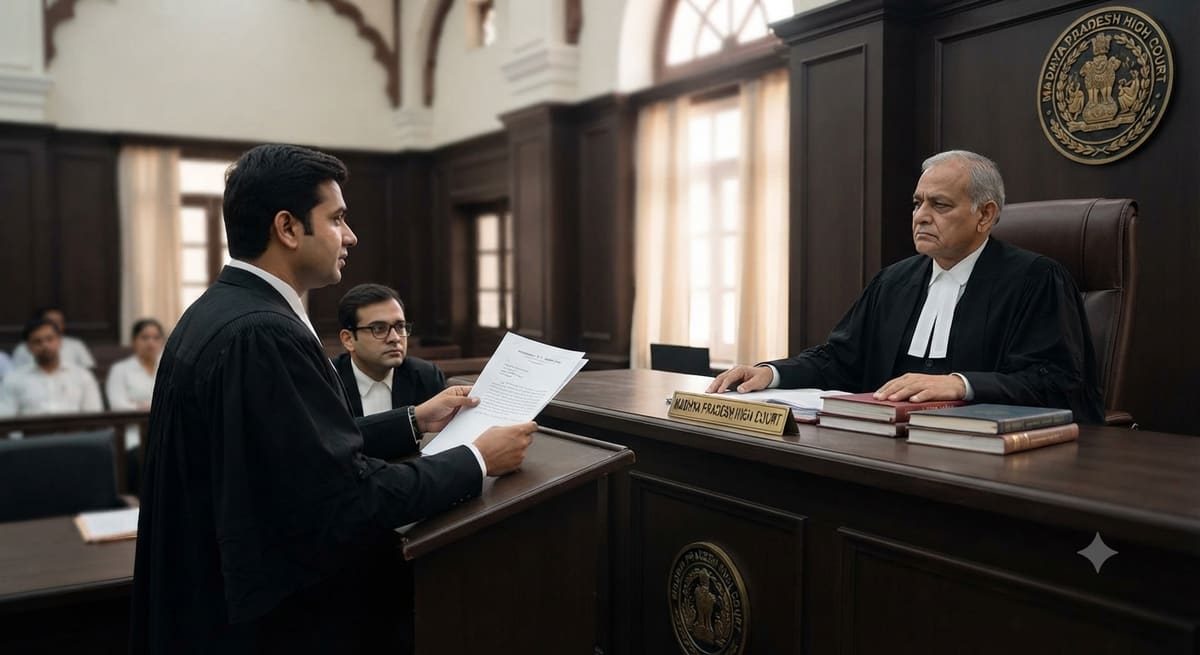
The Madhya Pradesh High Court has clarified that once a public officeholder's tenure expires, they lose all legal standing to challenge subsequent appointments made in that capacity. This ruling reinforces the principle that standing in writ petitions is tied to subsisting rights and interests, not past positions.
Background & Facts
The Dispute
The petitioner, Mohammed Nasir Hussain, served as the Chairperson of the District Haj Committee, Gwalior, under the Haj Committee Act, 2002. His tenure was fixed and came to an end on 01.05.2026. On 25.05.2026, the Chief Executive Officer (Respondent No. 3) issued an order removing the petitioner from office and directing the appointment of a new Chairperson. Respondent No. 5 was subsequently appointed as the new Chairperson.
Key Facts
- The petitioner was appointed Chairperson of the District Haj Committee, Gwalior, for a fixed term ending 01.05.2026
- No extension or continuance order was issued beyond 01.05.2026
- On 25.05.2026, the Chief Executive Officer issued an order removing the petitioner and directing appointment of a successor
- Respondent No. 5 was appointed as the new Chairperson on or about 25.05.2026
- The petitioner filed the writ petition on 19.06.2026, after his tenure had expired
Procedural History
- 01.05.2026: Petitioner’s tenure as Chairperson of the District Haj Committee expired
- 25.05.2026: Chief Executive Officer issued order removing petitioner and directing appointment of new Chairperson
- 25.05.2026: Respondent No. 5 appointed as new Chairperson
- 19.06.2026: Writ Petition No. 19663 of 2026 filed before the High Court of Madhya Pradesh at Gwalior
- 22.06.2026: Hearing conducted before Justice Milind Ramesh Phadke
The Parties' Positions
For the Petitioner
- Admitted that his tenure ended on 01.05.2026
- Did not seek continuation or challenge the removal order
- Argued that the Chief Executive Officer had no legal authority under the Haj Committee Act, 2002 to appoint the Chairperson
- Sought direction to the competent authority (Respondent No. 2) to examine the legality of the appointment power and pass fresh orders if required
For the Respondent / State
- Contended that the petitioner had no locus standi to file the writ petition after his tenure expired
- Argued that the petitioner could not challenge the appointment of Respondent No. 5 as he had no personal or legal interest remaining
- Asserted that the petition was not maintainable on grounds of non-est of rights
Relief Sought
The petitioner sought:
- Quashing of the order dated 25.05.2026 appointing Respondent No. 5
- Declaration that the Chief Executive Officer lacks authority to appoint the Chairperson under the Haj Committee Act, 2002
- Direction to Respondent No. 2 to examine the legal position and issue fresh orders if necessary
The Legal Issue
Can a former officeholder, whose tenure has expired, maintain a writ petition challenging the appointment of their successor on the ground that the appointing authority lacked statutory power?
Arguments Presented
For the Petitioner
The petitioner conceded that his tenure had expired and that he could not challenge his own removal. However, he argued that the appointment of Respondent No. 5 was void ab initio because the Chief Executive Officer was not the competent authority under the Haj Committee Act, 2002. He contended that the issue of statutory competence was a question of public interest and legal validity affecting the entire structure of the Haj Committee, and thus, even a former officeholder could raise it to prevent illegal exercise of power.
For the Respondent / State
The State argued that locus standi is a threshold requirement for maintaining a writ petition under Article 226. Once the petitioner’s tenure ended, he ceased to have any legal right, interest, or status in the office. He could not claim any injury from the appointment of a successor. The State further submitted that the petitioner’s attempt to challenge the appointment was an indirect effort to revive his own claim, which was barred by lapse of time and extinguishment of rights.
The Court's Analysis
The Court acknowledged the petitioner’s admission that his tenure ended on 01.05.2026 and that no order of continuance was issued. It held that upon expiry of tenure, the petitioner’s rights, duties, and interests in the office ceased entirely. The Court observed:
"In actual parlance, no further rights survived in favour of the petitioner to continue as Chairperson of the District Haj Committee after expiry of his tenure and without there being any order of continuance, he could not have continued beyond the prescribed period."
The Court emphasized that the writ jurisdiction under Article 226 is not a general forum for ventilating grievances of former officeholders. The petitioner’s challenge to the appointment of Respondent No. 5 was not rooted in any personal or legal injury he suffered after 01.05.2026. His standing was extinguished with his tenure.
However, the Court noted that the petitioner raised a substantial question of law regarding the statutory authority of the Chief Executive Officer to appoint the Chairperson. The Court held that while the petitioner lacked locus to challenge the appointment, the issue of whether the appointment was made by a legally competent authority was of public importance and affected the integrity of the statutory framework governing the Haj Committee. The Court therefore exercised its discretion under Article 226 to direct the competent authority to examine the matter.
The Verdict
The petition was dismissed as not maintainable on grounds of locus standi. However, the Court directed Respondent No. 2 - the competent authority under the Haj Committee Act, 2002 - to examine whether the Chief Executive Officer had statutory power to appoint the Chairperson of the District Haj Committee. The authority was directed to take a decision on this legal question expeditiously and in accordance with law.
What This Means For Similar Cases
Locus Standi Is Tied to Subsisting Interest
- Practitioners must establish a continuing legal or personal interest at the time of filing a writ petition
- Former officeholders cannot invoke public interest to challenge appointments made after their tenure ends
- Mere theoretical illegality in appointment does not confer standing if no personal right is infringed
Public Interest Can Trigger Judicial Oversight Even Without Standing
-
Courts may, in exceptional cases, take cognizance of serious statutory violations affecting institutional integrity
-
The absence of locus does not preclude the Court from issuing a direction to the competent authority to rectify a legal defect
-
This creates a narrow but important pathway for judicial intervention in cases of apparent ultra vires appointments
-
Always verify the statutory provisions governing appointment authority before challenging an appointment
-
If challenging an appointment made by an unauthorized officer, consider filing a representation to the competent authority first
-
In writ petitions, clearly plead how the petitioner’s rights are directly and adversely affected - general illegality is insufficient