Topic

Public Safety Act

The Public Safety Act (PSA) in Jammu & Kashmir allows preventive detention without trial to maintain public order, subject to strict judicial scrutiny under Article 22 of the Constitution.

13 articlesLatest 1 week ago
Stale FIRs & Failure to Notify Representation Authority Invalidate PSA Detention | Preventive Detention : J&K HC
Case Law Analysis
|Jammu & Kashmir and Ladakh High Court

Stale FIRs & Failure to Notify Representation Authority Invalidate PSA Detention | Preventive Detention : J&K HC

The J&K High Court quashed a PSA detention order, ruling that reliance on stale FIRs without a proximate link to current public order prejudice, and failure to inform the detenue of the specific representation authority, violates Article 22(5) safeguards. The decision reinforces that preventive detention requires fresh, live grounds, not mechanical reproduction of past cases.

Stale FIR Evidence Cannot Satisfy Subjective Satisfaction Under J&K Public Safety Act 1978 | Preventive Detention : JK HC
Case Law Analysis
|Jammu & Kashmir and Ladakh High Court

Stale FIR Evidence Cannot Satisfy Subjective Satisfaction Under J&K Public Safety Act 1978 | Preventive Detention : JK HC

The Jammu & Kashmir High Court set aside a PSA detention order that relied on a 2022 FIR, holding that preventive detention must be based on fresh, current material to meet the authority's subjective satisfaction. This ruling narrows the scope of PSA detentions and obliges officials to base orders on up-to-date evidence, impacting current and future detainees under the Act.

PSA Detention Valid Despite Six-Year Delay | Persistent Anti-National Conduct Justifies Preventive Detention : J&K HC
Case Law Analysis
|Jammu & Kashmir and Ladakh High Court

PSA Detention Valid Despite Six-Year Delay | Persistent Anti-National Conduct Justifies Preventive Detention : J&K HC

J&K High Court rules that a six-year gap between alleged acts and detention order does not invalidate preventive detention under the Public Safety Act if a persistent pattern of anti-national conduct is established. The ruling underscores that ongoing threats to national security can override procedural delays, even when the detenu is on bail in related cases.

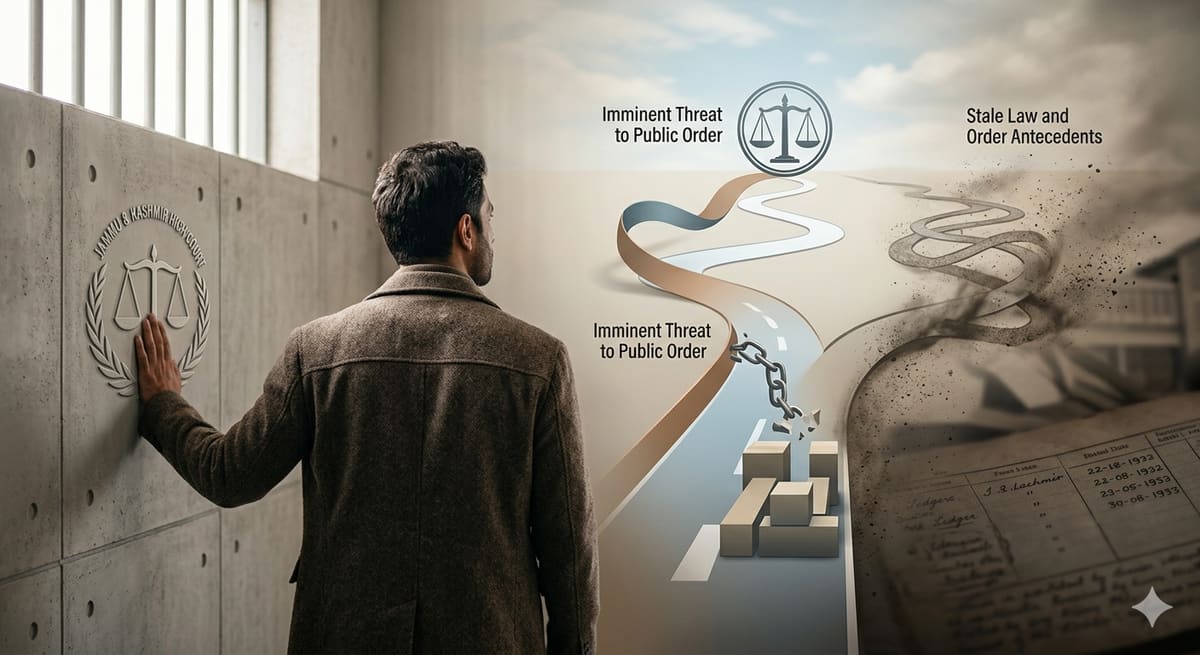
PSA Detention | Grounds Must Relate to Imminent Threat to Public Order, Not Stale Law and Order Antecedents : J&K HC
Case Law Analysis
|Jammu & Kashmir and Ladakh High Court

PSA Detention | Grounds Must Relate to Imminent Threat to Public Order, Not Stale Law and Order Antecedents : J&K HC

The J&K High Court has struck down a preventive detention under the Public Safety Act, ruling that reliance on outdated criminal antecedents tied to routine law and order issues - not a genuine threat to public order - renders the detention illegal. This reaffirms that PSA cannot be used as a tool for punitive detention and sets a vital boundary for executive power in Jammu & Kashmir.

Preventive Detention Under PSA | Stale FIRs Without Live Proximate Link Violate Article 21 : J&K HC
Case Law Analysis
|Jammu & Kashmir and Ladakh High Court

Preventive Detention Under PSA | Stale FIRs Without Live Proximate Link Violate Article 21 : J&K HC

The J&K High Court quashed a preventive detention order under the Public Safety Act, ruling that reliance on a 24-year-old FIR without evidence of a current threat fails the 'live and proximate link' test. The judgment reaffirms that preventive detention cannot be used as a tool for punishing past conduct without trial, safeguarding personal liberty under Article 21.

J&K Public Safety Act | Detention Order Quashed Over Fatal Discrepancies Between Police Dossier and Grounds : J&K HC
Case Law Analysis
|Jammu & Kashmir and Ladakh High Court

J&K Public Safety Act | Detention Order Quashed Over Fatal Discrepancies Between Police Dossier and Grounds : J&K HC

The Jammu & Kashmir High Court set aside a preventive detention order under the Public Safety Act, ruling that material inconsistencies between the police dossier and the detention grounds violated procedural fairness. The court emphasized that even in national security cases, non-compliance with statutory safeguards nullifies detention, leading to the immediate release of the petitioner.

Article 22(5) | Preventive Detention Void Without Communicating Right to Represent Before Detaining Authority : J&K HC
Case Law Analysis
|Jammu & Kashmir and Ladakh High Court

Article 22(5) | Preventive Detention Void Without Communicating Right to Represent Before Detaining Authority : J&K HC

The J&K High Court ruled that a preventive detention order under the Public Safety Act is legally invalid if the detenue is not informed of their right to make a representation before the detaining authority. This omission violates Article 22(5) of the Constitution, regardless of compliance with other procedural requirements, reinforcing the principle of natural justice in preventive detention cases.

PSA Detention | Unexplained Delay & Lack of Communal Threat Proof Void Preventive Detention : J&K & Ladakh HC
Case Law Analysis
|Jammu & Kashmir and Ladakh High Court

PSA Detention | Unexplained Delay & Lack of Communal Threat Proof Void Preventive Detention : J&K & Ladakh HC

Preventive detention under the Public Safety Act requires immediate action and concrete evidence of public order threat. The J&K & Ladakh HC ruled that a one-month delay in passing detention orders and mere allegations of bovine smuggling-without proof of communal unrest-fail to meet the legal threshold, quashing the detention order and reinforcing safeguards against arbitrary state action.

Preventive Detention Under J&K PSA Valid Despite Bail in Criminal Cases: Distinct Legal Purposes Affirmed | High Court of Jammu & Kashmir and Ladakh
Case Law Analysis
|Jammu & Kashmir and Ladakh High Court

Preventive Detention Under J&K PSA Valid Despite Bail in Criminal Cases: Distinct Legal Purposes Affirmed | High Court of Jammu & Kashmir and Ladakh

The High Court of Jammu & Kashmir and Ladakh ruled that preventive detention under the J&K Public Safety Act (PSA) remains lawful even if the detenu is granted bail in criminal cases, emphasizing that preventive and punitive detention serve separate legal objectives. The judgment underscores that activities threatening public order and communal harmony justify detention irrespective of bail status, impacting individuals involved in organized crime or public disorder.