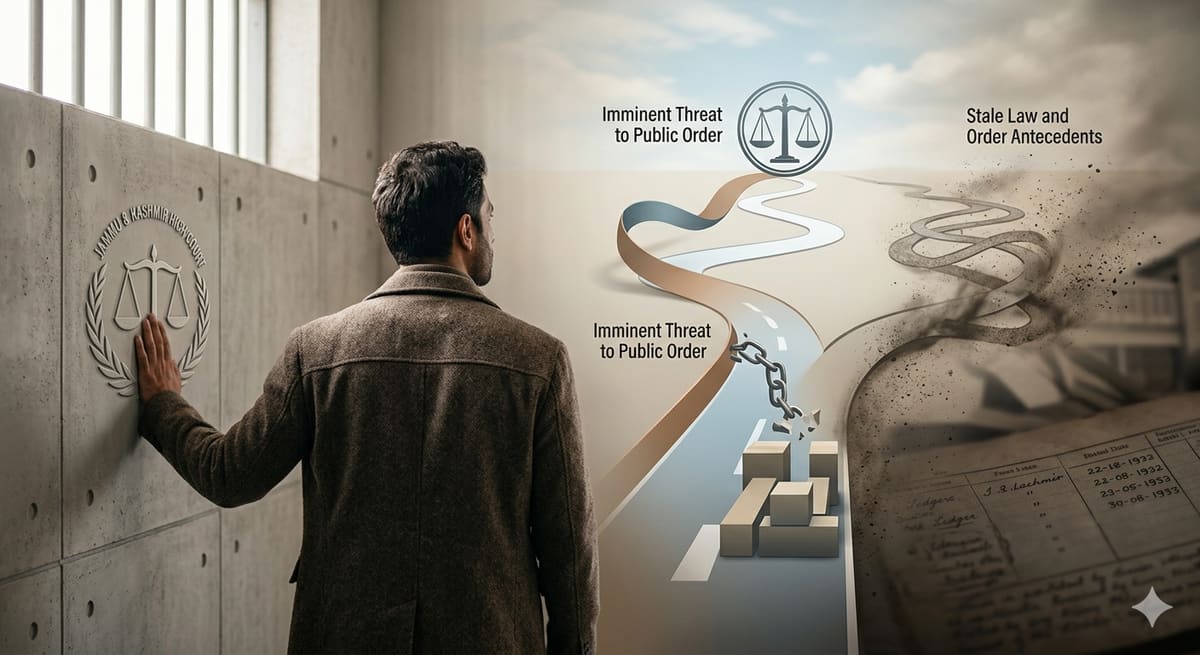
The High Court of Jammu & Kashmir and Ladakh has reaffirmed that preventive detention under the J&K Public Safety Act, 1978, remains lawful even when the detenu is on bail in connected criminal proceedings. This judgment clarifies a critical doctrinal boundary between punitive prosecution and precautionary detention, offering definitive guidance to practitioners navigating overlapping legal remedies.
Background & Facts
The Dispute
The petitioner, Shokat Ali, a 21-year-old resident of Kathua, was detained under Section 8 of the J&K Public Safety Act, 1978 (PSA), on 25 June 2025. The detaining authority, the District Magistrate of Kathua, relied on a dossier submitted by the Senior Superintendent of Police, which cited four FIRs against the petitioner for offenses related to bovine smuggling under Sections 188 IPC and 331(4) BNS. The dossier further alleged that the petitioner was part of an organized smuggling network, had links with notorious criminals, and posed a persistent threat to public order.
Procedural History
- 25 June 2025: Detention order PSA No. 168/2025 issued; petitioner lodged in Central Jail, Kot Bhalwal.
- 27 June 2025: Petitioner received detention order and 47-page dossier, signed acknowledgment of receipt.
- 13 August 2025: Representation filed by petitioner’s mother, Kali Begum.
- 14 August 2025: Representation forwarded to Principal Secretary, Home Department.
- 1 September 2025: Home Department rejected representation as without merit.
- 11 September 2025: Jail authorities confirmed communication of rejection to petitioner.
- 26 February 2026: HCP No. 111/2025 heard; judgment reserved.
- 5 March 2026: Judgment pronounced dismissing the petition.
Relief Sought
The petitioner sought quashing of the detention order on seven grounds, including: failure to explain grounds in Gojri language, non-supply of FIRs and bail orders, reliance on frivolous or bailed-out cases, non-application of mind, and failure to record subjective satisfaction that ordinary law had failed. He also challenged a clerical error in the order naming another individual, Kamal @ Kaka, as the intended detenu.
The Legal Issue
The central question was whether preventive detention under Section 8 of the J&K Public Safety Act can be lawfully invoked when the detenu is already enlarged on bail in criminal cases arising from the same conduct, and whether the detaining authority’s reliance on such cases constitutes a legal infirmity.
Arguments Presented
For the Petitioner
The petitioner’s counsel argued that: (1) the detention order violated Article 22(5) of the Constitution by failing to communicate grounds in Gojri, the petitioner’s native language; (2) the detention was based on FIRs for which bail had been granted, indicating lack of prosecutorial confidence; (3) the detaining authority failed to independently assess the material and merely reproduced the SSP’s dossier; (4) no satisfaction was recorded that ordinary law had failed to deter the petitioner; and (5) the detention order contained a clerical error naming the wrong person, rendering it void.
For the Respondent
The State contended that: (1) the petitioner had acknowledged receipt of the dossier and grounds in Hindi/Urdu, which he understood; (2) the four FIRs demonstrated a consistent pattern of anti-social conduct justifying preventive action; (3) bail in criminal proceedings does not preclude preventive detention, as the purposes are fundamentally distinct; (4) the representation was duly considered and rejected; and (5) the clerical error was promptly corrected by a formal corrigendum issued on 30 June 2025.
The Court's Analysis
The Court undertook a rigorous doctrinal review of the nature and scope of preventive detention under the PSA, distinguishing it sharply from punitive prosecution. It emphasized that preventive detention is not a substitute for criminal trial, but a precautionary measure aimed at forestalling future harm to public order.
"The power of preventive detention is qualitatively different from punitive detention. The power of preventive detention is a precautionary power exercised in reasonable anticipation. It may or may not relate to an offence. It is not a parallel proceeding. It does not overlap with prosecution even if it relies on certain facts for which prosecution may be launched or may have been launched."
The Court relied on the five-judge bench decision in Haradhan Saha v. State of West Bengal (1975) 3 SCC 198, which established that pendency of prosecution, grant of bail, or even acquittal does not bar preventive detention. The Court held that the subjective satisfaction of the detaining authority - based on past conduct and reasonable prognosis of future behavior - is the cornerstone of validity, not the outcome of criminal proceedings.
The Court rejected the argument that the detention order was a mere repetition of the dossier. It found that the grounds of detention were precise, referenced specific FIRs, and articulated a clear link between the petitioner’s habitual conduct and the threat to public order. The Court further held that writ courts cannot substitute their opinion for the administrative satisfaction of the detaining authority, absent mala fides or patent illegality.
Regarding the representation, the Court noted the documentary trail - receipt, forwarding, rejection, and communication to the detenu - established compliance with procedural safeguards. The clerical error naming Kamal @ Kaka was deemed a non-substantive typographical mistake, corrected within days by a formal corrigendum, and thus insufficient to invalidate the order.
The Verdict
The petitioner’s challenge was dismissed. The Court held that preventive detention under the PSA is lawful even when the detenu is on bail in related criminal cases, provided the detaining authority records a reasonable apprehension of future misconduct based on past conduct. The detention order was upheld as legally valid, procedurally sound, and constitutionally compliant.
What This Means For Similar Cases
Bail Does Not Shield Against Preventive Detention
- Practitioners must advise clients that grant of bail in criminal cases does not confer immunity from PSA detention.
- The purpose of bail is procedural, while preventive detention is prophylactic - they operate in separate legal spheres.
- Arguing that detention is invalid because bail was granted will not succeed unless mala fides or procedural violation is proven.
Subjective Satisfaction Is Insulated from Scrutiny
- Courts will not re-evaluate the weight of evidence or second-guess the detaining authority’s assessment of public threat.
- The burden shifts to the petitioner to prove that the satisfaction was arbitrary, based on irrelevant material, or mala fide.
- Detention orders based on multiple FIRs showing a pattern of conduct are likely to survive judicial review.
Procedural Compliance Must Be Documented
- Detaining authorities must ensure written acknowledgment of receipt and explanation of grounds in the detenu’s language.
- Representations must be formally recorded, forwarded, and responded to with a clear record of disposal.
- Any clerical errors must be corrected promptly via corrigendum; failure to do so may invite invalidation.