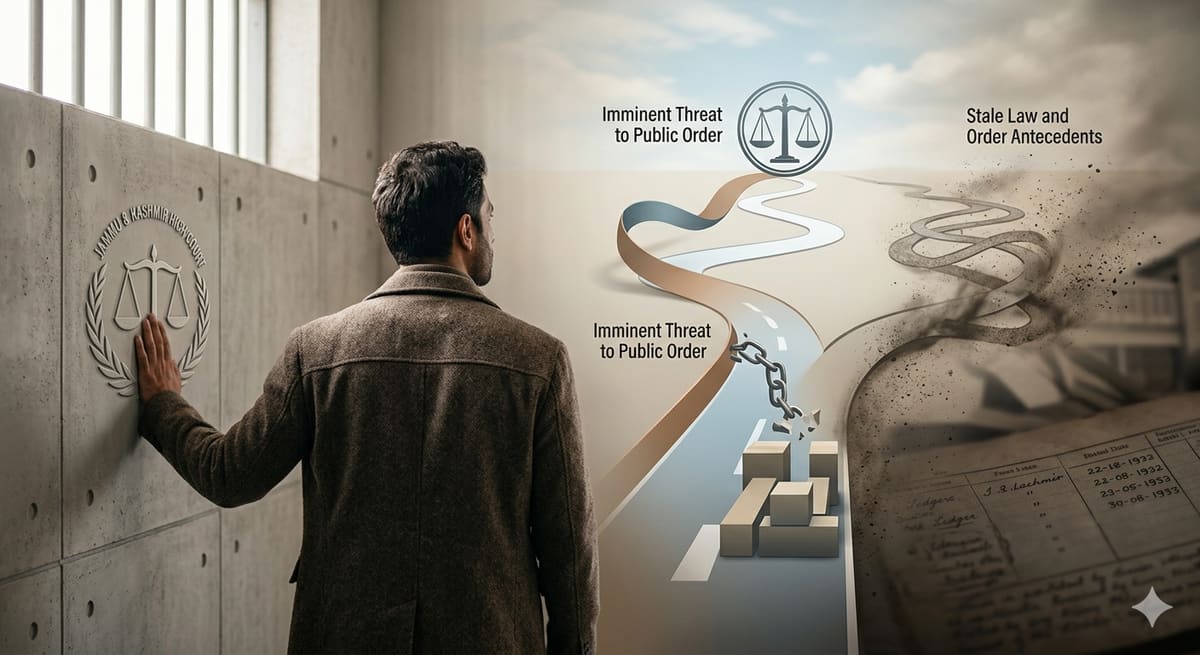
The Jammu & Kashmir and Ladakh High Court has delivered a significant ruling reinforcing that preventive detention under the Public Safety Act cannot be justified by mere procedural delays or routine law-and-order violations. The judgment underscores that public order requires more than isolated criminal acts - it demands a demonstrable threat to societal stability.
Background & Facts
The Dispute
The petitioner, Kamal @ Kaka, was detained under the Jammu & Kashmir Public Safety Act, 1978 (PSA), based on allegations of involvement in eight FIRs related to unauthorized transportation of bovine animals. The detaining authority, the District Magistrate of Kathua, relied on a dossier submitted by the Senior Superintendent of Police on 16.05.2025 and issued the detention order on 16.06.2025 - after a delay of exactly one month.
Procedural History
- 16.05.2025: Dossier recommending detention submitted by SSP Kathua
- 16.06.2025: Impugned detention order issued under PSA
- 03.03.2026: Petition heard by High Court
- 12.03.2026: Judgment pronounced quashing the detention order
Relief Sought
The petitioner sought quashing of the detention order on grounds of: (i) unexplained delay in issuance; (ii) failure to furnish complete material; (iii) lack of explanation in a language understood by him; and (iv) absence of nexus between alleged acts and threat to public order.
The Legal Issue
The central question was whether unexplained delay of one month in issuing a preventive detention order under the PSA, coupled with allegations of transporting bovine animals without permission, suffices to establish a threat to public order warranting deprivation of liberty.
Arguments Presented
For the Petitioner
Learned counsel argued that the one-month delay in issuing the detention order, without any recorded justification, negated the claim of urgency required under the PSA. They relied on Javed Iqbal Itoo v. UT of J&K to assert that such delay implies the situation was not emergent. Further, they contended that mere violation of prohibitory orders on animal transport does not equate to public order disturbance, especially where no link to communal tension or widespread unrest was recorded.
For the Respondent
The State countered that the petitioner’s repeated involvement in eight FIRs demonstrated a pattern of lawlessness and that bovine transportation, given its religious sensitivity, could incite communal discord. They argued that the detaining authority’s subjective satisfaction, even if minimal, was sufficient under PSA jurisprudence and that procedural lapses were technicalities.
The Court's Analysis
The Court examined the doctrine of public order as distinct from law and order, citing K. Anand v. State of U.P. and State of Maharashtra v. Bharat Shantilal Shah to emphasize that public order involves disturbances affecting the community at large, not merely individual violations.
"Public order is a form of development, which erupts due to public anger and is something beyond the failure of the law and order... Without any such development, it cannot be stated that the detenue was a threat to the maintenance of public order."
The Court found the detaining authority’s grounds of detention to be conclusory and devoid of any specific reasoning linking the petitioner’s acts to communal tension or societal unrest. The reference to bovine smuggling as inherently threatening to communal harmony was unsupported by any factual or contextual basis in the order.
Regarding delay, the Court held that the one-month gap between receipt of the dossier and issuance of the order, with no correspondence or inquiry, created an inference that the situation lacked urgency. This directly contradicted the foundational premise of preventive detention under the PSA - that liberty must be curtailed only when immediate action is necessary to prevent harm.
The Court also distinguished the petitioner’s conduct from cases involving organized crime, rioting, or incitement, noting that violating a district order on animal transport is prosecutable under Section 188 IPC, not grounds for one-year detention without trial.
The Verdict
The petitioner won. The Court held that unexplained delay in issuing a PSA order and allegations of unauthorized bovine transport, without evidence of potential to incite communal violence or widespread unrest, are insufficient to justify preventive detention. The impugned order was quashed, and the petitioner was directed to be released immediately.
What This Means For Similar Cases
Delay Under PSA Is Fatal Without Justification
- Practitioners must now challenge any PSA detention issued more than 7 - 10 days after dossier submission unless a detailed, documented justification is provided
- Courts will infer lack of urgency from unexplained delays, triggering automatic invalidation under Javed Iqbal Itoo
- Detaining authorities must maintain contemporaneous records of all internal deliberations and communications
Bovine Transport ≠ Public Order Threat
- Allegations of violating prohibitory orders on animal movement cannot, by themselves, attract PSA
- Detaining authorities must explicitly record how such acts could trigger communal unrest, public outrage, or societal disruption
- Prosecution under IPC Sections 188 or 427 remains the appropriate remedy - preventive detention is reserved for exceptional cases
Subjective Satisfaction Must Be Specific, Not Formulaic
- Generic phrases like "disrupting communal harmony" without factual anchoring are legally inadequate
- Detention orders must reflect individualized assessment, not copy-pasted templates from police dossiers
- Courts will scrutinize whether the authority applied its mind to the specific facts, not merely rubber-stamped recommendations