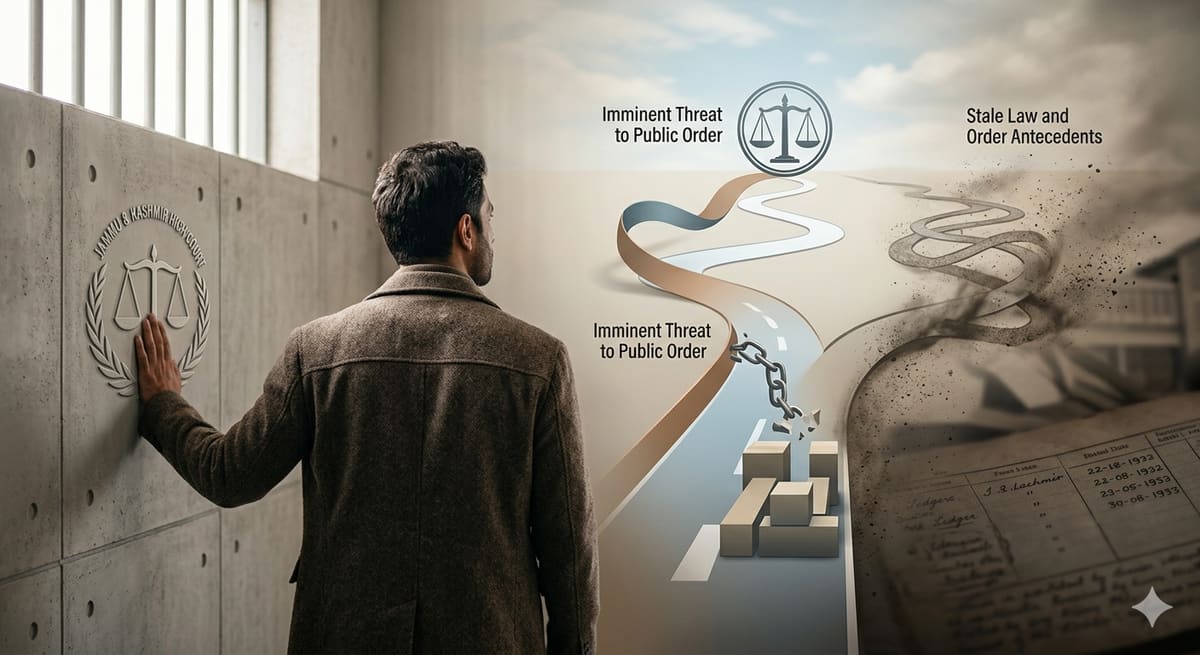
The Jammu & Kashmir High Court has delivered a stern rebuke to state authorities for gross procedural lapses in a preventive detention case under the Public Safety Act, 1978. The judgment underscores that even in matters of national security, constitutional rights cannot be sacrificed on the altar of administrative carelessness. The detention order was rendered void not due to lack of suspicion, but because of irreparable inconsistencies that betrayed a fundamental disregard for due process.
Background & Facts
The Dispute
The petitioner, Mudasir Ahmad Bhat, a salesman in Pulwama, was detained under Section 8 of the Jammu & Kashmir Public Safety Act, 1978 (PSA) on 30 April 2025, following a dossier prepared by the Senior Superintendent of Police (SSP), Pulwama. The dossier alleged that the petitioner was providing logistical support to terrorists, radicalizing youth, and sharing intelligence on security force movements. Based on these allegations, the District Magistrate, Pulwama, passed a detention order citing subjective satisfaction of threat to public order and state security.
Procedural History
The case unfolded through the following steps:
- 28 April 2025: SSP Pulwama submitted a dossier to the District Magistrate, alleging anti-national activities.
- 30 April 2025: District Magistrate issued detention order No. 12/DMP/PSA/25.
- 1 May 2025: Petitioner allegedly arrested and lodged in District Jail, Udhampur.
- 8 May 2025: Government confirmed detention.
- 21 May 2025: Advisory Board upheld detention.
- 30 May 2025: Government extended detention to six months (until 31 October 2025).
- 28 October 2025: Further extension granted until 30 April 2026.
- 27 May 2025: Writ petition filed under Article 226 challenging the detention.
Relief Sought
The petitioner sought quashing of the detention order and immediate release, arguing procedural violations, non-disclosure of material facts, and contradictions between the dossier and grounds of detention.
The Legal Issue
The central question was whether a preventive detention order under the PSA can survive judicial scrutiny when there are material discrepancies between the dossier submitted by the police and the grounds of detention formulated by the detaining authority, particularly when such errors undermine the detainee’s right to make an effective representation.
Arguments Presented
For the Petitioner
The petitioner’s counsel argued that the detention order was vitiated by fatal contradictions: the dossier cited police summons on 28 February and 23 April 2025, while the grounds of detention erroneously referenced 23 February 2025 - a date not mentioned in the dossier. This discrepancy, they contended, violated the principle of fair notice under Khudiram Bose v. State of West Bengal and rendered the representation process a mere formality. They further cited Rajendra Prasad v. State of U.P. to assert that procedural infirmities in PSA cases are not curable by subsequent approvals.
For the Respondent
The State, through the Government Advocate, defended the detention on the grounds of national security and the broad discretionary powers granted under the PSA. They argued that minor clerical errors do not invalidate the entire order, especially since the Advisory Board had confirmed the detention and the petitioner had been provided with copies of documents. They relied on K. S. Puttaswamy v. Union of India to emphasize the state’s duty to maintain internal security.
The Court's Analysis
The Court conducted a meticulous review of the procedural record and found that the discrepancies were not trivial but foundational. The grounds of detention must mirror the dossier upon which the detaining authority relies. Here, the substitution of 23 February 2025 for 23 April 2025 was not a typographical oversight - it was a substantive misrepresentation that deprived the petitioner of the ability to meaningfully respond.
"The detaining authority cannot be permitted to rely on a dossier it never read, nor to formulate grounds it never verified. This is not mere negligence; it is a constitutional dereliction."
The Court further noted the shocking revelation that the petitioner had allegedly been lodged in jail since 5 December 2024 - months before the detention order was even passed. This contradiction, exposed only through the jail’s own communication, revealed systemic apathy. The Court held that the right to personal liberty under Article 21 is non-negotiable, even in the context of preventive detention. The failure of multiple authorities - the District Magistrate, the Home Department, the Jail Superintendent, and the Advisory Board - to notice or correct these errors demonstrated a collapse of internal checks.
The Court emphasized that PSA is not a license for arbitrary detention. The Supreme Court in A.K. Roy v. Union of India had recognized the extraordinary nature of preventive detention and imposed strict procedural safeguards. Here, those safeguards were not just breached - they were ignored.
The Verdict
The petitioner won. The Court held that procedural infirmities in a PSA detention order, especially those affecting the right to representation, render the order illegal and void ab initio. The detention order dated 30 April 2025, along with all subsequent confirmations and extensions, were quashed. The Superintendent of District Jail, Udhampur, was directed to release the petitioner forthwith.
What This Means For Similar Cases
Procedural Compliance Is Non-Negotiable
- Practitioners must scrutinize detention orders for exact correspondence between dossier and grounds.
- Any discrepancy in dates, names, or alleged activities - no matter how minor - must be challenged as fatal to the order’s validity.
- The burden is on the state to prove that the detaining authority applied independent mind; mere approval by Advisory Board does not cure procedural defects.
Representation Is Not a Formality
- Detainees must be given accurate grounds to respond. If the grounds misstate facts from the dossier, the representation is rendered meaningless.
- Courts will not accept post-hoc justifications. The record as it stood at the time of representation is decisive.
- Failure to correct known errors by higher authorities (e.g., Home Department) constitutes complicity in violation of Article 21.
Judicial Review of PSA Is Vigorous
- This judgment reaffirms that PSA cases are not beyond judicial review.
- Courts will not defer to state claims of security when procedural violations are evident.
- Practitioners should routinely file writs where there is any inconsistency in the detention record, even if the detainee is accused of serious offenses.