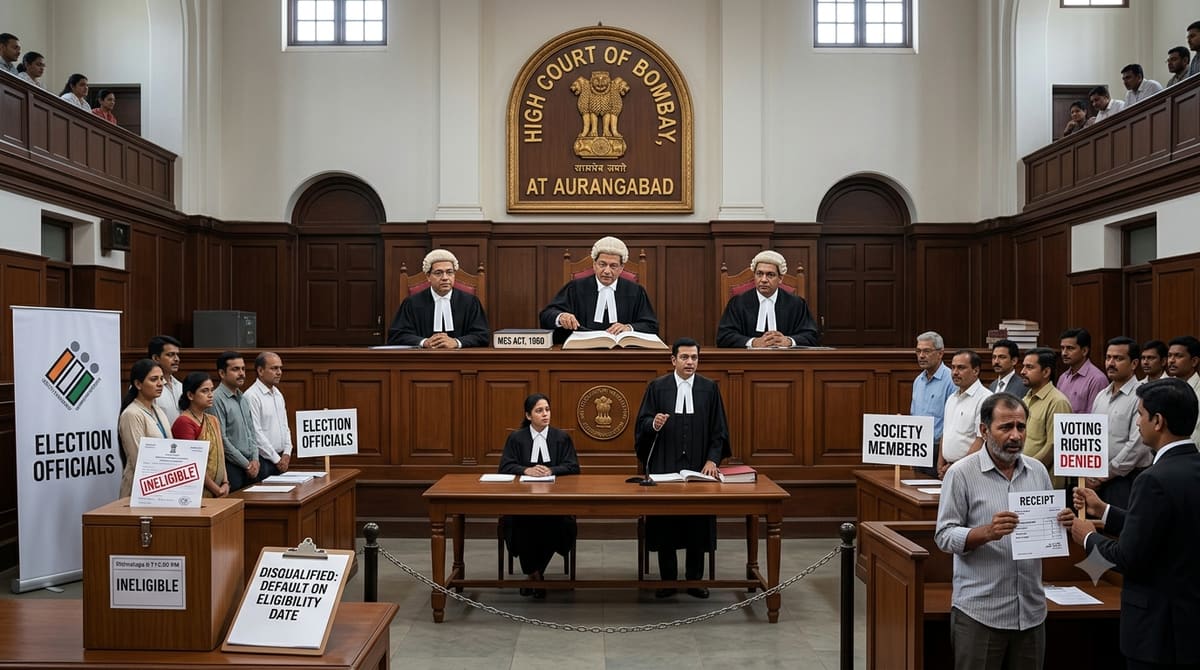
The Bombay High Court has clarified that voter eligibility in cooperative housing society elections is strictly governed by the membership register, not by subjective or extraneous criteria. This ruling reinforces procedural integrity in electoral processes governed by statutory frameworks and sets a binding precedent for similar disputes across Maharashtra.
Background & Facts
The Dispute
The petitioners, members of a cooperative housing society, challenged the exclusion of their names from the final voters' list for the society’s committee elections. The Deputy Registrar, acting under Rule 76 of the Maharashtra Cooperative Society (Committee Election) Rules, 2014, had rejected their claims on grounds not enumerated in the Rules, including alleged non-payment of dues and disputed ownership status.
Key Facts
- The petitioners’ names were duly entered in the society’s membership register maintained under Section 21 of the Maharashtra Cooperative Societies Act, 1960
- The membership register was certified by the society’s secretary and approved by the Registrar on 15.02.2026
- The society’s election committee prepared a preliminary voters’ list on 01.03.2026, excluding the petitioners without assigning reasons under Rule 76
- The petitioners filed objections on 08.03.2026, which were summarily dismissed by the Deputy Registrar on 20.03.2026
- The impugned order dated 20.03.2026 cited alleged arrears and title disputes as grounds for exclusion, despite no adjudication on these matters by any competent authority
- The society’s bylaws, approved on 10.01.2020, explicitly state that membership registration is the sole criterion for voting rights
Procedural History
- 01.03.2026: Preliminary voters’ list published by the society
- 08.03.2026: Petitioners filed written objections to exclusion
- 20.03.2026: Deputy Registrar issued impugned order excluding petitioners
- 10.04.2026: Writ Petition No. 5655 of 2026 filed before the Bombay High Court
- 05.05.2026: Hearing concluded before Justice Amit Borkar
Relief Sought
The petitioners sought quashing of the Deputy Registrar’s order dated 20.03.2026, inclusion of their names in the final voters’ list based on the membership register, and a direction to conduct elections within 30 days.
The Legal Issue
The central question was whether the Deputy Registrar, under Rule 76 of the Maharashtra Cooperative Society (Committee Election) Rules, 2014, has the authority to exclude a member from the voters’ list based on disputed title or dues, when the member’s name is duly recorded in the statutory membership register.
Arguments Presented
For the Petitioner
The petitioners, through Senior Advocate Atul Damle, argued that Rule 76 permits only a limited verification of whether names appear in the duly maintained membership register. They cited State of Maharashtra v. Suresh B. Patil to assert that the Registrar’s role is ministerial, not adjudicatory. They emphasized that title disputes and dues claims are civil matters requiring independent adjudication and cannot be used to deprive statutory voting rights.
For the Respondent
The Respondents, represented by the Additional Government Pleader and counsel for the Deputy Registrar, contended that the Registrar has inherent power to ensure only bona fide members vote. They relied on Cooperative Societies v. Registrar to argue that the Registrar may examine the validity of membership where fraud or irregularity is alleged. However, they offered no evidence of fraud or procedural defect in the membership register.
The Court's Analysis
The Court examined the language of Rule 76 of the Maharashtra Cooperative Society (Committee Election) Rules, 2014, which states: "The Registrar shall verify the list of members from the register maintained under Section 21 of the Act and shall include only those whose names appear therein." The Court held that this provision is unambiguous and leaves no room for discretionary exclusion.
"The authority under Rule 76 is confined to a narrow examination and is not vested with jurisdiction to adjudicate upon issues beyond the prescribed parameters."
The Court observed that the Deputy Registrar had effectively acted as a civil court by adjudicating title and dues disputes - matters outside the scope of electoral oversight. The Court distinguished Cooperative Societies v. Registrar, noting that case involved a register with demonstrable falsification, whereas here the register was duly maintained and certified.
The Court further held that allowing such extraneous grounds would undermine the statutory scheme of cooperative democracy and invite arbitrary exclusion of members.
The Verdict
The petitioners succeeded. The Court quashed and set aside the Deputy Registrar’s order dated 20.03.2026. The Court directed that all persons whose names appear in the duly maintained membership register shall be included in the final voters’ list. The said exercise shall be completed within one week from the date of this order. Elections shall be conducted thereafter in accordance with the Rules.
What This Means For Similar Cases
Membership Register Is the Sole Authority for Voter Eligibility
- Practitioners must now argue that any exclusion from the voters’ list without reference to the statutory membership register is ultra vires
- Objections based on dues, title, or occupancy must be raised in civil proceedings, not electoral forums
- Cooperative societies must ensure their membership registers are updated, certified, and publicly accessible
Registrar’s Role Is Ministerial, Not Adjudicatory
- The Deputy Registrar cannot act as a quasi-judicial authority on membership validity
- Any dispute over membership status must be resolved by civil courts or the Registrar under Section 91 of the Act, not Rule 76
- Election committees must rely solely on the register and cannot impose additional conditions
Procedural Compliance Is Non-Negotiable
- Failure to include a name from the register constitutes a violation of statutory rights
- Delay in inclusion after court order may render subsequent elections void
- Societies must maintain digital and physical copies of the register with timestamps and signatures