The Bombay High Court has clarified that a dispute seeking execution of a joint lease deed from a housing society is not automatically outside the jurisdiction of the Cooperative Court merely because it involves a contested family arrangement, provided the society had previously recognized the claimant’s predecessor as an associate member.
Background & Facts
The Dispute
The present writ petition challenges the order of the Maharashtra State Cooperative Appellate Court dated 10 October 2024, which reversed the Trial Cooperative Court’s rejection of Dispute No. 88 of 2023. The dispute was instituted by respondent Nos. 1 and 2 - legal heirs of Mr. Pradeep Govind Takwale - against respondent No. 3, the Shri Chhatrapati Rajaram Cooperative Housing Society Limited, and petitioners, who are other members of the society. The respondents sought a declaration of their entitlement to a joint lease deed over Suit Plot No. 41, based on an alleged family arrangement deed and their status as legal heirs of an associate member.
Key Facts
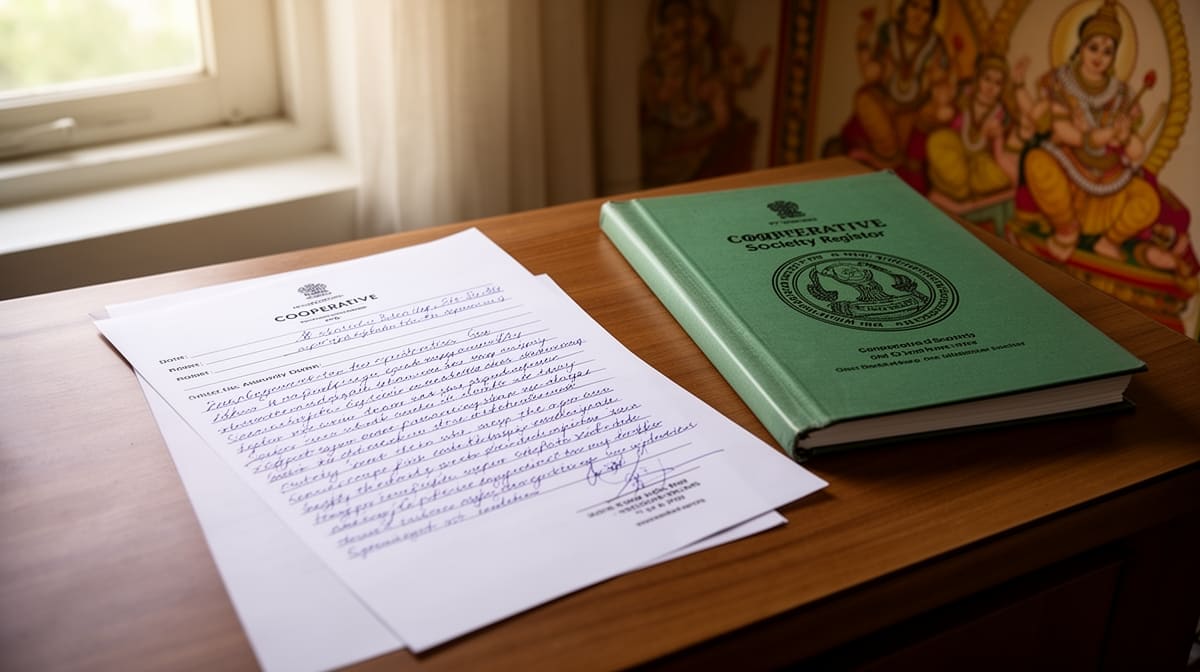
- Mr. Pradeep Govind Takwale, the predecessor of respondent Nos. 1 and 2, was admitted as an associate member of the society pursuant to a resolution passed by the managing committee on 24 April 1980.
- The society recorded his name as an associate member and issued a share certificate (Exhibit 3) in his name.
- Upon his demise, respondent Nos. 1 and 2, as his legal heirs, claimed rights to the plot and sought execution of a joint lease deed with the petitioners, who are also claimants under the same family arrangement.
- The respondents did not seek adjudication of title inter se among family members but sought to compel the society to execute a lease deed in their favor.
- The petitioners contested the validity of the family arrangement deed and argued that the dispute was purely inter se among members and not related to the society’s business.
Procedural History
- 24 April 1980: Society passed resolution admitting Mr. Pradeep Govind Takwale as associate member.
- Date unspecified: Share certificate (Exhibit 3) issued in name of deceased associate member.
- Dispute No. 88 of 2023: Filed by respondent Nos. 1 and 2 before Cooperative Court No. 2, Pune, seeking declaration and direction for joint lease deed.
- 26 April 2024: Trial Cooperative Court rejected the dispute under Order VII Rule 11 CPC, holding it lacked jurisdiction and disclosed no cause of action.
- 10 October 2024: Maharashtra State Cooperative Appellate Court allowed the appeal, set aside the rejection, and restored the dispute for trial.
- 28 October 2024: Writ Petition No. 18770 of 2024 filed before Bombay High Court challenging the Appellate Court’s order.
- 29 April 2026: Judgment reserved.
- 5 May 2026: Judgment pronounced.
The Parties' Positions
Petitioners (Defendants in Dispute): Argued that the dispute is purely inter se among family members over a contested family arrangement, and the society cannot be compelled to act on an untested document. They contended that Section 91 of the Maharashtra Cooperative Societies Act, 1960, does not empower the Cooperative Court to adjudicate private title disputes.
Respondents (Plaintiffs in Dispute): Contended that the society had recognized their predecessor as an associate member, thereby creating a legal relationship with the society. They asserted that the claim for a joint lease deed directly relates to the society’s statutory obligation to execute lease deeds for its members, bringing the dispute within Section 91.
Relief Sought
The petitioners sought quashing of the Appellate Court’s order dated 10 October 2024 and restoration of the Trial Court’s order dated 26 April 2024 rejecting the dispute. They also sought a declaration that the Cooperative Court lacks jurisdiction to entertain disputes founded on unverified family arrangements.
The Legal Issue
The central question was whether a dispute seeking execution of a joint lease deed from a housing society, based on the legal heirship of a deceased associate member and a contested family arrangement, discloses a cause of action within the meaning of Section 91 of the Maharashtra Cooperative Societies Act, 1960, such that rejection under Order VII Rule 11 of the Code of Civil Procedure, 1908 is impermissible.
Arguments Presented
For the Petitioner
Learned counsel for the petitioners relied on the principle that Order VII Rule 11 CPC permits rejection only when the plaint, on its face, discloses no cause of action or is barred by law. He argued that the claim was a disguised private family dispute, not touching the society’s business. He emphasized that the society cannot be compelled to act on a family arrangement whose validity is unproven. He cited Alok Agarwal and Others v. Punam Cooperative Housing Society Limited to assert that jurisdiction under Section 91 cannot be stretched to cover private title claims. He contended that the Trial Court correctly applied the threshold test and that the Appellate Court erred by allowing the matter to proceed without resolving the jurisdictional defect.
For the Respondent
Learned counsel for the respondents argued that the society had formally recognized the predecessor as an associate member through resolution and share certificate, thereby creating a legal nexus between the claimants and the society. He submitted that the relief sought - execution of a lease deed - is a core function of a tenant ownership housing society under the Act. He maintained that the existence of a family arrangement does not negate the society’s obligation, and that the validity of the arrangement is a matter for trial, not rejection at threshold. He relied on the distinction between jurisdiction and maintainability, citing Bank of India Staff Panchsheel Cooperative Housing Society Limited, to argue that a contested factual foundation does not justify rejection under Order VII Rule 11.
The Court's Analysis
The Court examined the nature of the pleadings and the scope of Order VII Rule 11 CPC, emphasizing that rejection at threshold is an extraordinary remedy reserved for cases where the defect is patent on the face of the plaint. The Court observed:
"The Court is not required to weigh evidence as if deciding the dispute. The petitioners' submission would have merit only if the plaint by itself showed an absolute bar."
It noted that the respondents’ plaint did not merely assert a private family claim; it specifically alleged that the society had, through its own resolution and issuance of a share certificate, recognized the predecessor as an associate member. This created a prima facie connection between the claimants and the society’s statutory obligations.
The Court distinguished between a purely inter se family dispute and a claim that invokes the society’s functional duties. It held:
"If the society itself has recorded such association, then at least prima facie the matter cannot be said to be outside the society framework."
The Court rejected the petitioners’ argument that the family arrangement rendered the dispute jurisdictionally invalid. It clarified that while the validity of the arrangement may be challenged at trial, it cannot be presumed invalid at the threshold stage. The Court emphasized that jurisdiction under Section 91 is triggered when the dispute touches the business of the society, and compelling execution of a lease deed for a recognized associate member’s heir falls squarely within that ambit.
The Court further held that the Trial Court had erred by treating the petitioners’ defence as conclusive and by conducting a mini-trial on the merits of the family arrangement. Such an exercise is impermissible under Order VII Rule 11. The Appellate Court correctly restored the dispute for adjudication on evidence.
The Verdict
The writ petition was dismissed. The judgment and order dated 10 October 2024 of the Maharashtra State Cooperative Appellate Court, Mumbai, Bench at Pune, in Appeal No. 40 of 2024, was upheld. The order dated 26 April 2024 of the Cooperative Court No. 2, Pune, rejecting Dispute No. 88 of 2023, was set aside, and the dispute was restored to the file of the Cooperative Court for adjudication on merits. All contentions on the merits of the family arrangement and lease deed entitlement are expressly kept open. The Cooperative Court is directed to proceed expeditiously. There shall be no order as to costs.
What This Means For Similar Cases
Associate Membership Creates Jurisdictional Nexus
- Practitioners must now treat recognition of an associate member by the society’s resolution and share certificate as sufficient to establish a prima facie jurisdictional link under Section 91 of the Maharashtra Cooperative Societies Act, 1960.
- Legal heirs of such members may maintain disputes seeking lease deeds or membership rights, even if family arrangements are contested.
- A mere allegation of a private family dispute is insufficient to invoke Order VII Rule 11 rejection.
Threshold Rejection Under Order VII Rule 11 CPC Is Narrow
- Courts must confine themselves to the pleadings and documents annexed to the plaint.
- If the plaint discloses a document issued by the society (e.g., share certificate, resolution), rejection under Order VII Rule 11(d) is impermissible unless the bar is self-evident.
- Defence arguments based on validity of underlying agreements must be addressed at trial, not at the threshold.
Family Arrangements Do Not Automatically Exclude Cooperative Court Jurisdiction
- The presence of a family arrangement does not convert a society-related dispute into a private civil matter.
- The key test is whether the claim seeks to enforce a right against the society based on its own records and statutory obligations.
- Cooperative Courts are empowered to adjudicate disputes where the society’s role is invoked, even if the claimant’s title is derived from a private arrangement.