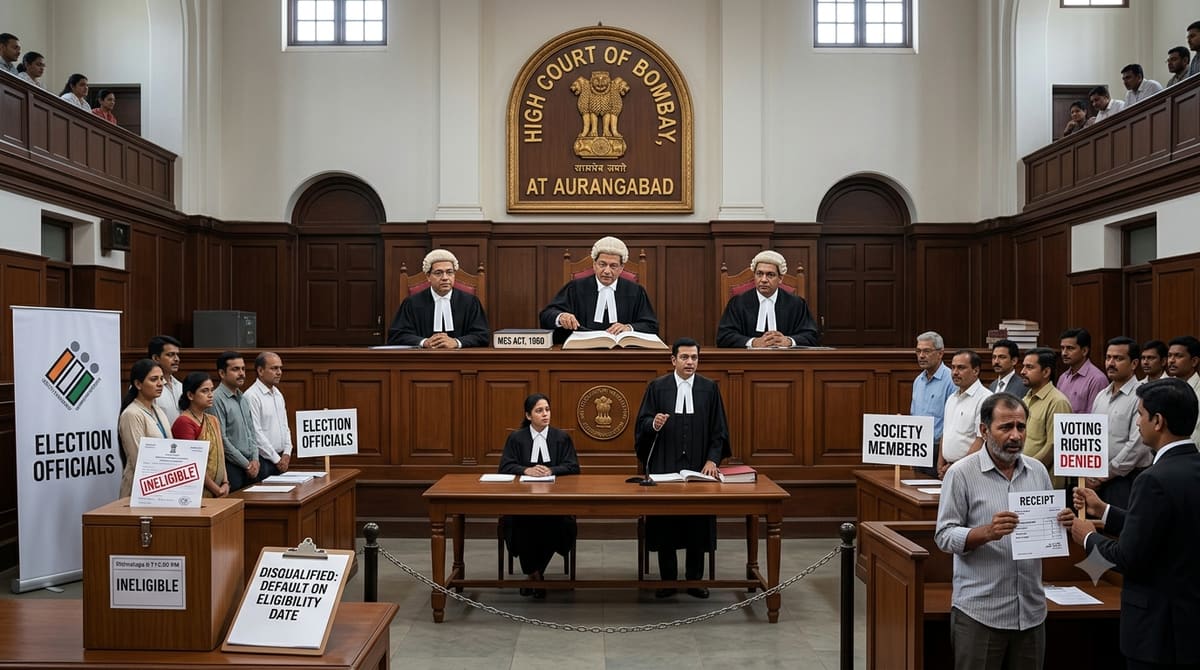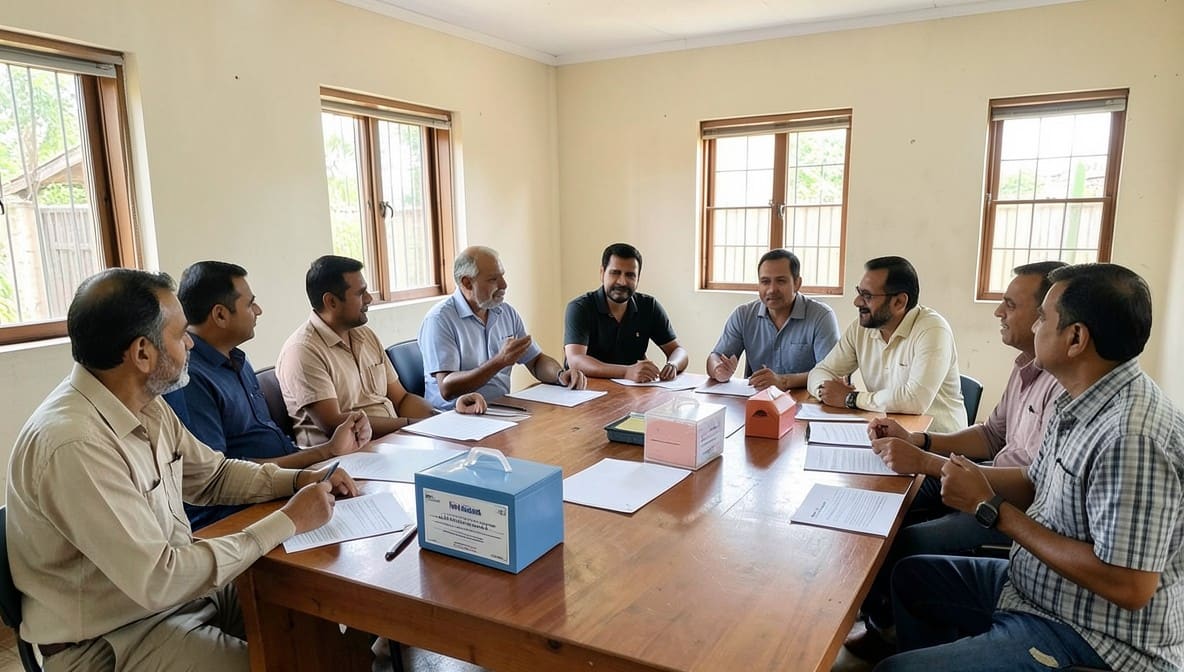
The Bombay High Court has clarified that the mere issuance of an interim liquidation order against a cooperative society does not automatically disqualify it from participating in elections of its federal institutions. This ruling reinforces the principle that procedural rights under cooperative statutes endure until final adjudication, safeguarding democratic participation even during financial distress.
Background & Facts
The Dispute
The petitioners, Shri Vijay Sudhakar Pagar and another, represent a cooperative society that is a member of the Aurangabad District Central Co-operative Bank Ltd (ADCC Bank). The election of the Board of Directors of ADCC Bank was scheduled for March 2026. Under the Maharashtra Cooperative Societies (Election to Committee) Rules, 2014, member societies were required to submit resolutions nominating representatives for the election.
Key Facts
- The petitioner society passed a resolution on or before 11.03.2026 nominating its representatives for the ADCC Bank election.
- The Respondent No. 2, District Cooperative Election Officer, Chhatrapati Sambhajinagar, included the petitioner society’s representatives in the provisional voters list issued on 11.03.2026.
- On 10.04.2026, Respondent No. 5 submitted an objection to the inclusion of the petitioner society, alleging that it was under liquidation.
- The objection was raised outside the statutory window for objections, which was from 27.04.2026 to 06.05.2026 as per Rule 11 of the Election Rules of 2014.
- On 18.05.2026, Respondent No. 2 issued an order deleting the petitioner society from the voters list solely on the basis of the objection and a report from Respondent No. 1, without granting a hearing.
- The interim order appointing a liquidator under Section 103 of the Maharashtra Cooperative Societies Act, 1960, had been passed earlier, but no final order of winding up had been issued.
- The liquidator had not taken charge of the society’s affairs, and no steps had been taken to suspend the powers of the society’s governing body.
Procedural History
- 11.03.2026: Notification issued by Respondent No. 2 inviting resolutions from member societies for nomination of representatives.
- On or before 11.03.2026: Petitioner society passed resolution nominating its delegates.
- 10.04.2026: Objection raised by Respondent No. 5 against inclusion of petitioner society.
- 27.04.2026 to 06.05.2026: Statutory period for filing objections under Rule 11 of Election Rules of 2014.
- 18.05.2026: Respondent No. 2 passed impugned order deleting petitioner society from voters list.
- 28.05.2026: Writ Petition No. 15108 of 2026 filed before the Bombay High Court, Aurangabad Bench.
The Parties' Positions
Petitioners: Argued that the objection by Respondent No. 5 was time-barred and lacked locus standi. They emphasized that the interim liquidation order did not extinguish the society’s legal personality or its right to vote. They relied on Vineshkumar Mavjibhai Parmar v. Dethali Gopalak Vividh Karyakari Sahakari Mandali Ltd and Balaji Phale Bhaji Pala Kharedi Vikri and Prakriya Sahakari Sanstha Ltd v. State of Maharashtra.
Respondents: Contended that the interim order under Section 103 of the Act rendered the society incapable of participating in elections. They asserted that the society’s officers were no longer in charge and that the deletion was justified to preserve electoral integrity.
Relief Sought
The petitioners sought quashing of the order dated 18.05.2026, restoration of their society’s name to the voters list, and directions to conduct the election with their participation.
The Legal Issue
The central question was whether the issuance of an interim order of liquidation under Section 103 of the Maharashtra Cooperative Societies Act, 1960 automatically terminates a cooperative society’s right to vote in elections of its federal institution, prior to the passing of a final order of winding up.
Arguments Presented
For the Petitioner
The petitioners argued that under Section 103(3) of the Act, the powers of the society’s governing body are suspended only upon the passing of a final winding-up order, not an interim one. They cited Vineshkumar Mavjibhai Parmar to show that interim orders are provisional and do not extinguish legal rights. They emphasized that the objection was filed outside the statutory period under Rule 11 of the Election Rules of 2014 and that Respondent No. 5 had no locus standi to raise it. They further contended that the deletion order violated principles of natural justice by denying a hearing.
For the Respondent
The respondents argued that the interim order appointing a liquidator had attained finality and that the society’s officers were no longer functioning. They claimed that allowing a society under liquidation to participate in elections would undermine the integrity of the electoral process and that the Election Officer acted in good faith based on the report from the Registrar.
The Court's Analysis
The Court examined the statutory scheme under Section 103 of the Maharashtra Cooperative Societies Act, 1960, particularly sub-section (3), which states that officers of the society vacate their offices and the general body loses its powers only upon the passing of a final winding-up order. The Court noted that no such final order had been passed in this case.
"The Gujarat legislature expressly provided under the SOCIETIES ACT for the curtailment of certain rights of the officers of societies facing liquidation proceedings. It must be remembered that at the same time it also declared that such OFFICERS cease to be the officers of the Society only when a final order of winding up is passed."
The Court held that the interim order merely suspends certain functions, such as granting new loans or entering into new contracts, but does not extinguish the society’s legal existence or its right to participate in federal elections. The Court distinguished between functional restrictions and complete legal incapacitation.
The Court further observed that the objection raised by Respondent No. 5 was not filed within the statutory period prescribed under Rule 11 of the Election Rules of 2014, rendering it invalid. Moreover, Respondent No. 5, being a private party, had no statutory authority to initiate such an objection.
The Court emphasized that the deletion order was passed without affording the petitioner society an opportunity of hearing, thereby violating the principles of natural justice. The Court concluded that the impugned order was legally unsustainable on multiple grounds: procedural illegality, lack of locus standi, and misinterpretation of the statutory effect of an interim liquidation order.
The Verdict
The writ petition was allowed. The Court quashed the order dated 18.05.2026 passed by Respondent No. 2, restoring the petitioner society’s name to the voters list for the election of the Board of Directors of ADCC Bank. The Court directed that the election proceed with the petitioner society’s representatives duly included. Costs of Rs. 10,000 were awarded to the petitioners.
What This Means For Similar Cases
Interim Liquidation Does Not Nullify Voting Rights
- Cooperative societies under interim liquidation retain the right to vote in federal elections unless a final winding-up order is passed.
- Practitioners must challenge any deletion of voting rights based solely on interim orders as legally untenable.
Procedural Compliance Is Non-Negotiable
- Objections to voters lists must be filed strictly within the statutory window under Rule 11 of the Election Rules of 2014.
- Any action taken on objections filed outside this period is void ab initio.
Natural Justice Applies to Cooperative Elections
- Cooperative election authorities must provide a hearing before deleting a member society from the voters list.
- Failure to do so renders the order invalid, regardless of the substantive grounds.