The Andhra Pradesh High Court has clarified that authorities under the Essential Commodities Act, 1955 cannot indefinitely retain seized stock without concluding statutory proceedings. In a significant ruling, the Court mandated a strict timeline for disposal of Section 6A proceedings and permitted immovable property as security for release of seized goods, reinforcing procedural fairness over arbitrary financial demands.
Background & Facts
The Dispute
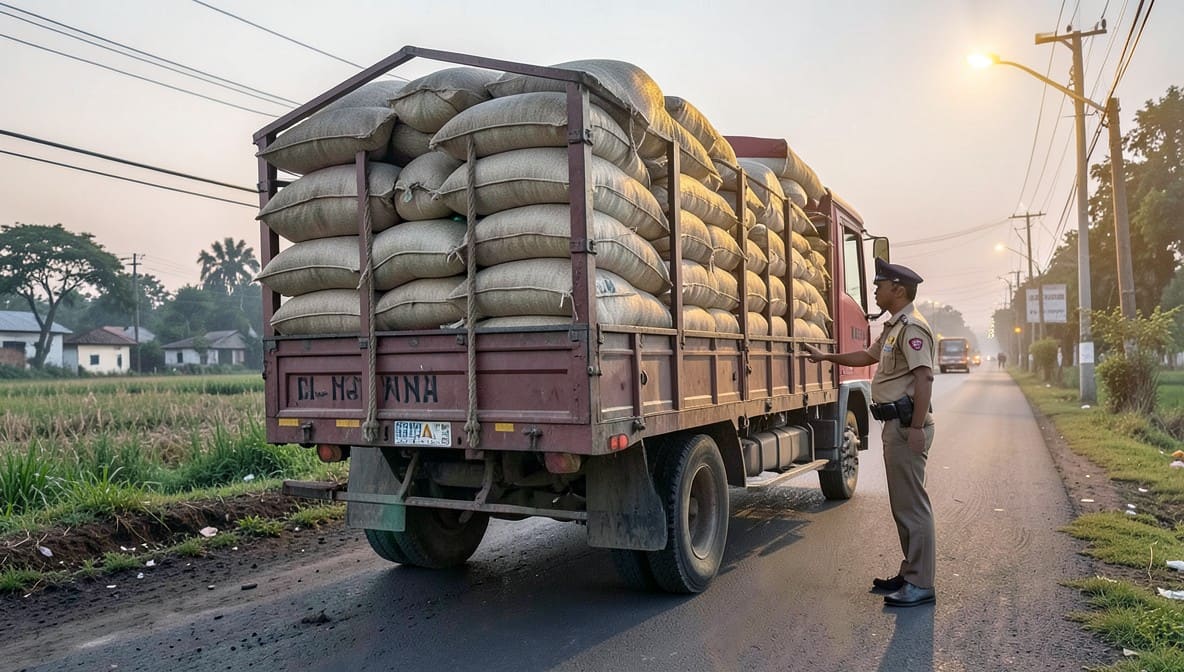
The dispute arose from the seizure of 274 quintals of raw rice belonging to the 1st petitioner, M/s. Sri Sai Sahasra Traders, and a lorry bearing registration number AP 35 Y 5598 owned by the 2nd petitioner, Malgoti Praveen Kumar Reddy. The seizure occurred on 30.01.2026 on NH-16 near Golagamudi Arch, Venkatachalam Mandal, SPS Nellore District, under a panchanama dated 31.01.2026, purportedly under the powers conferred by the Essential Commodities Act, 1955.
Key Facts
- The seized rice was valued at approximately Rs. 3,50,000 based on prevailing market rates
- The lorry was seized as it was being used to transport the rice
- The 3rd respondent, Civil Supplies Deputy Tahsildar, Venkatachalam, conducted the seizure
- Proceedings under Section 6A of the Essential Commodities Act were initiated before the 2nd respondent, the Collector (Civil Supplies), SPS Nellore District
- On 29.04.2026, the 2nd respondent passed order Rc.B2.85/2026 directing:
- Sale of the seized 274 quintals of rice through public auction
- Release of the lorry only upon the 2nd petitioner furnishing a Bank Fixed Deposit Receipt (F.D.R.) for Rs. 3,50,000
- The petitioners challenged the legality of the seizure and the mandatory bank guarantee condition
- The petitioners had previously submitted representations for release of the seized goods, which remained unaddressed
Procedural History
- 30.01.2026: Seizure of 274 quintals of raw rice and lorry AP 35 Y 5598
- 31.01.2026: Panchanama executed documenting the seizure
- 29.04.2026: Order Rc.B2.85/2026 passed by the 2nd respondent directing auction and bank FDR for release of lorry
- 12.05.2026: Writ Petition No. 13205/2026 filed before the High Court of Andhra Pradesh
- 07.05.2026: Hearing before Justice Ravi Cheemalapati
The Parties' Positions
For the Petitioners
- The seizure was arbitrary and not accompanied by a reasoned order
- The mandatory requirement of a Bank F.D.R. for release of the lorry was unreasonable and not mandated by law
- The auction of rice without concluding Section 6A proceedings violated natural justice
- The petitioners were ready to provide adequate security, but bank guarantees were financially burdensome for small traders
For the Respondents
- The seizure was lawful under Section 6 of the Essential Commodities Act
- The order dated 29.04.2026 was passed in accordance with established procedure
- The bank F.D.R. condition was a standard safeguard to ensure recovery of potential penalties
- Reliance was placed on W.P. No. 4165 of 2023 to argue consistency in approach
Relief Sought
The petitioners sought:
- Declaration that the seizure and order Rc.B2.85/2026 were illegal and violative of the Essential Commodities Act
- Setting aside of the order directing auction of rice
- Immediate release of the 274 quintals of rice and the lorry AP 35 Y 5598
- Suspension of the auction order pending disposal of the writ petition
- Direction to accept immovable property as security instead of bank F.D.R.
The Legal Issue
The central question was whether the Collector (Civil Supplies) could lawfully mandate a Bank Fixed Deposit Receipt as the sole form of security for the release of a seized vehicle under Section 6A of the Essential Commodities Act, 1955, and whether the auction of seized stock could proceed before conclusion of the adjudicatory proceedings.
Arguments Presented
For the Petitioner
Counsel for the petitioners relied on the principle of proportionality and the doctrine of natural justice. He argued that Section 6A proceedings are adjudicatory in nature and require a fair hearing before any disposal of seized goods. The mandatory bank F.D.R. condition imposed an undue financial burden on small traders and was not stipulated under any rule or order. He cited Onteru Bhaskar v. State of Andhra Pradesh to show that courts have permitted alternative forms of security, including immovable property, to prevent hardship.
For the Respondent
The Assistant Government Pleader contended that the seizure was lawful and the order dated 29.04.2026 was in line with administrative practice. He relied on W.P. No. 4165 of 2023 to argue that the court had previously upheld similar conditions. He maintained that the bank F.D.R. was a standard precaution to ensure that if the seized goods were found to be in violation, the state could recover penalties without delay.
The Court's Analysis
The Court acknowledged that the seizure of goods under Section 6 of the Essential Commodities Act is a valid exercise of statutory power. However, it emphasized that Section 6A proceedings are quasi-judicial and must be concluded within a reasonable time. The Court observed that indefinite retention of goods without adjudication violates Article 14 and Article 21 of the Constitution.
"The illegality and validity of the seizure has to be decided by the 2nd respondent in 6-A proceedings. This Court is not inclined to interfere into the 6-A proceedings."
The Court further noted that while the state has a legitimate interest in securing potential penalties, the requirement of a Bank F.D.R. was not statutorily mandated. The Court held that such a condition, if imposed, must allow for reasonable alternatives to prevent undue hardship, especially for small traders and transporters.
The Court distinguished W.P. No. 4165 of 2023 on the ground that it did not address the issue of alternative security. It relied on Onteru Bhaskar v. State of Andhra Pradesh, where a Division Bench had permitted immovable property as security for release of seized goods under the ECA. The Court held that the state’s interest in security can be adequately protected by accepting immovable property as collateral, which is equally enforceable and less burdensome.
The Court also stressed that the auction of rice before conclusion of Section 6A proceedings would render any future adjudication meaningless, as the subject matter would be destroyed. This would violate the fundamental principle that adjudication must precede confiscation.
The Verdict
The writ petition was disposed of with the following directions:
- The 2nd respondent shall conclude the Section 6A proceedings within one month from the date of receipt of this order
- If the proceedings are not concluded within one month, the 274 quintals of seized rice shall be released to the 1st petitioner upon furnishing security in the form of third-party immovable property equivalent to the value of the rice
- The lorry bearing AP 35 Y 5598 shall be released to the 2nd petitioner within two weeks from the date of receipt of this order, upon furnishing personal or third-party immovable property security equivalent to the value of the vehicle
- The condition of Bank F.D.R. for release of the lorry is hereby set aside
- There shall be no order as to costs
What This Means For Similar Cases
Immoveable Property Is a Legally Valid Alternative to Bank FDR
- Practitioners may now argue that requiring Bank F.D.R. as the sole security for release of seized goods under Section 6A is arbitrary and violative of Article 14
- Immovable property, duly documented and valued by a registered valuer, is a legally acceptable substitute
- This applies to seizures of food grains, sugar, fertilizers, or other essential commodities
Strict Timeline for Section 6A Proceedings
- Authorities must conclude adjudicatory proceedings under Section 6A within a reasonable period
- Failure to do so triggers an automatic right to release of goods upon provision of immovable property security
- This creates a clear incentive for timely disposal and prevents indefinite detention of property
Auctions Cannot Precede Adjudication
- Any order directing sale or destruction of seized goods before conclusion of Section 6A proceedings is illegal
- Petitioners may seek immediate stay on auction orders in writ petitions
- Courts will now view such auctions as prejudicial to the right to fair hearing