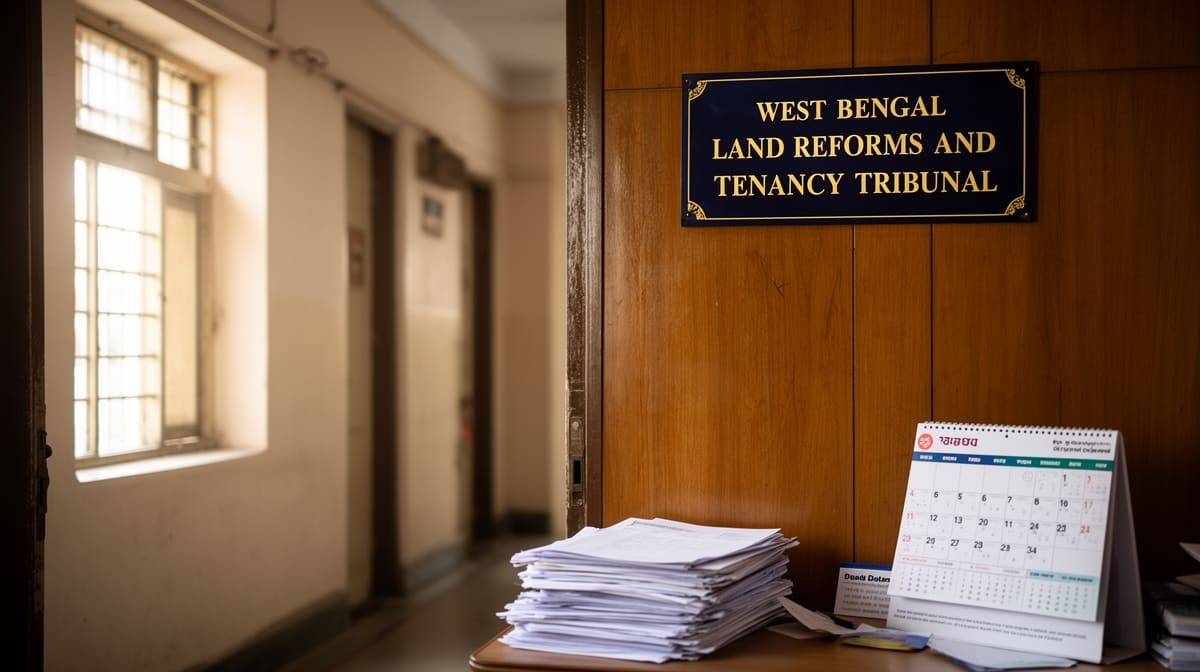
The Calcutta High Court has reaffirmed the exclusive jurisdiction of Revenue Authorities under the West Bengal Land Reforms Act, 1955, holding that the mere pendency of civil suits cannot justify setting aside orders passed by such authorities. This ruling clarifies a critical boundary between civil and revenue jurisdiction in land disputes, offering decisive guidance to practitioners handling land reform matters.
Background & Facts
The Dispute
The present batch of writ petitions challenges orders passed by the First Bench of the West Bengal Land Reforms and Tenancy Tribunal, which set aside orders issued by the Appellate Authority under Section 54 of the West Bengal Land Reforms Act, 1955. The Tribunal’s decision was based solely on the ground that civil litigations concerning the same land were pending before civil courts, which it held rendered the Appellate Authority functus officio.
Key Facts
- The Appellate Authority under Section 54 of the 1955 Act had reversed the order of the Block Land and Land Reforms Officer (B.L. & L.R.O.) regarding land rights and tenancy status.
- The Appellate Authority’s order was challenged before the Land Reforms Tribunal on the ground that civil suits were pending.
- Two civil suits are pending: one filed by the petitioners seeking partition of land, and another filed by the private respondent seeking declaration of title and permanent injunction.
- The Appellate Authority had itself declined to stay proceedings, but the Tribunal set aside its order purely on the basis of pendency of civil litigation.
- The disputes before the civil courts and the Revenue Authorities involve distinct causes of action and legal frameworks.
Procedural History
- Date of B.L. & L.R.O. order: Not specified, but impugned before Appellate Authority under Section 54.
- Date of Appellate Authority order: Not specified, but issued prior to March 17, 2025.
- 17.03.2025: First Bench of West Bengal Land Reforms and Tenancy Tribunal set aside the Appellate Authority’s order on ground of pending civil suits.
- 2026: Writ Petitions filed before Calcutta High Court:
- WPLRT 25 of 2026
- WPLRT 26 of 2026
- WPLRT 27 of 2026
- WPLRT 28 of 2026
- WPLRT 29 of 2026
- WPLRT 30 of 2026
- 30.03.2026: Hearing concluded and judgment delivered.
The Parties' Positions
Petitioners: Argued that the Appellate Authority had statutory power under Section 54 to adjudicate land rights under the 1955 Act, and that the Tribunal erred in assuming jurisdiction to nullify its order on the basis of pending civil litigation.
Respondent State: Acknowledged conflicting precedents among coordinate benches but conceded that Section 61 of the 1955 Act bars civil courts from interfering in matters within the exclusive domain of Revenue Authorities.
Private Respondent: Supported the Tribunal’s view, contending that civil suits involving title and possession should stay the hand of Revenue Authorities.
Relief Sought
The petitioners sought quashing of the Tribunal’s order dated 17.03.2025, restoration of the Appellate Authority’s order, and remand of the original applications for fresh adjudication on merits.
The Legal Issue
Can the pendency of civil litigation regarding land title or possession deprive a Revenue Authority under the West Bengal Land Reforms Act, 1955, of its statutory jurisdiction to adjudicate matters under Sections 50 and 54?
Arguments Presented
For the Appellant/Petitioner
The petitioners relied on the plain language of Section 61 of the West Bengal Land Reforms Act, 1955, which explicitly bars civil courts from entertaining any question relating to land or matters required to be enquired into or decided by Revenue Officers under the Act. They argued that the Tribunal, being a statutory tribunal created under the same Act, cannot assume powers beyond its statutory mandate by invoking the pendency of civil suits as a jurisdictional bar. They cited State of West Bengal v. Abdul Majid and Bijoy Kumar Das v. State of West Bengal to show that Revenue Authorities must proceed independently unless expressly stayed by law.
For the Respondent/State
The State acknowledged the existence of conflicting judgments among coordinate benches but emphasized that Section 61 is a complete bar to civil court jurisdiction. It conceded that the Tribunal’s reasoning, while consistent with some prior decisions, was legally unsustainable in light of the unambiguous language of Section 61. The State did not defend the Tribunal’s order on merits but urged the Court to resolve the legal conflict.
The Court's Analysis
The Court undertook a rigorous textual analysis of Section 61 of the West Bengal Land Reforms Act, 1955, which states:
"Notwithstanding anything contained in the Code of Civil Procedure or any other law for the time being in force or in any decree, judgment, decision or award of any court, tribunal or authority, no court shall have jurisdiction to determine any question relating to any land or connected with any matter which is required to be or which has been enquired into or decided by any Revenue Officer or prescribed authority or any officer or authority under the provisions of this Act."
The Court observed that the Tribunal, despite being a tribunal under the same statutory framework, acted beyond its jurisdiction by treating the pendency of civil suits as a jurisdictional impediment to the Appellate Authority’s function. The Court emphasized that Section 61 is not merely a procedural bar but a substantive exclusion of civil court jurisdiction, extending by necessary implication to all tribunals operating under the Act.
The Court distinguished the nature of adjudication in civil suits - focused on title, possession, and injunction - from the statutory functions of the B.L. & L.R.O. and Appellate Authority under the 1955 Act, which concern tenancy rights, land ceiling, and occupancy status. The Court noted:
"The scopes of adjudication in the said suits are completely different from the scope of the decision in the matter before the B.L. & L.R.O. or the Appellate Authority under the provisions of the 1955 Act, particularly in the context of Section 61 of the 1955 Act."
The Court further held that the Tribunal’s reliance on conflicting precedents could not override the clear statutory mandate. It rejected the notion that judicial comity or procedural prudence could justify abdicating statutory jurisdiction. The Court concluded that the Tribunal’s order was a nullity, as it was passed without jurisdiction.
The Verdict
The writ petitions were allowed. The Calcutta High Court set aside the Tribunal’s order dated 17.03.2025 in OA 1191 of 2022 (LRTT), OA 1192 of 2022 (LRTT), OA 1190 of 2022 (LRTT), OA 1189 of 2022 (LRTT), OA 1187 of 2022 (LRTT), and OA 1188 of 2022 (LRTT). The original applications were remanded to the Tribunal for fresh adjudication on merits. Any action taken pursuant to the impugned order stands revoked. There will be no order as to costs.
What This Means For Similar Cases
Revenue Jurisdiction Is Exclusive and Non-Negotiable
- Practitioners must immediately challenge any tribunal or court order that stays or nullifies a Revenue Authority’s decision on the ground of pending civil litigation.
- Section 61 creates a statutory firewall; civil suits cannot be used as a procedural tool to delay or derail land reform proceedings.
Civil and Revenue Proceedings Are Parallel, Not Mutually Exclusive
- A party may pursue civil remedies for title or possession while simultaneously contesting tenancy or occupancy rights before Revenue Authorities.
- The existence of a civil suit does not render the Revenue Authority functus officio unless a stay is expressly granted under the Act.
Tribunals Must Not Assume Civil Court Powers
- Statutory tribunals under land reform laws cannot adopt civil court doctrines like lis pendens or res judicata to decline jurisdiction.
- Any order passed by a tribunal on the basis of pendency of civil suits is liable to be set aside as ultra vires.