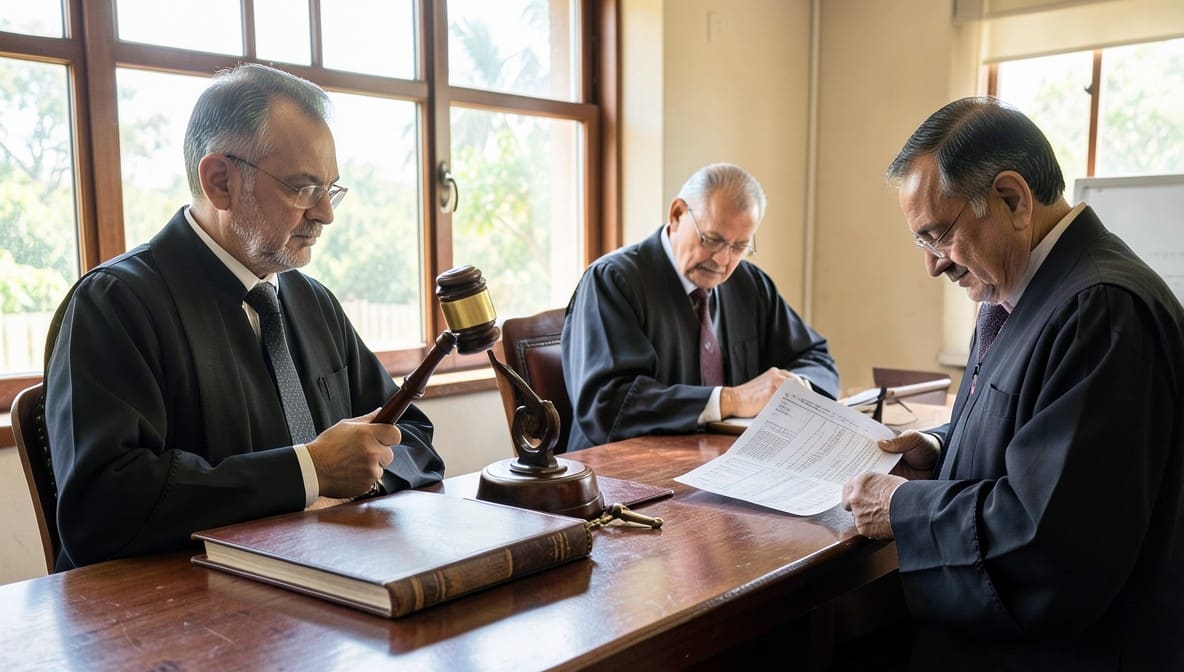
The Karnataka High Court has reaffirmed that revenue authorities, including Tahsildars, Assistant Commissioners, and Deputy Commissioners, lack jurisdiction to adjudicate title disputes between parties. The Court held that such disputes fall exclusively within the domain of civil courts, and any revenue proceedings touching upon title are impermissible under Section 136 of the Karnataka Land Revenue Act, 1964. This judgment underscores the limited scope of revenue authorities in land disputes and the binding nature of civil court decrees on such matters.
Background & Facts
The Dispute
The appellant, Sri A. Venkatesh, claimed ownership of 2 acres of land in Savarline Village, Bengaluru North Taluk, based on a Grant Order dated 07.10.1954 issued in favour of his father, Nagarajappa. The land was subsequently partitioned among family members via a registered Partition Deed dated 18.02.2009, with the appellant inheriting Sites 1 and 2. A registered Will dated 18.07.1984 further reinforced his claim. The appellant’s name was entered in the revenue records of the Bruhat Bengaluru Mahanagara Palike (BBMP).
Key Facts
07.10.1954: Grant Order issued in favour of Nagarajappa for 2 acres in Sy.No.1, Savarline Village.
18.07.1984: Registered Will executed by Nagarajappa in favour of the appellant.
18.02.2009: Registered Partition Deed executed among family members, allocating Sites 1 and 2 to the appellant.
11.12.2009: Defence Estate Officer (DEO) issued a No Objection Certificate (NOC) after verifying the Military Land Register and physical boundaries, confirming the land fell outside defence boundaries.
Subsequent Events: The DEO recalled the NOC at the instance of the Parachute Regiment Training Centre (PRTC), leading to proceedings under Section 136(3) of the Karnataka Land Revenue Act, 1964 by the Special Deputy Commissioner (SDC).
Procedural History
The dispute traversed multiple forums, reflecting the complexity of the title claims:
19.06.2014: SDC passed an order in RRT (2)/NA/CR/28/2010-11, remanding the matter to the Tahsildar. The SDC noted that Section 136(3) empowers only correction of entries, not cancellation, and directed parties to approach civil courts under Section 135 for title disputes.
13.07.2015: Tahsildar passed an order in LND(Y)CR/338/2014-15, confirming the Grant Order of 1954 and the revenue entries in favour of Nagarajappa. The order relied on certified copies of the Official Memorandum, Saguvali Chit, Darkhast Register, and Settlement Register.
2016: The PRTC appealed the Tahsildar’s order before the Assistant Commissioner (AC) in LND(A)15/2016-17, challenging the genuineness of the Grant Order.
23.05.2023: SDC passed a fresh order in RRT (2)/NA/CR/28/2010-11, dropping proceedings against the PRTC. The SDC relied on a Judgment and Decree in O.S.No.2403/2006, which held that the land was acquired by the Defence Department, and the Military Land Register as evidence of title.
15.02.2024: Writ Court allowed W.P.No.669/2024, quashing the SDC’s order dated 23.05.2023, the Tahsildar’s order dated 13.07.2015, and the AC’s proceedings. The Court held that revenue authorities cannot adjudicate title disputes.
23.06.2026: Present Writ Appeal No. 392 of 2024 filed by the appellant, challenging the Writ Court’s order to the extent it quashed the Tahsildar’s order dated 13.07.2015 and other directions.
Relief Sought
The appellant sought:
Quashing of the Writ Court’s order dated 15.02.2024 to the extent it set aside the Tahsildar’s order dated 13.07.2015 and the SDC’s order dated 23.05.2023.
Restoration of the Tahsildar’s order confirming the Grant Order of 1954 and the revenue entries.
Clarification that the Writ Court’s directions at (V), (VI), and (VII) were passed without specific prayer and are unsustainable.
The Legal Issue
The central question was whether Section 136 of the Karnataka Land Revenue Act, 1964 empowers revenue authorities, including the SDC, AC, and Tahsildar, to adjudicate title disputes between parties or test the genuineness of land grants. Additionally, the Court examined whether the Writ Court erred in quashing the Tahsildar’s order dated 13.07.2015, which confirmed the Grant Order, without specific prayer to that effect.
Arguments Presented
For the Appellant
The Tahsildar’s order dated 13.07.2015 was passed in compliance with the SDC’s direction dated 19.06.2014 and confirmed the Grant Order of 1954 after considering all material evidence.
The Writ Court erred in quashing the Tahsildar’s order without any prayer to that effect in the Writ Petition, which was limited to challenging the SDC’s order dated 23.05.2023 and the AC’s proceedings.
The directions at (V), (VI), and (VII) in the Writ Court’s order were passed without specific prayer and are unsustainable in law.
For the Respondents
State of Karnataka (Respondents 1-5): The SDC’s order dated 19.06.2014 relegated parties to approach civil courts under Section 135 for title disputes. The SDC’s subsequent order dated 23.05.2023 was based on the Military Land Register and findings in O.S.No.2403/2006, which held that the land was acquired by the Defence Department. Revenue authorities lack jurisdiction to adjudicate title disputes, as held by the Full Bench of the Karnataka High Court in Smt. Jayamma v. State of Karnataka.
PRTC and Defence Estate Officer (Respondents 6-7): The land was acquired by the Defence Department in 1907, predating the Grant Order of 1954. The Military Land Register has evidentiary value, and the Tahsildar’s order dated 13.07.2015 was unsustainable as it confirmed the Grant Order without considering the Defence Department’s claim.
The Court's Analysis
The Division Bench of the Karnataka High Court conducted a meticulous analysis of the powers of revenue authorities under the Karnataka Land Revenue Act, 1964, and the scope of judicial review under Article 226 of the Constitution of India.
"The Full Bench of this Court in Smt. Jayamma v. State of Karnataka has put a quietus with respect to powers of Revenue Authorities when there are title disputes between the parties, holding that it is the exclusive domain of the competent Civil Court to adjudicate upon the disputed question of title and ultimately if any decree is passed by the Civil Court, it shall be having binding force not only on the private parties who are litigating, but also on the Revenue Authorities."
The Court observed that the SDC’s order dated 19.06.2014 had already relegated the parties to approach civil courts under Section 135 for title disputes. The SDC’s subsequent direction to the Tahsildar to inquire into the genuineness of the Grant Order of 1954 under the Land Grant Rules was impermissible, as it encroached upon the exclusive jurisdiction of civil courts. The Court held that the Writ Court rightly quashed the SDC’s order dated 23.05.2023, which reopened settled proceedings.
Regarding the Tahsildar’s order dated 13.07.2015, the Court expressed grave concerns about its authenticity. The then Tahsildar, Sri Shivappa Lamani, was summoned and directed to read his own order. To the Court’s dismay, he was unable to read the order or explain the legal provisions under which it was passed. This raised serious suspicions about the order’s legitimacy, suggesting it may have been drafted by "unseen hands." The Court held that the Writ Court was justified in quashing the order under its extraordinary powers under Article 226 to prevent miscarriage of justice.
The Court also upheld the Writ Court’s directions at (V), (VI), and (VII), which were aimed at safeguarding the interests of both parties. These directions clarified that:
Revenue authorities cannot make observations on title disputes.
Any civil suit filed by the parties must be adjudicated independently, without undue influence from revenue entries or observations by revenue authorities or courts.
The Verdict
The Writ Appeal was dismissed, and the Writ Court’s order dated 15.02.2024 was confirmed. The Court held:
The SDC’s order dated 23.05.2023 in RRT (2)/NA/CR/28/2010-11 was rightly quashed, as it impermissibly reopened settled proceedings.
The Tahsildar’s order dated 13.07.2015 in LND(Y)CR/338/2014-15 was quashed due to doubts about its authenticity and the lack of jurisdiction of revenue authorities to adjudicate title disputes.
The AC’s proceedings in LND(A)15/2016-17 were quashed, as they were based on an impermissible challenge to the Tahsildar’s order.
The Court directed that any civil suit filed by the parties must be adjudicated independently, without reliance on revenue entries or observations by revenue authorities or courts.
What This Means For Similar Cases
Revenue Authorities Have No Jurisdiction Over Title Disputes
This judgment reinforces the principle that revenue authorities, including Tahsildars, Assistant Commissioners, and Deputy Commissioners, cannot adjudicate title disputes. Practitioners must:
Argue that any revenue proceedings touching upon title are void ab initio and liable to be quashed under Article 226.
Rely on the Full Bench judgment in Smt. Jayamma v. State of Karnataka to challenge the jurisdiction of revenue authorities in title disputes.
Emphasize that Section 136 of the Karnataka Land Revenue Act, 1964 empowers revenue authorities only to correct entries, not to cancel or adjudicate title.
Civil Courts Are the Exclusive Forum for Title Disputes
Parties must approach civil courts under Section 135 of the Karnataka Land Revenue Act, 1964 for declaration of title.
Civil courts must adjudicate disputes independently, without being influenced by revenue entries or observations by revenue authorities or courts.
Revenue entries, such as Pahanis or RTCs, hold no evidentiary value in title disputes before civil courts.
Scrutiny of Revenue Orders for Authenticity
Courts may scrutinize revenue orders for authenticity, especially if the issuing officer lacks knowledge of the legal provisions or the order’s contents.
Suspicious orders may be quashed under Article 226 to prevent miscarriage of justice, even if no specific prayer is made in the Writ Petition.