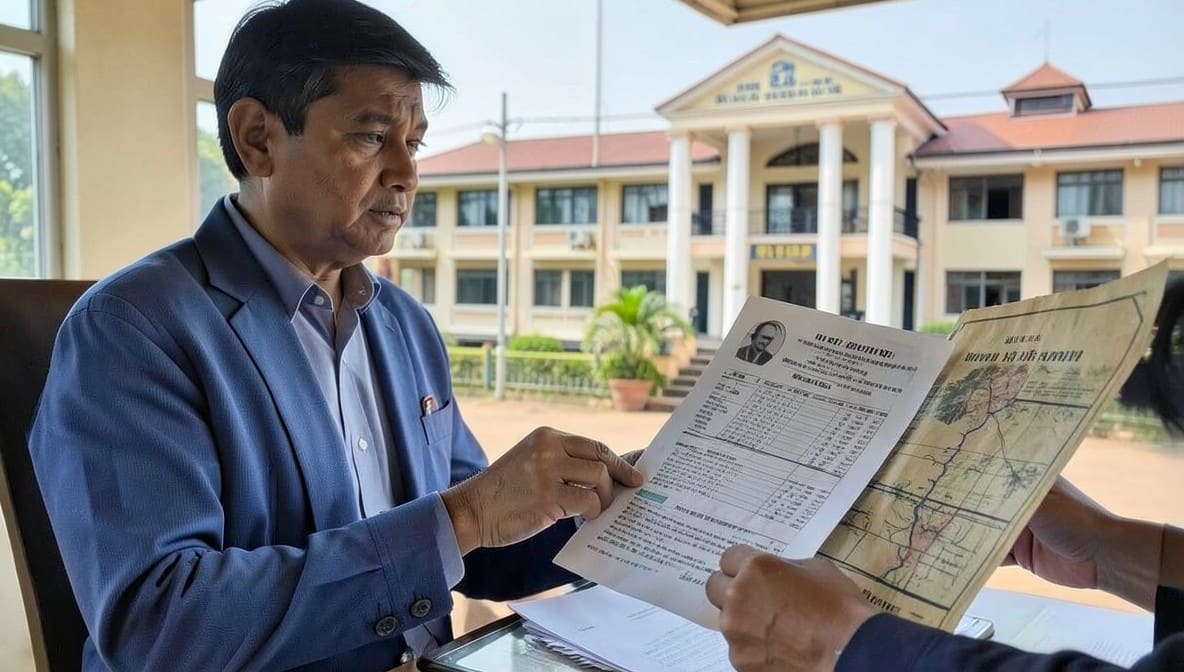
The Calcutta High Court has clarified that mutation proceedings under the West Bengal Land Reforms Act, 1955 (the 1955 Act) cannot be stayed merely due to the pendency of a civil suit or a status quo order passed by a civil court. The judgment underscores the distinct spheres of adjudication between revenue authorities and civil courts, emphasizing that mutation entries are administrative in nature and do not confer or extinguish title.
Background & Facts
The Dispute
The writ petitioner, M/s. Uma Forging Works (P) Ltd., challenged an order of the West Bengal Land Reforms and Tenancy Tribunal (the Tribunal), which had set aside the orders of the Block Land & Land Reforms Officer (BL & LRO) and the Appellate Authority. The BL & LRO and the Appellate Authority had rejected the mutation application filed by respondent no. 5 (defendant no. 1 in the civil suit) on the ground of pendency of a civil suit (Title Suit No. 178 of 2014) filed by the writ petitioner.
Key Facts
- The writ petitioner and respondent no. 5 are embroiled in a dispute over a property, which is the subject matter of Title Suit No. 178 of 2014 filed by the petitioner.
- The petitioner claims to be an irrevocable licensee of the suit property and seeks a declaration of ownership over the factory shed and plant and machinery installed therein.
- Respondent no. 5, the subsequent purchaser of the property from the erstwhile owners (respondents no. 6 and 7), filed an application for mutation of the property in his name.
- The BL & LRO and the Appellate Authority rejected the mutation application citing the pendency of the civil suit.
- The Tribunal, however, directed the BL & LRO to decide the mutation application in accordance with law, leading to the present writ petitions.
Procedural History
- 15.03.2023: Civil court passed a status quo order in Title Suit No. 178 of 2014, recording that respondent no. 5 is in physical possession of the suit property.
- 24.07.2024: Another status quo order was passed, reiterating that the petitioner is in constructive possession while respondent no. 5 is in physical possession.
- 15.03.2023: Civil court observed that mutation proceedings would not violate the status quo order (order relied upon by respondent no. 6).
- Date not specified: BL & LRO rejected the mutation application of respondent no. 5.
- Date not specified: Appellate Authority confirmed the BL & LRO’s order.
- 19.02.2026: Tribunal allowed the challenge against the Appellate Authority’s order and directed the BL & LRO to decide the mutation application.
- Date not specified: Present writ petitions (WPLRT No. 52 of 2026 and WPLRT No. 53 of 2026) filed before the Calcutta High Court.
The Parties' Positions
- Petitioner: Argued that mutation proceedings should not proceed during the pendency of the civil suit, relying on coordinate bench judgments and the status quo order. Cited Rule 59 of the West Bengal Land and Land Reforms Manual, 1991, which mandates an enquiry into possession and transfer deeds - matters already under adjudication in the civil suit.
- Respondent no. 5: Contended that the mutation proceedings would not violate the status quo order, as the civil court itself had observed that mutation does not alter the nature, character, or possession of the property. Further, the mutation entries are merely for revenue purposes and do not confer title.
- Respondent no. 6: Argued that the scope of adjudication in mutation proceedings is distinct from that of a civil suit. Relied on Sohel Ahammed v. State of West Bengal (WPLRT No. 206 of 2025), where it was held that an injunction order binds only the parties and not tribunals, and mutation proceedings do not affect the corporeal possession of the property.
- Respondent no. 7: Highlighted that the records of rights currently stand in the name of the erstwhile owners (respondents no. 6 and 7), and mutation in favor of respondent no. 5 would not affect the petitioner’s rights. Cited Jitendra Singh v. State of Madhya Pradesh (2021 SCC OnLine SC 802), where the Supreme Court held that mutation entries have no presumptive value on title and are only for revenue purposes.
Relief Sought
The writ petitioner sought quashing of the Tribunal’s order dated 19.02.2026 and a direction to the BL & LRO to stay the mutation proceedings until the disposal of the civil suit.
The Legal Issue
The central questions before the Court were:
- Whether the BL & LRO can proceed with mutation proceedings under Section 50 of the 1955 Act during the pendency of a civil suit involving the same property.
- Whether a status quo order passed by the civil court operates as a bar to mutation proceedings.
Arguments Presented
For the Petitioner
- Relied on three unreported coordinate bench judgments (WPLRT No. 300 of 2014, WPLRT No. 140 of 2014, and WPLRT No. 356 of 2014) and an order of the Supreme Court in SLP (C) Diary No. 68933 of 2025 to argue that mutation proceedings should not proceed during the pendency of a civil suit.
- Contended that mutation proceedings would violate the status quo order passed by the civil court, which mandates maintenance of the nature, character, and possession of the property.
- Argued that Rule 59 of the 1991 Manual requires an enquiry into possession and transfer deeds - matters already under adjudication in the civil suit.
For the Respondents
- Respondent no. 5: Argued that the status quo order does not bar mutation proceedings, as the civil court itself had observed that mutation does not violate the order. Further, the mutation entries are merely administrative and do not affect title.
- Respondent no. 6: Relied on Sohel Ahammed to argue that mutation proceedings do not affect the corporeal possession of the property and are distinct from civil adjudication. The civil court’s decree, if any, would bind the revenue authorities, but pendency of the suit does not bar mutation proceedings.
- Respondent no. 7: Highlighted that the records of rights stand in the name of the erstwhile owners, and mutation in favor of respondent no. 5 would not affect the petitioner’s rights. Cited Jitendra Singh to argue that mutation entries have no presumptive value on title.
The Court's Analysis
The Court undertook a detailed analysis of the interplay between mutation proceedings under the 1955 Act and the pendency of civil suits, as well as the effect of status quo orders.
Distinction Between Mutation Proceedings and Civil Adjudication
The Court observed that the judgments cited by the petitioner did not lay down a general proposition of law but were decided based on the facts of each case. None of the judgments considered the specific provisions of the 1955 Act or the scope of adjudication in mutation proceedings versus civil suits.
"Section 50 of the 1955 Act empowers the prescribed authority to maintain up-to-date village records of rights by incorporating changes on account of mutation of names as a result of transfer or inheritance etc. Thus, the scope of enquiry by the prescribed authority under Section 50 is in the nature of an administrative process, limited to an enquiry as to the actual possession and the transfer deeds of the parties... It is to be noted that such exercise is merely procedural and ministerial in nature and does not have any element of judicial or quasi-judicial adjudication, contrary to the scope of a civil suit."
The Court further noted that Section 61 of the 1955 Act explicitly debars the jurisdiction of civil courts from determining any question relating to land or matters required to be enquired into or decided by revenue authorities under the Act. The non-obstante clause in Section 61 overrides any other law, decree, judgment, or award.
"Hence, it is evident from the provisions of the 1955 Act that the scope of enquiry and adjudication falling within the domain of the authorities prescribed under the said Act are completely different in scope from the adjudication of title in a civil suit. Despite the decree of a civil court being conclusive in nature and binding between the parties, per se the pendency of a civil suit before a competent civil court cannot operate as a bar to a proceeding falling within the exclusive domain of the authorities under the 1955 Act."
The Court relied on Jitendra Singh to reiterate that mutation entries neither create nor extinguish title and are relevant only for the purpose of collecting land revenue. Title can only be decided by a competent civil court, and there is no overlap in jurisdiction between revenue authorities and civil courts.
Effect of Status Quo Orders on Mutation Proceedings
The Court examined whether the status quo order passed by the civil court would bar mutation proceedings. It relied on Sohel Ahammed, where it was held that an injunction order binds only the parties and not tribunals or forums. Mutation proceedings affect only the legal nature of possession and not the corporeal possession of the property.
"In Sohel Ahammed, it was considered by the Court that an order of injunction binds only the parties and not any Tribunal or forum and, in any event, an adjudication by the Tribunal only affects the legal nature of the possession of the parties and not the nature, character and possession of the suit property in its corporeal sense."
The Court noted that the records of rights currently stand in the name of the erstwhile owners (respondents no. 6 and 7), who have transferred the property to respondent no. 5. Mutation in favor of respondent no. 5 would merely reflect this transfer and would not affect the petitioner’s rights, as the petitioner claims only an irrevocable license over the land and ownership of the factory shed and machinery, not the land itself.
The Court also relied on the civil court’s own interpretation of its status quo order, wherein it observed that mutation proceedings would not violate the order. The civil court had clarified that it could not restrain the BL & LRO from mutating names, as the process is governed by the 1955 Act.
The Verdict
The Court dismissed WPLRT No. 52 of 2026 and WPLRT No. 53 of 2026, affirming the Tribunal’s order dated 19.02.2026. The BL & LRO was directed to reconsider the mutation application of respondent no. 5 strictly in accordance with law, without being influenced by the pendency of the civil suit. The Court extended the eight-week timeline granted by the Tribunal for completing the mutation process by an additional ten weeks, citing the upcoming State elections as a ground for the extension. No costs were awarded.
What This Means For Similar Cases
Mutation Proceedings Are Administrative, Not Judicial
- Mutation proceedings under the 1955 Act are administrative and ministerial in nature, limited to verifying possession and transfer deeds. They do not involve adjudication of title, which remains the exclusive domain of civil courts.
- Practitioners must distinguish between revenue proceedings and civil adjudication. Pendency of a civil suit does not bar mutation proceedings, as the two operate in distinct spheres.
Status Quo Orders Do Not Bind Revenue Authorities
- A status quo order passed by a civil court binds only the parties to the suit and not tribunals or revenue authorities. Mutation proceedings affect only the legal nature of possession and not the physical possession of the property.
- Courts will not interfere with mutation proceedings merely because a civil suit is pending, unless the mutation directly contravenes the corporeal possession of the property as recorded in the status quo order.
Title and Mutation Are Distinct Concepts
- Mutation entries have no presumptive value on title and are relevant only for revenue collection. Title can only be decided by a competent civil court.
- Parties cannot rely on mutation proceedings to establish or extinguish title. Any decree passed by a civil court will bind the revenue authorities, but the pendency of a civil suit does not bar mutation.
Remand Orders Must Be Followed Strictly
- Where a higher authority (such as the Tribunal) remands a matter to a lower authority (such as the BL & LRO), the lower authority must decide the matter strictly in accordance with law, without being influenced by extraneous factors such as pendency of civil suits.
- Practitioners should ensure that remand orders are complied with in letter and spirit, as failure to do so may invite judicial scrutiny.