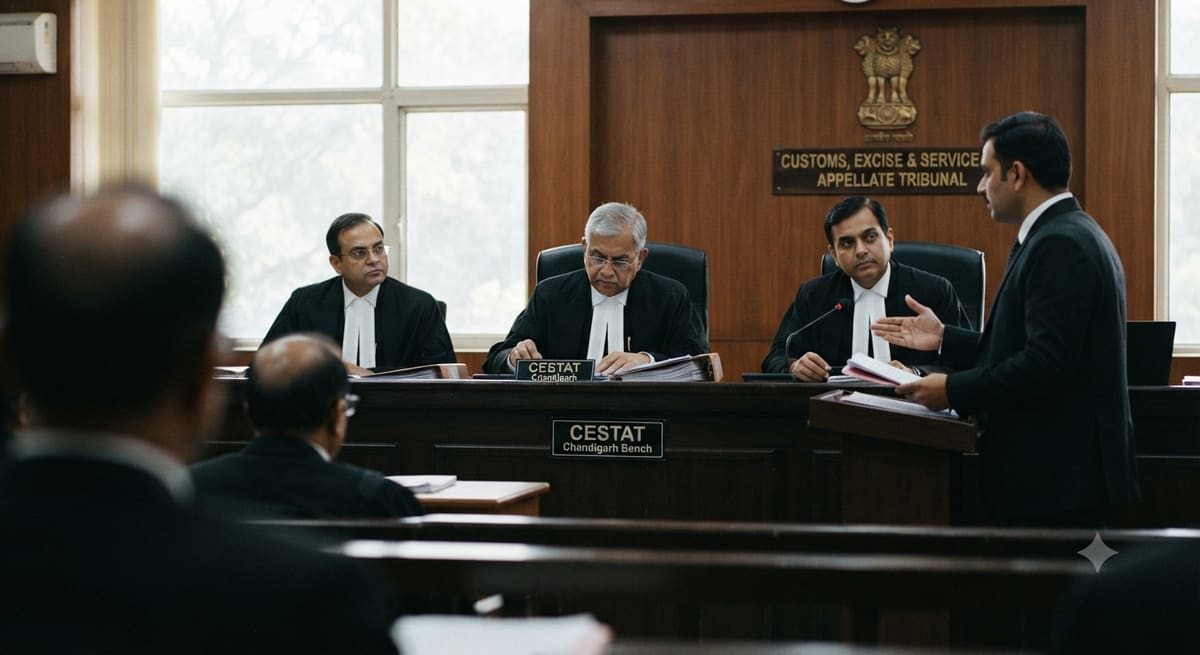
The Customs, Excise and Service Tax Appellate Tribunal (CESTAT), Kolkata has delivered a significant ruling on the admissibility of actual production records in excise duty disputes when statutory documents are unavailable due to prolonged delays. The Tribunal set aside a duty demand of Rs. 68,10,427 after 18 years, holding that the department cannot insist on production of statutory documents like RT-12 Returns and RG-1 Registers when the assessee’s actual production records remain unchallenged.
Background & Facts
The Dispute
The appellant, M/s Simran Metals Limited, a manufacturer of M.S. Ingots of Non-Alloy Steel falling under Chapter 72 of the Central Excise Tariff Act, 1985, was liable to pay central excise duty under Section 3A of the Central Excise Act, 1944 with effect from 01.09.1997. The dispute arose over the method of duty calculation - whether based on Annual Capacity of Production (ACP) under Rule 96ZO(3) or actual production and clearance under Rule 96ZO(1) of the Central Excise Rules, 1944.
Key Facts
- The appellant initially opted to pay duty under Rule 96ZO(3) but sought to switch to Rule 96ZO(1) vide letter dated 23.02.1998.
- The Commissioner of Central Excise, Patna, rejected the switch-over application by order dated 01.04.1998.
- The Commissioner determined the ACP vide orders dated 25.03.1998 and 30.03.1999.
- Four Show Cause Notices were issued for non-compliance with the ACP orders.
- The appellant challenged the orders before CESTAT, which set aside the impugned order and remanded the matter for fresh adjudication vide Order No. A-1413-CAL/2000 dated 31.08.2000.
- The Commissioner passed Order-in-Original No. 219-224/MP/Ayukt/Denovo/2001 dated 03.12.2001, confirming a duty demand of Rs. 73,10,427 along with interest and penalty equal to the duty amount.
- The appellant appealed to CESTAT, which remanded the matter vide Final Order No. 387/2002-B dated 05.08.2002 for determining actual production under Section 3A(4) and considering abatement applications.
- The impugned order (Order-in-Original No. 08/M.P/Ayukt/Denovo/2018 dated 06.04.2018) confirmed a duty demand of Rs. 68,10,427 on the ground that the appellant failed to produce RT-12 Returns and RG-1 Register, despite submitting details of actual production, clearances, raw materials, and electricity consumption.
Procedural History
- 23.02.1998: Appellant applies for switch-over to Rule 96ZO(1).
- 01.04.1998: Commissioner rejects switch-over application.
- 25.03.1998 & 30.03.1999: Commissioner determines ACP.
- 31.08.2000: CESTAT sets aside ACP orders and remands for fresh adjudication.
- 03.12.2001: Commissioner confirms duty demand of Rs. 73,10,427.
- 05.08.2002: CESTAT remands matter for determining actual production.
- 06.04.2018: Commissioner passes impugned order confirming Rs. 68,10,427.
- 19.05.2026: Final hearing before CESTAT.
- 22.05.2026: CESTAT allows appeal and sets aside duty demand.
Relief Sought
The appellant sought setting aside of the impugned order and the duty demand of Rs. 68,10,427, contending that the demand was based on an impermissible insistence on statutory documents unavailable after 18 years.
The Legal Issue
The central question was whether the department could deny the appellant’s claim for duty calculation based on actual production solely on the ground of non-production of RT-12 Returns and RG-1 Register after nearly two decades, when the appellant had submitted unchallenged evidence of actual production and clearances.
Arguments Presented
For the Appellant
- The impugned order was passed after 18 years without communication, rendering the demand impermissible.
- The appellant had regularly filed RT-12 Returns and submitted RG-1 register details during adjudication, but the department insisted on production of these documents after two decades, which was legally untenable.
- The issue was squarely covered by the Supreme Court judgments in:
- Union of India v. Ata Freight Line (I) Pvt. Ltd. [2023 (73) G.S.T.L. 581 (S.C.)]
- Commissioner, GST and Central Excise v. Shree Baba Exports [2023 (384) E.L.T. 246 (S.C.)]
- The appellant had paid duty on actual production from 01.04.1998 to 31.03.2000, and the department had not disputed the submitted production records.
For the Respondent
- The Ld. Authorized Representative reiterated the findings of the impugned order, emphasizing the appellant’s failure to produce RT-12 Returns and RG-1 Register as mandated by law.
The Court's Analysis
The Tribunal critically examined the impugned order and the appellant’s submissions. Key observations included:
- The adjudicating authority did not dispute the correctness of the appellant’s actual production records submitted for the period 01.04.1998 to 31.03.2000.
- The department had no contrary findings to establish that the appellant’s production records were false.
- The appellant had opted to pay duty on actual production and effected clearances accordingly. The production and clearance details (Annex. 24) were not disputed by the adjudicating authority.
- The RT-12 Returns and RG-1 Register were statutory documents available with the department, and their absence after 18 years could not justify rejecting the appellant’s claim.
The Tribunal held:
"These figures could have been easily verified from the statutory records, RT-12 Returns and Challans for payment of duty through PLA, of the appellant, for the relevant period. These are statutory documents available with the department. Thus, we do not find any justification on the part of the adjudicating authority insisting on submission of these statutory documents by the appellant."
The Tribunal concluded that the appellant’s actual production records should be accepted, as the evidence on record indicated that duty had already been paid on actual production and clearances. Thus, no further duty liability arose for the disputed period.
The Verdict
The CESTAT allowed the appeal, setting aside the demand of Rs. 68,10,427 confirmed vide the impugned order. The appellant was granted consequential relief, if any, as per law.
What This Means For Similar Cases
Delayed Document Demand Is Impermissible
- Practitioners can now argue that demanding statutory documents after prolonged delays (e.g., 18 years) is legally untenable, especially when the assessee has submitted uncontroverted evidence of actual production and duty payment.
- The judgment reinforces that departmental records (e.g., RT-12 Returns, RG-1 Registers) must be relied upon when available, and assessees cannot be penalized for non-production of documents unavailable due to passage of time.
Actual Production Records Prevail Over Procedural Lapses
- Unchallenged production records submitted by the assessee carry significant weight, even if statutory documents are missing.
- The Tribunal’s reliance on Annex. 24 (production and clearance details) underscores that substantive evidence prevails over procedural non-compliance when the department fails to dispute its accuracy.
Precedential Value of Supreme Court Judgments
- The appellant successfully relied on Ata Freight Line and Shree Baba Exports to argue that delayed demands lack legal sanctity.
- Practitioners should cite these judgments to challenge excise duty demands based on procedural lapses or delayed document production.
Key Takeaways for Assessees
- Maintain detailed records of production, clearances, and duty payments, as these can serve as substantive evidence in disputes.
- Challenge delayed demands by arguing that the department’s insistence on unavailable documents is unreasonable and impermissible.
- Invoke Supreme Court precedents to strengthen arguments against procedural non-compliance being used to deny legitimate claims.