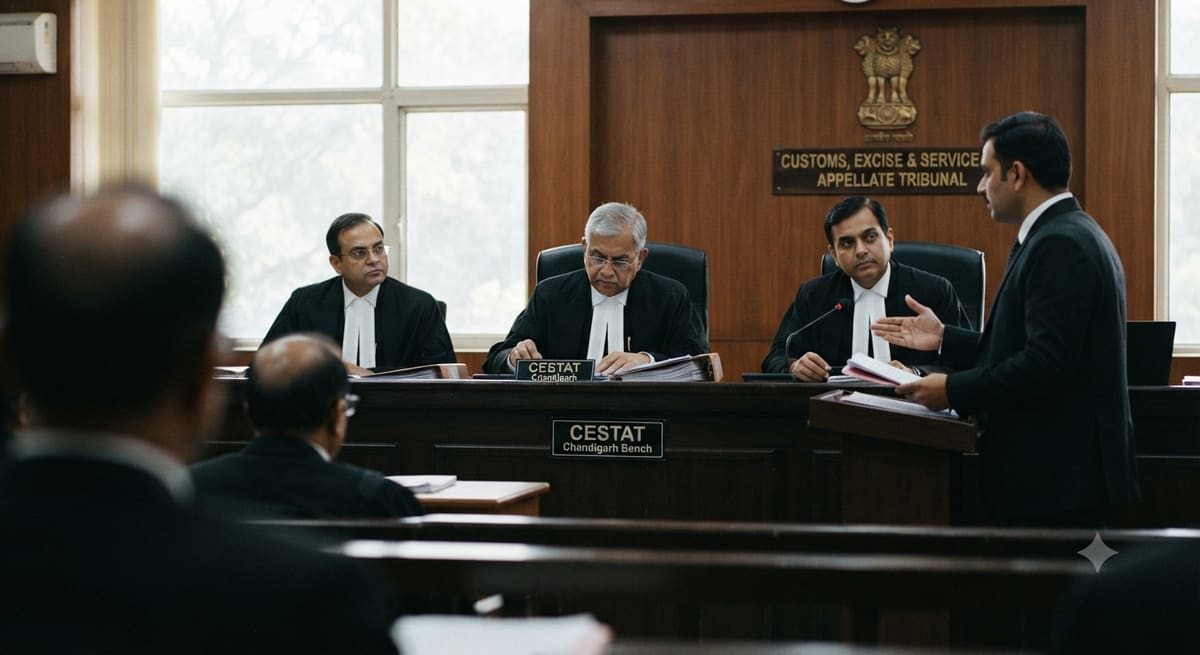
In a significant ruling on the retrospective application of statutory provisions, the Customs, Excise and Service Tax Appellate Tribunal (CESTAT), Chandigarh, has set aside a demand of Rs.55,01,282 under Section 11D of the Central Excise Act, 1944. The Tribunal held that Section 11D, introduced w.e.f. 20.09.1991, cannot be applied to periods prior to its enactment, reinforcing the principle that statutory provisions operate prospectively unless expressly stated otherwise.
Background & Facts
The Dispute
The appellant, M/s Kamal Steel Fabricators, a steel fabrication unit based in Faridabad, Haryana, was issued a show cause notice dated 04.06.1998 by the Principal Commissioner, Central Excise & Service Tax, Faridabad-I. The notice demanded central excise duty of Rs.55,01,282, alleging that the appellant had collected this amount from its customers, including Indian Railways, but failed to deposit it with the government exchequer. This was purportedly in violation of Section 11D of the Central Excise Act, 1944, which mandates the deposit of duty collected from customers.
Key Facts
The appellant was engaged in the manufacture and supply of steel fabrications to Indian Railways and other customers.
The show cause notice pertained to the period from 29.01.1990 to 19.09.1991, during which the appellant allegedly collected but did not deposit excise duty.
Section 11D of the Central Excise Act, 1944 was introduced w.e.f. 20.09.1991, nearly a year after the period in question.
The appellant contended that the demand was unsustainable as Section 11D could not be applied retrospectively.
The appellant had submitted RT-12 Returns and financial statements to establish proof of payment of duty, but the adjudicating authority disregarded these submissions.
Procedural History
The dispute followed a protracted litigation trail:
04.06.1998: Show cause notice issued demanding Rs.55,01,282 under Section 11D.
13.08.2015: Principal Commissioner, Central Excise & Service Tax, Faridabad-I, confirmed the demand along with a penalty of Rs. 5,00,000 under Rule 173Q of the Central Excise Rules, 1944.
11.01.2012: CESTAT, in Final Order No. A/30/2012-EX (DB), remanded the matter to the adjudicating authority for quantification, holding that excise duty actually paid by the appellant at the time of clearance of goods was not to be included in the total demand.
12.08.2015: In remand proceedings, the Principal Commissioner re-confirmed the demand of Rs.55,01,282.
29.05.2026: Final hearing before CESTAT, Chandigarh.
06.07.2026: CESTAT allowed the appeal, setting aside the impugned order.
Relief Sought
The appellant sought:
Quashing of the impugned order dated 13.08.2015.
A declaration that Section 11D cannot be applied retrospectively to the period 29.01.1990 to 19.09.1991.
Relief from the demand of Rs.55,01,282 and the penalty of Rs. 5,00,000.
The Legal Issue
The central question before the Tribunal was whether Section 11D of the Central Excise Act, 1944, which was inserted w.e.f. 20.09.1991, could be applied retrospectively to demand excise duty collected during the period 29.01.1990 to 19.09.1991. Additionally, the Tribunal was called upon to examine whether the demand was barred by limitation, even in the absence of a prescribed time limit under Section 11D.
Arguments Presented
For the Appellant
Ms. Shweta Chauhan, learned counsel for the appellant, advanced the following arguments:
Retrospective Application: Section 11D cannot be applied retrospectively to the period prior to 20.09.1991, as there is no express provision in the statute to that effect. She relied on:
Mahatma Sugar and Power Limited, Nagpur (Central Excise Appeal No. 3/2014 dated 05.12.2025), where CESTAT held that Section 11D operates prospectively.
Hindalco Industries Ltd. (2017 (52) STR 2023 (Del.)), where the Delhi High Court reiterated the same principle.
Limitation: Even if Section 11D does not prescribe a time limit for issuing show cause notices, the demand must be raised within a reasonable time. She cited Omid Engineering Pvt. Ltd. (2024 (7) TMI 61- CESTAT Chandigarh), where CESTAT held that undue delay in issuing a show cause notice renders the demand unsustainable.
Procedural Infirmity: The impugned order incorrectly stated that the appellant had failed to submit documents to establish proof of payment of duty. The appellant had furnished RT-12 Returns and financial statements, which were disregarded by the adjudicating authority.
For the Respondent
Shri Yashpal Singh, learned Authorized Representative for the Revenue, reiterated the findings of the impugned order, contending that:
The appellant had collected excise duty from customers but failed to deposit it with the government, thereby violating Section 11D.
The demand was valid as the appellant had not established proof of payment of duty.
The Revenue did not address the issue of retrospective application or limitation in its submissions.
The Court's Analysis
The Tribunal, after hearing both sides and perusing the records, delivered a detailed analysis:
Retrospective Application of Section 11D:
The Tribunal observed that Section 11D was inserted w.e.f. 20.09.1991, whereas the period in question was 29.01.1990 to 19.09.1991.
It held that statutory provisions operate prospectively unless expressly stated otherwise. There was no indication in the statute or the amendment that Section 11D was intended to apply retrospectively.
The Tribunal relied on the following precedents:
"We find that Hon'ble High Court of Mumbai in the case of Mahatma Sugar and Power Ltd. (supra) relying on the judgment of Hon'ble Supreme Court in the case of Jalna Sahakari Shakkar Karkhana Ltd. (Appeal No. 646/ 2006 dated 08.09.2017) held as follows: para 7, 8, 9 at page 4 & 5""We also find that Hon'ble Delhi High Court in the case of Hindalco Industries (supra) held as under: para 9, 10 at page 5"
These judgments reinforced the principle that Section 11D cannot be applied retrospectively.
Limitation:
The Tribunal noted that the appellant had also raised a strong case on limitation, citing Omid Engineering Pvt. Ltd. (2024 (7) TMI 61- CESTAT Chandigarh), which held that show cause notices must be issued within a reasonable time even in the absence of a prescribed limitation period.
However, the Tribunal did not delve into the limitation issue, as it found the case squarely covered on merits regarding the retrospective application of Section 11D.
Procedural Infirmity:
The Tribunal observed that the impugned order had incorrectly stated that the appellant failed to submit documents to establish proof of payment of duty. The appellant had, in fact, furnished RT-12 Returns and financial statements, which were disregarded by the adjudicating authority.
The Verdict
The Tribunal allowed the appeal, setting aside the impugned order dated 13.08.2015. The key holdings and directions were:
Section 11D of the Central Excise Act, 1944 cannot be applied retrospectively to demand excise duty for the period 29.01.1990 to 19.09.1991.
The demand of Rs.55,01,282 and the penalty of Rs. 5,00,000 under Rule 173Q were quashed.
The appeal was allowed in full, with no costs awarded.
What This Means For Similar Cases
Retrospective Application of Statutes: A Clear Precedent
Prospective Operation is the Rule: This judgment reinforces the well-established principle that statutory provisions operate prospectively unless the legislature expressly provides for retrospective application. Practitioners can now cite this judgment to challenge demands or penalties imposed under provisions that were not in force during the relevant period.
Burden on Revenue: The onus is on the Revenue to establish that a statutory provision is intended to apply retrospectively. In the absence of express language, courts are likely to lean in favor of prospective operation.
Limitation in Excise Demands: Reasonable Time is Key
No Prescribed Time Limit ≠ No Limitation: Even where a statute does not prescribe a specific time limit for issuing show cause notices (e.g., Section 11D), the Revenue must act within a reasonable time. Undue delay can render the demand unsustainable, as held in Omid Engineering Pvt. Ltd.
Practitioners' Strategy: In cases involving old demands, practitioners should argue that the delay in issuing the show cause notice violates the principles of natural justice and fairness, even if the statute is silent on limitation.
Documentary Evidence: The Need for Due Consideration
Returns and Financial Statements Suffice: The Tribunal noted that the appellant had submitted RT-12 Returns and financial statements to establish proof of payment of duty. The adjudicating authority's failure to consider these documents was a procedural infirmity that contributed to the demand being set aside.
Practical Takeaway: Assessees should ensure that all relevant documents, such as returns, invoices, and financial statements, are submitted during adjudication proceedings. If the authority disregards these, it can form a ground for appeal.