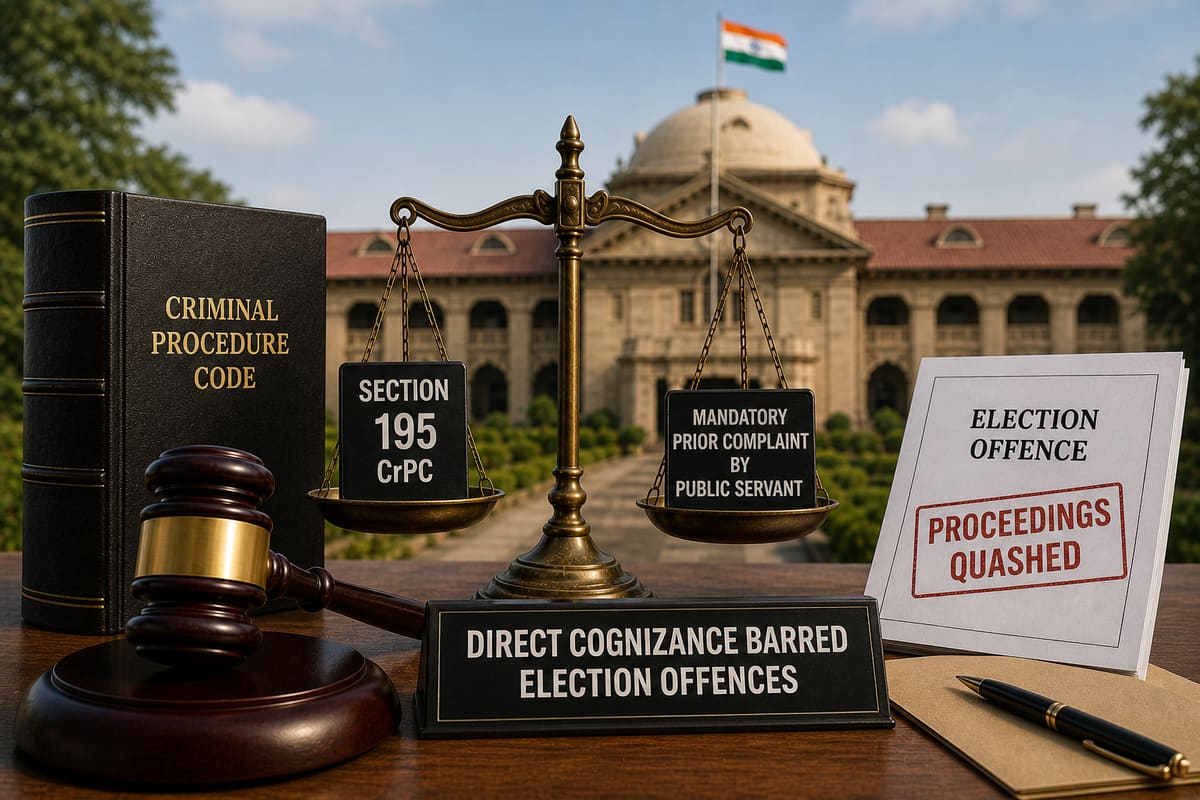
The Gujarat High Court set aside a FIR lodged in 2017 for alleged threats and obstruction of a public servant, emphasizing that offences falling within the ambit of Section 195 of the CrPC cannot be pursued without a written complaint from the concerned public servant. The judgment clarifies the scope of the statutory bar and its impact on the prosecution of public-servant offences.
Background & Facts
The Dispute
The applicants, Kailshbai Revaji Panchal (Luhar) and an associate, were named as original accused Nos.1 and 2 in a special criminal application (quashing) No. 3157 of 2017. They sought to quash FIR CR No. II-43 of 2017, lodged on 25.04.2017 at Amirgadh Police Station, Banaskantha district, for alleged offences under Sections 186, 189, 504, 506(2) and 114 of the IPC. The FIR alleged that on 28.03.2017, at around 3.00 pm, the applicants visited the Taluka Panchayat office, presented a computerized application stating that demolition of their houses would force them to commit suicide, and subsequently threatened to set fire to staff members.
Key Facts
- 28.03.2017: Alleged incident at Taluka Panchayat office, Amirgadh. Respondent No.2, the Taluka District Officer, and Senior Clerk Rohit Prajapati were on duty.
- 25.04.2017: FIR (CR No. II-43 of 2017) lodged, 27 days after the alleged incident.
- Sections invoked: 186 (obstructing public servant), 189 (threat to public servant), 504 (intentional insult), 506(2) (criminal intimidation), 114 (abetment).
- Applicants contended that:
- No element of Sections 504 or 506(2) was established.
- The 27-day delay indicated lack of intent to cause alarm.
- The alleged threat did not amount to a breach of peace.
- The offence under Section 186 is barred by Section 195 of the CrPC, which requires a written complaint from the public servant.
- Respondent (State) argued that the threats fell within the cited IPC sections and that investigation could continue under Section 189.
Procedural History
- 25.04.2017: FIR lodged.
- Date of filing of Special Criminal Application: not specified in the judgment (application filed before this Court invoking Sections 226 and 482 CrPC).
- 01.09.2026: Judgment delivered by Hon. Justice P. M. Raval, quashing the FIR.
Parties' Positions
- Applicants: Asserted that none of the statutory ingredients were satisfied and that the statutory bar under Section 195 precludes cognizance.
- State: Maintained that the alleged threats constitute offences under the IPC and that the investigation may proceed irrespective of the bar.
Relief Sought
The applicants prayed for a declaration that the FIR be quashed and set aside, invoking the extraordinary jurisdiction of the High Court under Sections 226 and 482 of the CrPC.
The Legal Issue
Whether the FIR alleging offences under Sections 186, 189, 504, 506(2) and 114 of the IPC can be sustained when the core offence falls within the ambit of Section 195(1)(a)(i) of the CrPC, which bars cognizance absent a written complaint from the public servant.
Arguments Presented
For the Applicants
- No essential ingredient of Sections 504 or 506(2) was proved; the alleged threat lacked the requisite intent to cause alarm.
- The 27-day gap between the incident and FIR filing undermines the claim of immediate intimidation.
- Section 186 is expressly barred by Section 195 of the CrPC; without a written complaint from the public servant, the Court lacks jurisdiction to take cognizance.
- Citing Devendra Kumar v. State (NCT of Delhi) and Another (2025) SC 1753, the applicants emphasized the twin-test approach for determining the applicability of Section 195.
For the State
- Argued that the threats, even if earlier, satisfy the elements of Sections 504 and 506(2).
- Contended that the bar under Section 195 does not extend to offences under Section 189, allowing investigation to continue.
- Maintained that the FIR, once lodged, creates a prima facie case warranting further inquiry.
The Court's Analysis
The Court began by reiterating the statutory scheme of Section 195 of the CrPC, which bars the Court from taking cognizance of offences punishable under Sections 172 to 188 of the IPC unless a written complaint is filed by the aggrieved public servant or his superior. The Court relied heavily on the Supreme Court’s pronouncement in Devendra Kumar v. State (NCT of Delhi) and Another (2025) SC 1753, particularly paragraphs 59(i)-(vi), which lay down a twin-test framework:
- Whether the alleged offence falls within the category covered by Section 195(1)(a)(i).
- Whether the other distinct offences are invoked merely to evade the statutory bar.
"The courts must apply twin tests. First, the courts must ascertain having regard to the nature of the allegations made in the complaint/FIR and other materials on record whether the other distinct offences not covered by Section 195(1)(a)(i) have been invoked only with a view to evade the mandatory bar of Section 195 of the I.P.C. and secondly, whether the facts primarily and essentially disclose an offence for which a complaint of the court or a public servant is required."
The Court observed that the FIR’s core allegation - obstructing a public servant in the discharge of his duties - squarely falls under Section 186 IPC, which is expressly barred by Section 195. Applying the twin-test, the Court found that the additional charges under Sections 504, 506(2) and 189 were not independent; they were intrinsically linked to the obstruction offence and therefore also fell within the statutory bar.
The Court further rejected the State’s contention that the delay in filing the FIR negated the bar, holding that the bar is jurisdictional and not dependent on the timing of the complaint. Moreover, the Court emphasized that the mere presence of a written complaint is a condition precedent; absent it, any investigation or subsequent charge-sheet would be futile.
Consequently, the Court concluded that the FIR could not stand, as proceeding with it would contravene the mandatory protection afforded by Section 195. The Court therefore exercised its extraordinary jurisdiction under Sections 226 and 482 CrPC to quash the FIR.
The Verdict
The petition was allowed. The impugned FIR (CR No. II-43 of 2017) lodged on 25.04.2017 at Amirgadh Police Station, Banaskantha, for offences under Sections 186, 189, 504, 506(2) and 114 of the IPC, was quashed and set aside. The State was directed that it may initiate fresh proceedings, if any, in accordance with the law, but the present FIR cannot be used as a basis for prosecution.
What This Means For Similar Cases
Section 195 Is a Jurisdictional Bar, Not a Procedural Hurdle
- Courts will dismiss any FIR where the core offence requires a written complaint from the public servant, irrespective of ancillary charges.
- Practitioners must verify the presence of such a complaint before filing a criminal case against a public servant.
Splitting Offences Is Not Permissible When Core Offence Is Barred
- Attempting to prosecute on ancillary IPC sections to bypass Section 195 will be rejected.
- The twin-test approach requires a holistic view of the facts; separate charges must be truly independent.
Delay in FIR Filing Does Not Cure the Bar
- Even a belated FIR cannot overcome the statutory requirement of a written complaint.
- Counsel should advise clients to secure the necessary complaint promptly; otherwise, the case may be vulnerable to quash.
Practical Takeaways
- Verify Section 195 applicability at the earliest stage of investigation.
- Obtain a written complaint from the concerned public servant before proceeding.
- Avoid reliance on ancillary charges to sustain a prosecution where the primary offence is barred.