The Punjab and Haryana High Court has clarified that attaching multiple overloaded trailers to an agricultural tractor constitutes a fundamental breach of motor insurance policy terms, even where the policy purports to cover agricultural use. This ruling reinforces the insurer’s statutory duty to compensate third-party victims while preserving its right to recover from the insured for reckless usage.
Background & Facts
The Dispute
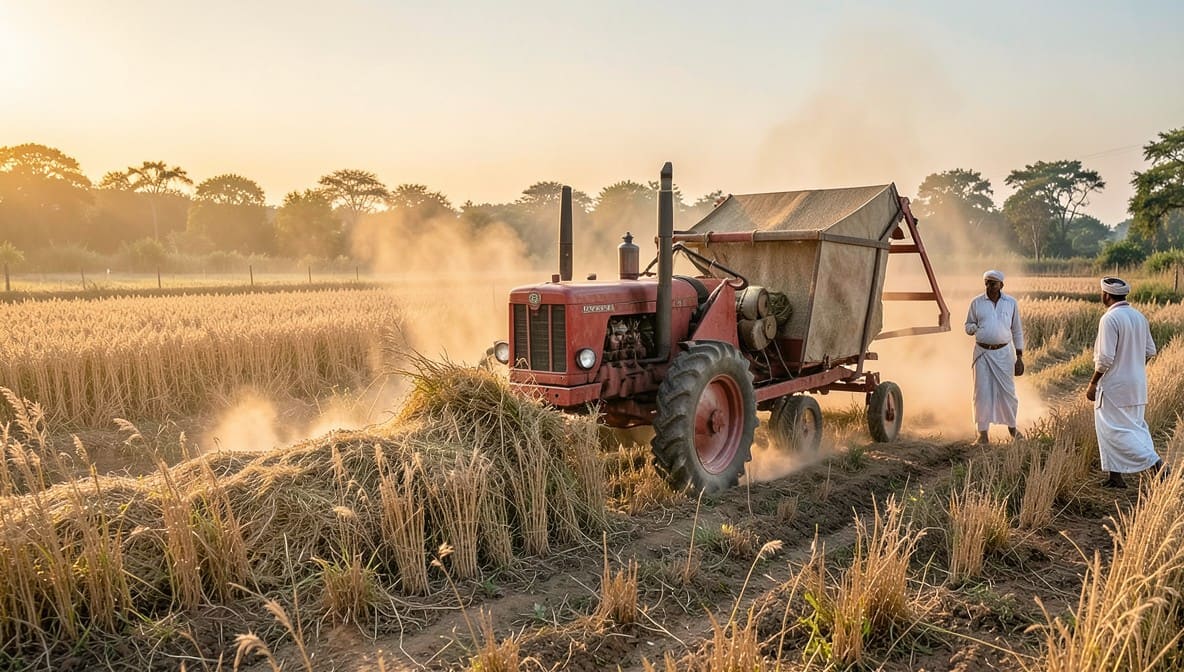
The present appeal challenges the award dated 05.11.2003 passed by the Motor Accident Claims Tribunal, Panipat, which held the insurer liable to pay compensation to the dependents of Nafe Singh, who died in a tractor accident on 07.02.2002. The Tribunal found that the accident resulted from the driver’s rash and negligent operation of a tractor carrying two heavily overloaded trolleys of sugarcane, which overturned into the Gang Canal near Muzaffarnagar. The deceased, seated atop the sugarcane, was crushed and died instantly. An FIR was registered against the driver, Jitinder, and a claim petition was filed under Section 166 of the Motor Vehicles Act, 1988.
Key Facts
- The deceased, Nafe Singh, was a passenger on a trolley attached to a tractor bearing registration No. HR-06D-1505.
- The tractor was being driven by appellant Jitinder, who was also the owner.
- Two trolleys, both heavily loaded with sugarcane, were attached to the tractor at the time of the accident.
- The deceased was seated on top of the loaded trolley, exposing him to extreme risk.
- The tractor was insured under a ‘Kisan Package Policy’ issued by The Oriental Insurance Company Ltd.
- The policy covered agricultural use, including trailers, but contained terms prohibiting unsafe or non-conforming usage.
- The accident occurred near the bridge of Gang Canal while the tractor was en route from Muzaffarnagar to Iqbalpur Sugar Mill.
- The vehicle was found to be operating in a rash and negligent manner due to excessive load and imbalance.
Procedural History
- 07.02.2002: Accident occurred resulting in death of Nafe Singh.
- 08.02.2002: FIR registered against driver Jitinder.
- 2003: Claim petition filed under Section 166 of the Motor Vehicles Act, 1988.
- 05.11.2003: Motor Accident Claims Tribunal, Panipat, awarded ₹1,51,200/- to the widow and five children of the deceased.
- The Tribunal held the insurer liable to pay the award in the first instance, with liberty to recover the amount from the appellants (driver and owner), due to breach of policy terms.
- 2004: Appeal filed before the High Court of Punjab and Haryana as FAO-767-2004 (O&M).
- 28.04.2026: Appeal heard and reserved.
- 30.04.2026: Judgment pronounced.
The Parties' Positions
- Appellants (Driver and Owner): Argued that the policy covered agricultural trailers and that Rule 2(b) of the Central Motor Vehicles Rules, 1989 permits attachment of multiple trailers. They contended that no breach occurred.
- Respondent (Insurance Company): Maintained that attaching two overloaded trolleys violated the policy’s implied safety conditions and the statutory purpose of the insurance cover.
- Claimants (Dependents of Deceased): Were not parties to the appeal but were the beneficiaries of the Tribunal’s award.
Relief Sought
The appellants sought to set aside the Tribunal’s order granting recovery rights to the insurer against them. They requested that the insurer be held solely liable for the entire compensation amount without any right of recovery.
The Legal Issue
The central question was whether attaching two heavily overloaded trolleys to an agricultural tractor constitutes a breach of the terms of a Kisan Package Insurance Policy, thereby entitling the insurer to recover compensation paid to third-party victims from the insured.
Arguments Presented
For the Appellant
Counsel for the appellants relied on Rule 2(b) of the Central Motor Vehicles Rules, 1989, which defines "agricultural trailer" in the plural form as "trailers". They argued that the use of the plural term implies an unrestricted right to attach multiple trailers for agricultural purposes. They further contended that since the policy covered agricultural use, the insurer could not deny liability merely because two trolleys were attached. They asserted that the insurer’s right to recover was unjustified and contrary to the spirit of the Motor Vehicles Act.
For the Respondent
Counsel for The Oriental Insurance Company Ltd. submitted that while the policy covered agricultural trailers, it did not contemplate unsafe or non-standard usage. The attachment of two overloaded trolleys materially altered the vehicle’s balance, braking capacity, and maneuverability, creating an unreasonable risk. They emphasized that the accident was a direct consequence of this unsafe configuration and that the insurer’s obligation to pay third-party claims does not extend to covering risks arising from policy violations. They cited settled law that insurers may recover amounts paid where the insured breaches policy conditions.
The Court's Analysis
The Court examined the definitions of "agricultural tractor" and "agricultural trailer" under Rule 2(b) and (c) of the Central Motor Vehicles Rules, 1989. It noted that an agricultural tractor is defined as a non-transport vehicle designed for field operations and transporting agricultural materials, and that an agricultural trailer is a single or double-axle, uncovered trailer coupled to such a tractor for transporting agricultural produce.
The Court rejected the appellants’ literal interpretation of the plural term "trailers" in Rule 2(b). It held that statutory definitions must be interpreted purposively and in context, not mechanically. The Court observed:
"The mere use of the plural form does not imply an unrestricted right to attach multiple trailers irrespective of safety considerations or policy limitations."
It further noted that the attachment of two overloaded trolleys fundamentally altered the vehicle’s dynamics, increasing the risk of overturning beyond what the insurer reasonably contemplated under the policy. The Court emphasized that the accident was a direct result of this unsafe configuration, and that the deceased was exposed to obvious danger by being seated atop the load.
The Court affirmed the Tribunal’s finding that this constituted a fundamental breach of the policy’s implied and express terms. It reiterated the settled legal principle that while insurers are statutorily obligated under Section 147 of the Motor Vehicles Act to compensate third parties, they retain the right to recover such payments from the insured where there is a breach of policy conditions.
"The Tribunal has rightly drawn such conclusion."
The Court found no perversity or illegality in the Tribunal’s reasoning and held that the insurer’s recovery rights were legally sound.
The Verdict
The appeal was dismissed. The Court upheld the Motor Accident Claims Tribunal’s award of ₹1,51,200/- to the dependents of Nafe Singh. The Oriental Insurance Company Ltd. was directed to pay the compensation in the first instance, with full liberty to recover the entire amount from the appellants, the driver and owner of the tractor. No further directions were issued regarding interest or costs.
What This Means For Similar Cases
Policy Coverage Is Not Absolute
- Practitioners must advise clients that insurance policies covering agricultural vehicles do not provide blanket coverage for all configurations.
- Attachment of multiple trailers, especially when overloaded, may be deemed a material breach even if the policy mentions "trailers" in plural.
- Insurers may successfully invoke policy breaches to recover compensation paid to third parties.
Safety Overrides Technical Compliance
- Courts will prioritize safety and practical risk assessment over technical interpretations of statutory definitions.
- The mere existence of a policy provision permitting trailers does not immunize the insured from liability for unsafe usage.
- Evidence of reckless conduct - such as carrying passengers on top of cargo - will strongly support a finding of breach.
Insurer’s Statutory Duty Remains Unaffected
- Insurers cannot avoid paying third-party claims even when the insured breaches policy terms.
- Recovery rights are automatic upon proof of breach; no separate legal proceeding is required.
- Claims tribunals and courts must apply this principle uniformly to ensure victims are promptly compensated.