The Karnataka High Court has clarified a critical principle under the Motor Vehicles Act: insurers cannot evade liability to third-party victims merely because the driver lacked a licence for the trailer attached to the tractor. This ruling reinforces the protective intent of the Act towards accident victims and establishes a clear hierarchy of liability.
Background & Facts
The Dispute
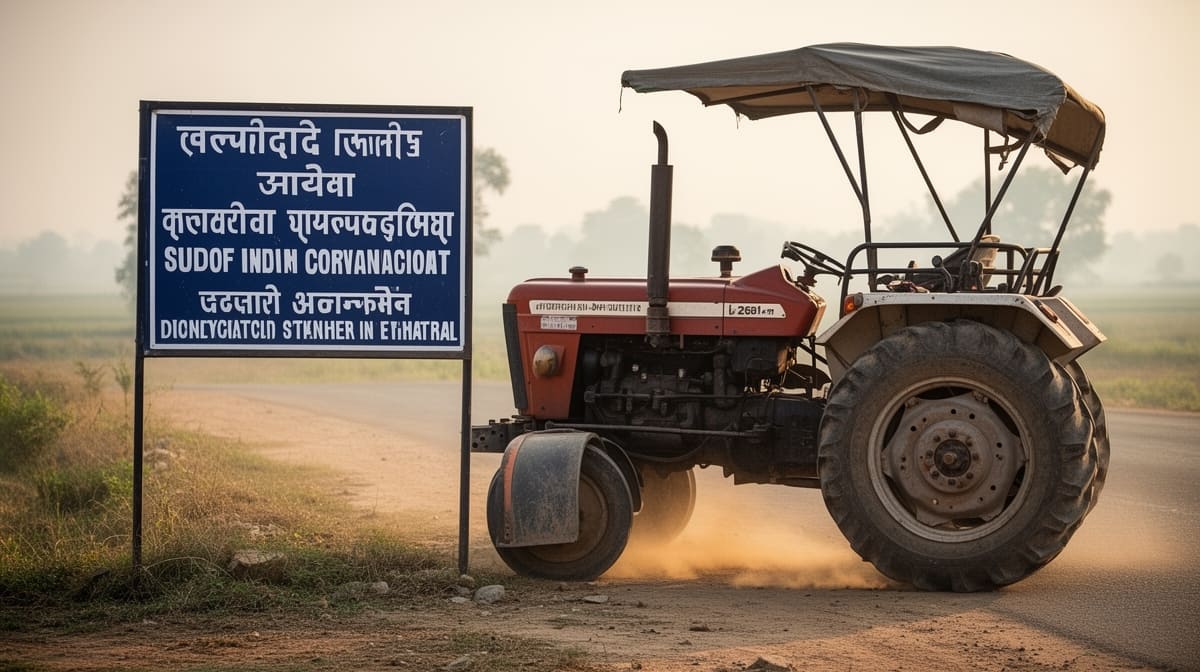
The dispute arose from a road accident on 23.12.2011 at Narenur Cross, Badami, Bagalkot district. The claimant, Dharamanna s/o Hanamappa Naikar, a coolie worker, was standing near the road when a tractor-trailer bearing registration number KA-29/T-8139/T-8140, owned by Mahantesh s/o Basappa Katti, struck him. The claimant sustained grievous injuries and underwent treatment at Dr. Kerudi Hospital, Bagalkot, but suffered permanent loss of earning capacity. He filed a claim petition under Section 166 of the Motor Vehicles Act, 1988 against the vehicle owner and its insurer, National Insurance Co. Ltd.
Key Facts
- The vehicle was a tractor (KA-29/T-8139) with an attached trailer (T-8140)
- The driver held a valid driving licence to operate a tractor but not for a goods carriage (which includes a tractor-trailer combination)
- At the time of the accident, the trailer was empty
- The claimant examined himself as PW-1 and Dr. V.R. Kanthi as PW-2
- Medical reports and hospital records were marked as Exhibits P1 to P8
- The insurer examined its official as RW1 and submitted policy documents as Exs. R1 and R2
- The claimant sought compensation for medical expenses, loss of earnings, and permanent disability
Procedural History
- 23.12.2011: Accident occurred at Narenur Cross, Badami
- 2012: Claim petition (MVC No. 295/2012) filed before the Motor Accident Claims Tribunal, Bagalkot
- 23.12.2013: Tribunal awarded ₹1,78,246/- with 6% interest against the owner, but dismissed the claim against the insurer on grounds that the driver lacked a valid licence for a goods carriage
- 16.03.2014: Miscellaneous First Appeal (MFA No. 102376/2014) filed before the Karnataka High Court, Dharwad Bench
The Parties' Positions
Appellant (Owner): Argued that the tractor-trailer combination, when the trailer is empty, does not constitute a goods carriage requiring a separate licence. Relied on the fact that the driver held a valid licence for the tractor and that the Supreme Court’s decision in Natwar Parikh & Co. Ltd. v. State of Karnataka pertained to taxation, not licensing under the MV Act.
Respondent (Insurer): Contended that the Supreme Court in Natwar Parikh had held that a tractor with a trailer attached is a goods carriage, and therefore, the driver’s lack of a goods carriage licence invalidated the policy coverage.
Relief Sought
The appellant sought to set aside the Tribunal’s dismissal of the claim against the insurer and direct the insurer to pay the awarded compensation of ₹1,78,246/- with 6% interest, with the right to recover the amount from the insured without initiating separate proceedings.
The Legal Issue
The central question was whether an insurer can deny third-party compensation under the Motor Vehicles Act, 1988, solely on the ground that the driver lacked a licence for the trailer attached to the tractor, despite holding a valid licence for the tractor itself.
Arguments Presented
For the Appellant
The appellant’s counsel argued that the Supreme Court’s decision in Natwar Parikh & Co. Ltd. v. State of Karnataka dealt with classification of vehicles for taxation purposes and was inapplicable to licensing under the Motor Vehicles Act. He emphasized that the driver held a valid licence for the tractor, the trailer was empty, and the combination was not being used for commercial transport at the time. He relied on the Full Bench decision of this Court in New India Assurance Co. Ltd., Bijapur v. Yallavva w/o Yamanappa Dharanakeri (2020) 2 AKR 484, which held that insurers must first indemnify third-party victims, even if the insured is in breach of policy conditions.
For the Respondent
The insurer’s counsel contended that the Supreme Court in Natwar Parikh had unequivocally held that a tractor with a trailer attached constitutes a goods carriage under the Act. He argued that Section 3 of the Motor Vehicles Act defines a goods vehicle as one used for carriage of goods, and attachment of a trailer, regardless of load, changes the vehicle’s classification. Therefore, the absence of a goods carriage licence rendered the driver unlicensed, voiding the insurer’s liability.
The Court's Analysis
The Court rejected the insurer’s narrow interpretation of Natwar Parikh. It observed that the Supreme Court’s ruling in that case was confined to the context of taxation under the Karnataka Motor Vehicles Taxation Act and did not address the statutory obligations of insurers under Section 147 and Section 166 of the Motor Vehicles Act, 1988.
"The object of the Motor Vehicles Act is to ensure that victims of road accidents are compensated expeditiously and without technical hurdles. The insurer’s liability to third parties is statutory and independent of the insured’s breach of policy terms."
The Court reaffirmed the binding precedent of its own Full Bench in New India Assurance Co. Ltd. v. Yallavva, which held that the insurer’s duty to compensate third parties arises immediately upon proof of accident and injury, irrespective of whether the insured violated policy conditions such as licensing. The insurer’s remedy lies in recovery from the insured through a separate cause of action, not in denying compensation to the victim.
The Court further noted that the trailer was empty at the time of the accident, and the vehicle was not being used for commercial carriage of goods. Even if the combination were classified as a goods vehicle, the statutory protection to third parties under the Act overrides technical non-compliance by the insured.
The Verdict
The appeal was allowed in part. The Court set aside the Tribunal’s dismissal of the claim against the insurer. The insurer is held liable to pay the compensation of ₹1,78,246/- with 6% interest from the date of the claim petition (2012) until realization. The insurer may recover the amount paid from the insured without initiating separate legal proceedings. Any amount deposited with the Tribunal is to be transmitted to it for disbursement.
What This Means For Similar Cases
Third-Party Compensation Is Absolute
- Practitioners must argue that insurers cannot invoke policy breaches (e.g., invalid licence, unpermitted use) to deny compensation to third-party victims under Section 166
- The insurer’s liability is statutory and arises independently of the insured’s conduct
- Any dispute over policy violations must be resolved in a separate recovery suit against the insured
Licensing Interpretation Must Be Context-Specific
- A driver’s licence for a tractor does not automatically extend to a tractor-trailer combination, but this does not negate insurer liability to victims
- Courts must distinguish between licensing requirements for regulatory compliance and statutory obligations to compensate accident victims
- Technicalities in vehicle classification cannot override the humanitarian purpose of the Motor Vehicles Act
Strategic Implications for Claimants
- Claim petitioners should always name both owner and insurer as respondents
- Medical evidence and accident reports remain the primary focus; licensing disputes are secondary to the insurer’s statutory duty
- Insurers’ attempts to delay payment by raising licensing objections can be countered with New India Assurance and this judgment as binding precedent